Translate

Guide to Patagonia's Monsters & Mysterious beings

I have written a book on this intriguing subject which has just been published.
In this blog I will post excerpts and other interesting texts on this fascinating subject.

Austin Whittall


Showing posts with label skull. Show all posts

Friday, December 20, 2019

Dorenberg Skull, more information


My post on the Dorenberg Skull mentioned a skull discovered in Mexico in the late 1800s, and lost during allied WW II bombing raids over Leipzig that flattened the local Museum of Ethnology.


Below are two images with more information from the book The Forgotten Collector: Josef Anton Dorenberg (1846-1935) by Ron Van Meer:


The description of it as a "Tertiary" skull is indeed interesting, the skull was set in stone.


The skull, though destroyed during the war, was studied by several scholars which identified new species of diatoms from samples taken from the skull.


Diatoms are minute single-cell algae that live in water. Their cell walls are composed in part of a transparent silica glass (they are the only living creatures that use silica to build their bodies -sea shells are made of calcium carbonate).


Well, Reichelt identified a diatom species he named Navicula dorenbergi in 1901 which he dated to the Sangamonian (80-220 Ky BP) -source.


Patagonian Monsters - Cryptozoology, Myths & legends in Patagonia Copyright 2009-2020 by Austin Whittall © <

Tuesday, December 17, 2019

Horn Rock Shelter a skull 11,000 years old with a distinct morphology


Horn Rock Shelter is located in Texas, and is the site of a double burial, a middle aged man (37 - 44 years old) and a girl of 10 - 11. Apparently the man was a shaman. Girl and shaman were buried together in this cave as shown in the image below (girl on the Left).


A recent comment on my Chapala "homo erectus" brow ridge revisited post prompted me to look into this site and its oddly shaped male skull (Thank you William).


You can read about the site, the skeletons and the tools and articles found in the grave, in this article: New Look at the Double Burial from Horn Shelter No. 2, by Margaret A. Jodry and Douglas W. Owsley 2014.


The remarkable point seems to be the shape of the man's skull, as portrayed in National Geographic, from which this image (below) was taken:


The skull appears to have distinctive features yet this paper says that there were "no significant differences" between the Horn individuals and later Central Texas populations.


This is a reconstruction of the male skull:


Notice the brow ridges. Credits

The bust depicting how the shaman looked when he was alive also displays prominent brow ridges:


The remains are old, 11,100 years BP, and surely reflect the great morphological diversity of the Paleoindians, lost during the depopulation of the Americas due to illness brought by the Europeans after 1492 (flu, measles, small pox, just to mention a few), diseases which wiped out millions of Native Americans in a few years.


There are several news articles dating to the period 2010-15 that mention samples having been taken for DNA analysis, but no results have appeared in print as a formal paper, only articles in newspapers. But they are interesting:


Waco Tribune Herald, 2010: "The handful of other ancient American remains whose mtDNA has been studied carry one of the five genetic markers that various Native American groups share. Not so with the Horn Shelter bones, according to numerous tests Baker has done so far.
'The results are different from what you'd expect from Native Americans,' she said. 'I'm looking at the sequence and I'm not able to determine a haplogroup. . . . Usually, when I run the sequence, I get something very clear.'
Baker is planning to send the bone samples to another laboratory for retesting to see if her results can be replicated"

KWTX, 2017: "Dr. Doug Owsley, head of the division of physical anthropology at the Smithsonian, said DNA material has been successfully recovered from the bones of a little girl recovered at the Horn Shelter, but analysis has not yet been completed.
He also said scientists failed in their effort to recover DNA material from adult bones found in the same grave, but are now trying a different technique to recover the material.
"


The local Museum at the site (Bosque Museum) published in 2013: "Dr. Lori Baker of Baylor University has received the most recent DNA results on the Horn Shelter Man. We are awaiting the publication of her report to find out what the results show. Earlier DNA studies showed that Horn Shelter Man was not related to modern Native Americans."


There is a paper: 2012 Pack, FL, Hulsey, BI, and Cabana GS. "Report on DNA Findings for the Horn Shelter Site." Report submitted to Dr. Lori Baker, Baylor University.

It is surprising that the results have not been revealed after all these years...


Patagonian Monsters - Cryptozoology, Myths & legends in Patagonia Copyright 2009-2020 by Austin Whittall © 

Saturday, July 13, 2019

Homo Sapiens in Greece 210,000 years ago


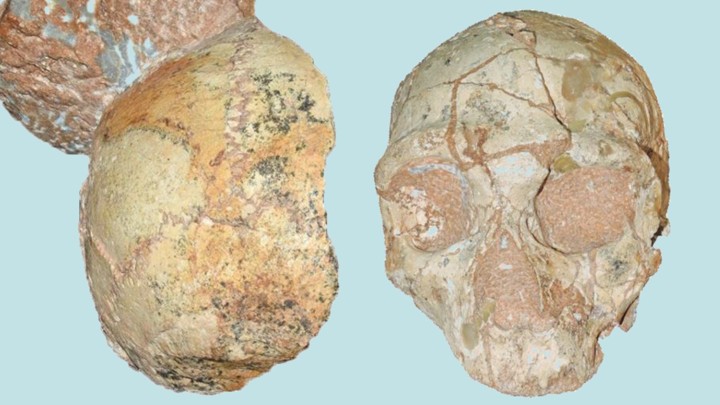
This paper: Apidima Cave fossils provide earliest evidence of Homo sapiens in Eurasia published in Nature (Katerina Harvati et al., Nature (2019). DOI: 10.1038/s41586-019-1376-z) provides sound evidence that Homo Sapiens were living in Greece 210,000 years ago, which is 150 ky earlier than what had been considered as their arrival date in Europe.


The cave of Apidima had two skulls, located side by side, roughly one foot apart (30 cm). One was identified as that of a Neanderthal, the other, a modern human skull.


Apidima Cave skulls, Homo sapiens (left) and Neanderthal (right).

The human skull is known as Apidima-1, and is definitively a H. sapiens skull based on its shape. It lacks the characteristic occipital bun that Neanderthals have.


The other skull, Apidima-2 is clearly a Neanderthal one. Its age is also correct -it was dated as being 170,000 years old- because Neanderthals lived in Europe at that time.


The paper summarizes its importance:


"Together, the Apidima crania suggest a complex pattern of population dispersal and possible replacement for southern Greece that is not dissimilar to that proposed for the Levant —a potential source area for the population represented by Apidima-1. In such a scenario, early modern humans who were present in the region in the late Middle Pleistocene were replaced by Neanderthals, whose subsequent pres-ence in southern Greece is well-documented. The latter were them-selves replaced by Upper Palaeolithic modern humans, whose earliest appearance in the region—as documented by Upper Palaeolithic lithic industries—dates to approximately 40ka."


The Apidima-1 skull is the oldest known modern human in Europe, and very likely in all of Eurasia. It is over 160,000 years older than the next oldest known European H. sapiens fossil.


The earliest Homo sapiens African remains -Africa is supposed to be the cradle of modern H. sapiens- date back to 315,000 years and were found in Morocco at Jebel Irhoud. Then come the Florisbad remains from South Africa at 260,000 years.


The skulls were washed into the cave in separate events 40,000 years apart, and stuck in the breccia, one foot apart until discovered in the 1970s.


This age of 210 ky is very close to the date assigned to another skull found in Greece, the Petralona crania dated at 160 - 240 kya yet belonging to a hominin which has been alternatively classified as being that of a Homo erectus, a Neanderthal and also a Homo heidelbergensis (ESR-dating of the fossil hominid cranium from Petralona Cave, Greece, G. J. Hennig, W. Herr, E. Weber & N. I. Xirotiris Nature volume 292, pages 533–536 (1981).


The dates are going back in time, and Sapiens in Eurasia is older than what a few years ago was deemed possible. Perhaps Homo sapiens fossils even older than those found in Africa are out there, waiting to be discovered.


Patagonian Monsters - Cryptozoology, Myths & legends in Patagonia Copyright 2009-2019 by Austin Whittall © 

Thursday, April 5, 2018

Update Paracas "elongated skulls" (not Alien but Siberian)


This article: "Russian origin of Peruvian elongated skulls?" by Will Hart, concludes that "the skulls probably originated in the Altai region of southern Siberia" it cites his investigations with Brien Foerster.


The article is interesting, but I disagree with the following point:


"There are other controversial issues that the Paracas skulls have raised. Without a doubt the individuals that had these skulls were not members of any native tribe. No Peruvian groups have red hair. We have also analyzed the results of ABO blood group studies and found they have blood groups A and B.
The Inca and other tribes were 100% type O+ positive, a fact that has long been known by anthropologists. They simple do not the prevailing theory and so have been dismissed for decades as genetic anomalies.
"


Because, there also are A blood group mummies in Peru according to: Am J Phys Anthropol. 1978 Jul;49(1):139-42. ABO blood groups in Chilean and Peruvian mummies. II. Results of agglutination-inhibition technique. by Allison MJ, Hossaini AA, Munizaga J, Fung R.


So it is not a 100% O blood group region.


The article mentions Huns, Denisovans and the fact that Paracas skulls have red hair (do they or is it merely bleaching as time goes by? or probably other factors... read this article for more on the hair of Paracas mummies (from www.livescience.com) - the hair in the photos looks dark or even black to me.


Furthermore, head binding was practiced not only by huns and Paracas people, it was quite common all over the globe: in Asia, Australia, Africa and also in other parts of America (see this great article with photos).


At least Hart and Foerster don't believe that these are alien skulls!


Patagonian Monsters - Cryptozoology, Myths & legends in Patagonia Copyright 2009-2018 by Austin Whittall © 

Sunday, February 9, 2014

Paracas mtDNA or selling snake oil to the gullible


As usual something that might be interesting if (and this is a big if) it was studied in a serious scientific manner. Instead it is treated with the usual slapdash paranormal bunkum ways of pseudoscientists who are always trying to make a fast buck with candid suckers who buy the nonsense they put forth as "scientific".


I am interested in an early peopling of the American continent either by Homo erectus or Neanderthals. I am also keen on the idea that modern Homo sapiens entered the Americas a long time ago, shortly after leaving Africa. Clues for this could be found in the remains of ancient Paleo Indians and Indians.


Paracas mtDNA


So when I read that the mtDNA of some mummies found in Paracas, Peru by Julio Tello in 1925 had been sequenced, I was quite thrilled.


I am well aware that most people who are interested in the Paracas mummies are considered either racists or wackos (the former because they promote an "arian" peopling of America and some mad notions of white supremacy, see, for example Alexander Kemp's book on the subject), the cranks on the other hand believe in Aliens (Indiana Jones and the Kingdom of the Crystal Skull), Atlanteans or hybrids of some or all of the above.


A minority (which includes me) are drawn by the oddness of these Paracans, they have a Caucasian air and light colored hair (reddish, brown and even fair) which is also wavy and fine. This is in stark contrast with the typical Amerindian features of coarse black hair and, which are Mongoloid (as opposed to Caucasian). Some of their funerary masks have blue stones embedded in them, in the place of the eyes, perhaps hinting at that kind of colored eyes!


An mtDNA analysis would be of great help to trace their origin (Asia, Europe, North America), stray Greeks or Phoenicians, Romans or Vikings. There is a lot to be learned from these mummies.


Coneheads = Aliens


That is what most believe when they see a deformed Paracas skull.


Paracans are not aliens

A genuine Paracas skull, note the color of the hair.
And, a skull from Indiana Jones "Aliens" movie

But, people focus on their deformed skulls. Many American Natives deformed the skulls of their babies into an elongated form, the Paracans were no exception (New: 10.Feb.2014 See my post on this).


Getting back to the mtDNA, the museum where the mummies are kept, authorised that their mtDNA be tested, and samples were taken by an "authority" on these elongated-skulled-people, Brien Foerster, who recently revealed the findings of the "geneticist" he hired to do the tests:


"it had mtDNA (mitochondrial DNA) with mutations unknown in any human, primate, or animal known so far. But a few fragments I was able to sequence from this sample indicate that if these mutations will hold we are dealing with a new human-like creature, very distant from Homo sapiens, Neanderthals and Denisovans [...] I am not sure it will even fit into the known evolutionary tree"


Fake science and hot air


Well, it turns out that the "expert" Foerster, has organized his livelihood around the mummies, he wrote and writes books, organizes tours and of course is keen on keeping his business growing [2].


He chose a rather strange analyst for the tests: "The samples were sent to Lloyd Pye in the US, famous as the caretaker of the Star Child skull, who has now delivered the samples to his geneticist in Texas" [2].


Star Child is a skull found in Mexico which (some non-scientists) believe is of extraterrestrial origin. Pye is therefore not a neutral, unbiased scientist interested in gleaning a human origin from the Paracans


In case you are wondering which is the University or Renown Laboratory that did the tests (i.e. the "geneticist in Texas"), don't expect a reliable institution, no, not at all, the analysis was done by "Dr. Melba Ketchum" [3]


You will recall that Dr. Ketchum said that she had sequenced bigfoot's DNA, which turned out to be so unscientific that she had to invent her own "peer-reviewed" journal to self-publish it.


I posted on thish Bigfoot DNA sequenced? or is it some fantasy?. And concluded in a later comment: "Actually, the whole paper seems to be based on poor science, incorrect assumptions and published in an unknown online publication apparently set up to specifically host this "paper". So I am extremely skeptical about the whole subject of the DNA testing." (I was trying to be polite. The Bigfoot mtDNA is fake science based on clumsy testing and incorrect interpretation of the results).


Having said this about Dr. Ketchum's credentials on mtDNA analysis, even though the "formal" paper with the Paracas mtDNA results has not been published, I can assure you all that it will display the same kind of "science" as the Bigfoot case. They will surely come up with an Alien origin for Paracans.


The press release hints at this, calling the Paracas people "new human-like creature[s]", worse still: their mtDNA has "mutations unknown in humans, primates or animal" which, is of course impossible.


Sources


[1] Tello, Julio C. Obras completas: Paracas. Primera parte. 2005. Fondo Editorial de la Universidad Nacional Mayor de San Marcos, 2004.
[2] B. Foerster Hidden Inca Tours
[3] Sharon Hill, February 6, 2014 Foerster, Pye and Ketchum collaborate: Paracas elongated skull exposed! (UPDATE)Dobutful News


Patagonian Monsters - Cryptozoology, Myths & legends in Patagonia Copyright 2009-2014 by Austin Whittall © 

Thursday, January 9, 2014

An Early Peopling of America (Part I)


An Early Peopling of America
This is an essay (It is not scholarly enough to be a "paper), which summarizes in a neat way many things that I have posted on my blog.
In Part II, coming soon, I look into the genetics of the peopling of America and try to build a case for early entry and admixture between modern humans and Neanderthals / H. erectus.


An Early Peopling of America (Part I)

Austin V. Whittall


Abstract

The argument used against an ancient peopling of America -before c. 25 thousand years ago (Kya)- is that there were no modern humans in Northeastern Siberia at that time ready to cross Beringia and enter North America.
Another claim is that only then, during the final period of the Wisconsin glaciations, had modern humans acquired the know-how to be able to survive in such a hostile environment and that the sea level had dropped enough to allow entry.
However archaeological remains dating >30 Kya in the Americas and the in depth sequencing of modern and archaic genomes open up the possibility that the first human occupant of the New World may have been either Homo erectus or H. Neanderthalensis.
This overview will present the case for an early peopling of America by these hominids and a later admixture in America with modern H. sapiens, which defined the particular genetic lineages of the New World.


Ancient hominids in Siberia

There is ample evidence of pre-sapiens hominids in Siberia and north East Asia who had mastered the techniques necessary to survive in that environment and could have entered America long before the 25 Kya “entry window period”.


Denisova Cave in Central Siberia site displays cultural sequences dating from 282.0 +⁄- 56.0 Kya to roughly 9.8 Kya, (1)(2) associated to both Neanderthals and the recently discovered Denisovans.


Further east the Diring Yuriakh site on Lena River has provided lithic elements dated to 260 Kya (3), probably fashioned by H. erectus or Denisovans.


Northern China is well known for H. erectus sites and remains from the Longlin cave in Guangxi and Malu cave in Yunnan China belonging to the “Red deer people” suggest that archaic hominids which display a mosaic of primitive and modern traits lived there 11.5 Kya (4); suggesting also admixture in China. An archaic skullcap from Salkit in Northeast Mongolia is also a mosaic of modern and archaic, similar to Neanderthals and Chinese Homo erectus yet has been dated to 12.6 Kya (34). These findings suggest a long history of archaic humans in Northeastern Asia.


Could these primitive Siberian Hominids migrate into America?

This question was posed by Argentine Anthropologist Juan Schobinger: “If relatively recent Homo erectus adapted to the cold winters of Northern China and Manchuria, why couldn't they advance along the North Pacific coast and enter -just like the fauna did- the American continent at any time during the last 400 thousand years?” (5).


The Beringia land route used by the fauna and later by modern humans was only open when the sea level dropped at the height of the glaciations. Warmer interglacial periods submerged that route and, would have required sailing across a short stretch of sea between Asia and America.


The Wisconsin glaciations (12 – 110 Kya), were one of many that occurred during the last half million years. The others glacial events are: Illinoian 120-200 Kya and Pre-Illinoian 300/380 - 455 Kya.


Regarding fauna migration, an ancestor of both black and brown bears colonized the Siberian steppe about 3.5 Mya. Shortly after that, the black bears migrated into America across Beringia. They were followed by the brown bears 300 Kya (6).


In an inverse path across Beringia, woolly mammoths from the New World colonized Eurasia 60 Kya (7). The cave lion ancestor of the American lion (puma) entered America through Beringia during the second-last (Illinoian) glaciations between 130 and 300 Kya.


If animals could cope with the harsh Beringian environment, an intelligent hominid such as H. erectus could do so too. H. erectus had adapted well to the extreme cold conditions of northern China and lived there for hundreds of thousands of years. They exploited the environment and used fire (8)(9) and perhaps clothing to deal with the cold. It is therefore possible that they could have crossed Beringia and entered America either by walking or, as suggested by recent evidence, sailing, during a warm interglacial period (10). Neanderthals, whose remains have been found in Western and Central Asia, were equally well adapted to the glacial conditions of Northern Eurasia.


Evidence of Archaic Humans in America

1. Ancient sites in America


Cobble assemblages with pebble and chopper tools similar to those found in Eurasian Pleistocene sites of Mid-Wisconsinan age (over 25 Kya) have been found in Alberta, Canada (Silver Springs, Grimshaw and Varsity Estates) (11)(12); however they have been contested as geofacts (13).


In South America tools from Malone, Lapa do Caboclo, Eduardo and Poseidon shelters in Brazil have been dated by TL and EPR methods to 41 - 60 Kya (14). Tools 22 Kya have been recovered from Toca da Tira Peia, Brazil (15). Arroyo Vizcaíno site in Uruguay has yielded stone tools and bones with man-made cut marks 27-30 Kya (16).


Bifacial axes similar to the Levalloisian, Mousterian and Clactonian industries, >35 Kya were reported in Cuba (17)(18). The Burnham site in Oklahoma, US, has bison bones associated with stone tools and radiocarbon dates of 35 to 42.5 rcybp (19).


Even older sites such as Valsequillo, Mexico and Calico Mountains, US, have produced lithic implements that have been dated to 80 - 220 Kya and 70 - 100 Kya respectively, generating controversy regarding their human or natural origin (20)(21)(22).


The paucity of such sites and associated archaic lithic industries in the Americas suggests that archaeologists pass over evidence that does not fit within the accepted framework of a late peopling of the contient as the last step of an Out Of Africa migration.

This oversight is not due to negligence or lack of knowledge, we assign it to training: if, under current theories such assemblages are not expected in America, then they are not sought for, or if encountered, are not identified at all.


2. Robust or Archaic crania


It is claimed that no remains of H. erectus or Neanderthal have been discovered in America; however crania with archaic features have been found but dismissed as belonging to modern humans.


A superciliary arch found at Lake Chapala site in Guadalajara, Mexico of notable “thickness and robustness are comparable to those of KNM-ER 3733 (African Homo erectus)… the brow is more like that of Zhoukoudian Skull XI (Asian Homo erectus)… the remains were mineralized and recovered with Pleistocene-age fauna” (23).


The “Loess Man” site close to Omaha, Nebraska, US, discovered in 1896 produced skulls with pronounced brow ridges of “Neanderthal type”, but they were dismissed as belonging to recent Native Americans (24).


A cranium discovered in the Paiute region of Nevada, US, at Lovelock Cave displayed: “Unusual features… prominent brow ridge… low retreating forehead… os inca… exceptionally developed occipital torus…”(25). The occipital torus or bun is a characteristic feature of Neanderthals, whereas it is very rare among modern humans. In part 2 of this paper we will review these archaic features.


Redheaded Paleo-Indians, Neanderthals?


At Spirit Cave, also in Lovelock, a mummified body of a man was recovered in 1940. Dated in 1994 to 10,630 Kya., its unusual “Caucasoid” features and red hair are quite unlike those of current Paiute natives, the Native Americans that peopled the area in historic times (26).


A book written in 1883 by a Paiute records that they: exterminated a “small tribe of barbarians” known as “people-eaters” who waylaid them to “kill and eat them”. These people “had reddish hair” from which the Paiute later made garments (27).


Red hair is very infrequent among Amerindians and Mongoloids, but, apparently could be a Neanderthal trait since they had the MC1R gene (melanocortin 1 receptor) associated with red hair in humans (28).


Remains that cannot be assigned to the typical East Asian morphology have been ascribed to Caucasoids (29), African Blacks (30), and other populations (31)(32) that may have peopled the continent before the arrival of Mongoloids groups via Beringia. Surprisingly the first Spanish Chronicles during the conquest of Meso-America, the Caribbean and Northwestern South America report Negroids (30). These distinct morphologies could be attributed to admixture with pre-sapiens hominids.


3. Lice


Humans are infested by three types of head louse (Pediculus humanus). One of them has a global distribution (Type A), while the other is only found in North America and Europe (Type B). The third type is very rare and found only in Nepal and Ethiopia.


Genetic analysis shows that type A an B diverged from each other about 1.2 Ma. Type B has been thought to have evolved separately in America and brought back to Europe by the Spanish conquistadors in the sixteenth century. American Type B louse is believed to be the original Homo erectus’ lice strain, that accompanied these hominids when they left Africa for Asia 1.2 Ma. They evolved isolated into a new variety, while the original strain that remained in Africa became Type A.


About 1.1 million years later Homo sapiens left Africa, moving out with their own Type A lice. When modern humans and ancient H. erectus met in Asia the primeval louse lineage (Type B) jumped from erectus to sapiens, infesting modern man who took the ancient Type B louse with them into America. The lice remained isolated from the rest of mankind until the arrival of Europeans.


Homo erectus died out in Asia and its Type B lice with them, removing them from further contact with humans in Eurasia and Africa (33).


We understand that this interpretation is flawed as it does not account for the lack of infestation with Type B variety in modern humans who remained in Asia.


A more plausible explanation is that Homo erectus had moved out on into America with its Type B lice and by the time humans reached Asia erectus had died out in there. Erectus had taken its Type B into America, effectively isolating them from all modern Old World humans. Infestation took place in America, when humans migrated to the New World and encountered H. erectus and its Type B lice.


(Continued in Part II


Bibliography


(1) Fabre V., Condemi S., Degioanni A., (2009). Genetic Evidence of Geographical Groups among Neanderthals. PLoS ONE 4(4): e5151. doi:10.1371/journal.pone.0005151
(2) Derev’anko A.P. , Postnov A.V., Rybin E.P., Kuzmin Y.V. and Keates S.G., (2005). The Pleistocene peopling of Siberia: a review of environmental and behavioural aspects. Indo-Pacific Prehistoric Association Bulletin 25: 57-68
(3) Waters M., Forman S., and Pierson J., (1997). Diring Yuriakh: A Lower Paleolithic Site in Central Siberia Science. 28 Feb 1997: 275 (5304), 1281-1284. doi:10.1126/science.275.5304.1281
(4) Barras C., (2012), Chinese human fossils unlike any known species. Journal reference: PLoS One, doi: 10.1371/journal.pone.0031918
(5) Schobinger J., (1988). 200.000 años del hombre en América: ¿qué pensar? Espacio, Tiempo y Forma, Serie I, Prehistoria, t. I, 1988, p. 375-395
(6) Craighead L., (2003). Bears of the World. Voyageur Press. p 115
(7) Palkopoulou E., et al., (2013). Holarctic genetic structure and range dynamics in the woolly mammoth. Proc R Soc B 280: 20131910
(8) Francesco Berna, et al., (2012). Microstratigraphic evidence of in situ fire in the Acheulean strata of Wonderwerk Cave, Northern Cape province, South AfricaPNAS 2012, doi:10.1073/pnas.1117620109
(9) Maohua Zhong et al., (2013). On the possible use of fire by Homo erectus at Zhoukoudian, China. Chinese Science Bulletin. Dec. 2013. doi: 10.1007/s11434-013-0061-0
(10) Gibbons A., (1998). Paleoanthropology: Ancient Island Tools Suggest Homo erectus Was a Seafarer. Science 279 (5357): 1635-1637. doi:10.1126/science.279.5357.1635
(11) Chlachula J., (1996). Geology and Quaternary environments of the first preglacial Paleolithic sites in Alberta, Canada. Quaternary Science Reviews, 17, 455–457
(12) Chlachula J., and LeBlanc R., (1996). Preglacial Archaeological Evidence at Grimshaw,the Peace River Area, Alberta, Canadian Journal of Earth Sciences 35:871-884
(13) Gillespie J., TupakKya S., and Cluney C., (2004). Distinguishing Between Naturally and Culturally Flaked Cobbles: A Test Case from Alberta, Canada. Geoarchaeology: An International Journal, Vol. 19, No. 7, 615–633
(14) Watanabe S., et al., (2008). Peopling Brazil took place much earlier than in North America? FUMDHAMentos VII. 182-190
(15) Lahaye C., et al., (2013). Human Occupation in South America by 20,000 BC: The Toca da Tira Peia Site, Piauí, Brazil Journal of Archaeological Science 40 (2013), 2840-2847 doi:10.1016/j.jas.2013.02.019
(16) Fariña R., et al., (2013). Arroyo del Vizcaíno, Uruguay: a fossil-rich 30-Kya-old megafaunal locality with cut-marked bones. Proc. R. Soc. B 7 January 2014 vol. 281 no. 1774 20132211. doi: 10.1098/rspb.2013.2211
(17) Suárez Tintín P., (1996). En el Paleolítico de Sagua La Grande. El Undoso # 263. March 1996. p. 24
(18) Bores Sellén Y., Una aproximación al conocimiento arqueológico en la cuenca del Damují. Facultad de Humanidades y Ciencias Sociales. p.19
(19) Wyckoff D., Theler J., Carter B., Eds., (2003). The Burnham Site in Northwestern Oklahoma: Glimpses Beyond Clovis? V. 9 Memoir (Oklahoma Anthropological Society)
(20) Simpson R., (1982). The Calico Mountains Archaeology Project: A Progress Report. In: Peopling of the New World. By J. Ericson, R. Taylor and R. Berger. Bellana Press. Anthropological Papers No. 23: 181-192
(21) Payen L., (1982). Artifacts or Geofacts at Calico: application of the Barnes’ Test. In: Peopling of the New World. By J. Ericson, R. Taylor and R. Berger. Bellana Press. Anthropological Papers No. 23: 193-202
(22) VanLandngham S., (2004). Corroboration of Sangamonian age of artifacts from the Valsequillo region, Pueblo, Mexico by means of diatom biostratigraphy. Micropaleontology, V. 50 No. 4. pp 313-342
(23) Irish J., Davis S., Lobdell J. and Solórzano F. , (2000). Prehistoric Human Remains from Jalisco, Mexico, Current Research in the Pleistocene 17, 2000 pg. 95-96
(24 ) Hrdlička A., (1907).Skeletal remains suggesting or attributed to early man in North America. Published 1907. Govt. print. Off. Washington. Series Smithsonian institution. Bureau of American ethnology. Bulletin 33
(25) Reed E., (1967). An Unusual Human Skull from near Lovelock, Nevada, University of Utah Press. Miscellaneous Collected Papers, No.18
(26) Ellis B., Damadio, S., (2000). Determination of cultural affiliation of ancient human remains from Spirit Cave. Nevada.Bureau of Land Management Nevada State Office
(27) Hopinks Winnemucca, (1883). Life among the Piutes, their wrongs and claims. Putnam’s. N. York. p. 73
(28) Lalueza-Fox C., Römpler H., Hofreiter M., et al., (2007). A melanocortin 1 receptor allele suggests varying pigmentation among Neanderthals. Science, Oct. 25, 2007
(39) Morell V., (1998). Kennewick Man's trials continue. Science 1998; 280:190-192
(30) Alcina-Franch J., (1985). Los orígenes de America. Madrid: Editorial Alhambra
(31) Bruges-Armas J., et al., (1999). HLA in the Azores Archipelago: possible presence of Mongoloid genes. Tissue Antigens 1999; 54:349-359
(32) Neves W., Pucciareli H., (1991). Morphological affinities of the First Americans: an exploratory analysis based on early South American remains. J Hum Evol 1991; 21:261-273
(33) Reed D., et al., (2004). Genetic Analysis of Lice Supports Direct Contact between Modern and Archaic Humans. PLoS Biol 2(11): e340 doi:10.1371/journal.pbio.0020340
(34) Coppens Y., Tseveendorj D., Demeter F., Tsagaan Turbat T., Giscard P., (2007). Discovery of an archaic Homo sapiens skullcap in Northeast Mongolia. doi : 10.1016/j.crpv.2007.12.004


© 09.January.2014. Austin V. Whittall


Patagonian Monsters - Cryptozoology, Myths & legends in Patagonia Copyright 2009-2014 by Austin Whittall © 

Tuesday, July 23, 2013

The Punin skulls from Ecuador and Homo Erectus


Last century some odd shaped skulls, with "archaic" appearance were dug up in Ecuador. Their appearance and apparent antiquity led some scientists to believe that these were of an Australoid origin, and that they predated the current Amerindians of Asian origin. Today's post deals with these findings.


The 1923 Punin skull


The Punin skull was discovered in the Andean highlands in Ecuador, by a team from the American Museum of Natural History.


The discovery took place on November 2, 1923, by field assistant G. H. H. Tate. They were exploring the Chalan ravine close to Punin, in Chimborazo near Riobamba, Ecuador when they uncovered the skull.


The site was close to a river at 9,000 ft (2.700 m) altitude, 3 ft. (1 m) below the top of the alluvial bank (2 m - 7 ft high).


When they found it, it was, according to one of the scientists (E. H. Anthony), damp and very fragile. Once it had been removed, it dried and hardened.


It was a startling discovery due to its archaic appearance perhaps due to its "exceptionally pronounced supra orbital robusticity" [2] (i.e. prominent brow).


The skull was ovoid and had a wide and short face with big teeth. It lacked its lower jaw. As it was surrounded by bones of extinct Pleistocene mammals (horses, camelids and mastodon), they assumed it was very old. These animal remains were between 15 - 30 m (50 - 100 ft.) from the skull.


It belonged to a woman who was about 45 to 50 years old, it was found embedded in a stratum of volcanic ash, with megafaunal fossils (10 - 20 kya). [2]


However, in the 1980s, Don Brothwell and Richard Burleigh dated the skull to 4,750 +/- 250 BCE [4], it is not "ancient", but quite "recent". Though it is contemporary with the Late Paleoindian stage no cultural remains such as tools or ceramic remains were found close to the crania. [3]


I believe that if it was a burial, the grave was probably dug into older strata (10-20,000 years old, with megafaunal fossils), but the woman was from 4.750 years ago.


Nevertheless, E. H. Anthony, who wrote the report on the finding, thought otherwise: the skull's position in the soil was not the usual one for a burial as was the lack of other bones; he believed it was contemporary with the fossils found in the ash beds. [5]


I have managed to unearth (pun intended) the description and measurement of the 1923 skull (Sullivan and Hellman, 1925) [5], and, as you can see in the photographs below, it does have a "solid" bone behind the eyebrows.


punin skull
punin skull
Photographs of the 1923 Punin skull. From [5].

In the early 1920s the Punin skull caused quite a stir in anthropological circles. Some, such as British anatomist Arthur Keith (1886-1955) noted that upon examination:


"its resemblance to the skulls of the native women of Australia [was striking] ...the points of resemblance are too numerous to permit us to suppose that the skull could be of a sort produced by an American Indian parentage.
We cannot suppose that an Australian native woman had been spirited across the Pacific in some migratory movement and that afterwards her skull was buried in a fossiliferous bed in the high plateau of Ecuador...The discovery at Punin does compel us to look into the possibility of a Pleistocene invasion of America by an Australoid people.
"


Harvard anthropologist Earnest Houghton stated " any competent craniologist would identify as Australian in type" and pointed out that ancient burials in America yielded more "Australoid-looking dolichocephals ...than anything in the way of a skull that resembles a Mongoloid."


They supported the theory of an ancient peopling of America by "Austronesians"


The Austronesian hypothesis


Allow me to quote from my book Monsters of Patagonia:


These ‘Australoids’ were indeed part of the first wave of modern humans (Homo sapiens) to leave Africa about 100,000 years ago. They used watercraft to navigate coastal waters and could have easily sailed along the shores of Asia, across Bering Strait into America long before the appearance of the Mongoloid type in Siberia 20,000 years ago.
When the Mongoloid Asians later moved across Beringia into America, they advanced on those original Americans replacing them. A few remnants of the first wave survived extermination by the newcomers isolated in the remote Patagonian hinterland.
This theory that we have outlined above was first proposed by French ethnologist Paul Rivet (1876-1958), but its validity rests on the disputed navigation skills of the Australoids. To overcome this, Portuguese anthropologist Mendes Correia (1888-1960) proposed a migration route via Tasmania, the Antarctic and Drake Passage, instead of trans-Pacific route, entering South America at Tierra del Fuego some 8,000 years BP, before the Antarctic ice cap formed. But this is conception is highly disputed and lacks archaeological proof.


Researching for my book, I came across many similarities between the myths of Patagonian natives and those of the Australian Aboriginals, they are remarkably similar in many strange ways. It gives support to the notion of a common origin for both groups.


But lets get back to the Ecuadorian highlands.


A second crania from Punin


Nearly fifty years later, on September 8, 1972, a farmer named Lucas Antonio Paredes came across a burial in Pailapata, 500 m (1/4 of a mile) from the site where Tate found the "Punin" skull. He promptly notified a trader in fossils and inca relics, Florencio Samaniego Santillán, who came over and, that same day, started digging at the site.


They uncovered a the bones of a (maybe more than one person) human being which was inside a layer of volcanic ash. They also uncovered a dolichoid skull, similar to the one found by Tate.


(One cannot help shuddering when imagining two amateurs digging up a grave without any scientific basis in their digging. Just imagine all the evidence they destroyed, tomb raiders of the worst kind.)


It was named promptly "Punin 2" and exhibited in 1979 at the Central Bank's Museum.


One of the bones (femur) were dated at 1,240 BCE, and belongs to the Formative Period however there is no proof that the bone and skull belong to the same body. [1] Once again, a primitive yet young skull.


Primitive but recent, how come?


Trying to accomodate the relatively recent date of the skulls wit their "primitive" features has led some to speculate that they were in fact of ancient stock, and that the Puninese people, may be a relict of an ancient population that survived in isolation in the Ecuadorean plateu until recent times, when they mixed with the natives of Asian stock.


On the other hand maybe they are just a modern group whose physical features were ingrained due to engogamy, in an isolated tribal group.


The missing upper third molars


An interesting point is the anomalous lack of upper third molars or M3 in the skull found in 1923 [5], this is a congenital defect, which is found at a very low frequency outside of Eastern Asia, but is especially common among the remains of Chinese people from prehistoric sites till nowadays. [6][7]


Table from [7]:

table of M3 agenesis

It was detected in the Lantian Man from Shaanxi (photo below) province in China which is about 650 ky old, and lacks both mandibular third molars congenitally, the more recent Liujiang Man (67 kya) also has congenital absence of upper third molars. [7]


This condition known as "third molar agenesis" is higher in Eastern Asia than in any other part of the world, including Australia and Melanesia, [7] it is very ancient and maybe an inheritance from our ancestor the Homo erectus:


The observations of dental specimens of Chinese populations showed the degeneration of M3 occurred as early as Homo erectus of 650,000 years ago. After that, the frequency of this trait has increased continually. [7]


homo erectus lantian man
Lantian Man (H. erectus) skull, note the similar brow to Punin woman's

Could the third molar agnesis of the Punin woman mean that she has H. erectus genes (from an ancient migration of Homo erectus into America)? or is it a more recent admixture of Chinese genes? (see my previous post on how did the Denisovan genes get to America, since the answer for both cases is similar: either erectus brought them himself or Chinese navigators did so).


She could be the only one in her tribe with this defect or maybe the whole tribe had it, we will never know unless we could obtain a larger sample of her group. It is possible that she has the agenesis because her ancestors were just plain Homo sapiens of Eastern Asian origin who trekked in to America with this trait in their genes, or she may have even been one of an Austronesian group who had this rare, among them, congenital defect.


The "primitive" appearance of the cranium tilts the balance towards a relict H. erectus population in America, thriving in Ecuador until recently... maybe the source of our bigfoot and ogre myths in the Americas.


Sources

[1] Daniela Carrillo D., (2007), La Quebrada de Chalán

[2] Joseph F. Powell, (2005), The First Americans: Race, Evolution and the Origin of Native Americans, Cambridge University Press.

[3] Frank Salomon, Stuart B. Schwartz Eds. (1999) Cambridge History of the Native Peoples of the Americas. Vol 3, part 1. Cambridge University Press. pp. 197

[4] Don Brothwell, Richard Burleigh. (1980) Human Cranium from Punin, Ecuador, With Particular Reference To Morphology and Dating. Journal of Archaeological Science. 7 1: 97-99. 1980

[5] Sullivan, Louis R., and Hellman, Milo, (1925) The Punin calvarium, Anthropological papers of the AMNH ; v. 23, pt. 7.

[6] Liu Wu and Zeng Xianglong, (1995) Preliminary Impression of Current Dental Anthropology Research in China, Dental Anthropology Newsletter, Arizona State University. Vol 9, No. 3.

[7] Liu Wu, The Dental continuity of humans in China from Pleistocene to Holocene, and the origin of Mongoloids, in Quaternary Geology. Volume 21 of International Geological Congress 30, 1996, Beijing, Editors: An Zhisheng, Weijian Zhou. pp 27


Patagonian Monsters - Cryptozoology, Myths & legends in Patagonia Copyright 2009-2013 by Austin Whittall © 

Thursday, November 24, 2011

Dr. Wolff and the "tertiary skull"

 
The prestigious journal Nature published [1] an interesting comment in the 1920s, which I quote in full below. It deals with a skull of alleged tertiary age which turned out to be a lusus naturae, a freak of nature, a stone shaped like a skull:

"In our issue of March 10, 1923, p. 336, we referred to a number of telegrams which had appeared in the daily Press reporting the discovery of a so-called fossilised human skull of Tertiary age in Patagonia.
At the time, we urged the need of caution in accepting such reports. Dr. Imbelloni has contributed to the Revista de la Universidad de Buenos Aires, t. li., under the title "Nota sobre los supuestos descubrimientos del Doctor J. G. Wolff en Patagonia" what may be regarded as teh final chaper in the history of hte alleged discovery. His object is to place the facts on record and at the same time to clear Argentine men of science of any suspicion of having lent support to the view that the find was genuine and of a high antiquity.
Dr. Imbelloni's account, which is written with an acid humor, makes it clear that the report was received from the first with scepticism. As soon as Dr. Eric Boman and others had an opportunity of cross-examining Dr. Wolff, they arrived at the opinion that the specimen was not a skull at all. It was not, however, available for examination. When it reached Buenos Aiers in May, it was immediately examined by a commission consisting of Dr. Boman, Dr. S. R. Dabbene, Dr. R. Lehmann-Nitsche, Prof. F. F. Outes, Dr. V. Vidakovitch, and the author, and it was at once pronounced to be a block of sandstone
". [1]

This Dr. Wolff (others write it Wolfe) and the skull were mentioned by Riggs during his 1923 paleontological expedition to Patagonia. Riggs he had the misfortune of meeting Wolff and believing him: [2]

...a certain J. G. Wolfe introduced himself and offered his services to the expedition. Wolfe claimed to have been a museum curator in Rio Gallegos and to have held a commission in the Argentine army. But what aroused Riggs' interest, more than his credentials, was Wolfe's description of a "Tertiary human skull [...] They set out for El Paso de Santa Cruz, [currently this place is the town of Luis Piedrabuena, close to the mouth of the Santa Cruz River] the settlement where the skull had apparently been found. The proprietor of a local hostelry recalled that the skull had first attracted notice about 1916 and had been discovered in a roadbed near town. The first person to suspect that it might be of scientific value was said to have been an English nurse, a Mrs. Vendrino, who had worked in the area for some years. She obtained custody of the skull and it was in her possession when Wolfe had examined it earlier.
In El Paso de Santa Cruz, Riggs— who was becoming increasingly suspicious of the alleged skull— was told that Mrs. Vendrino had recently "gone mad" and had been taken to Buenos Aires for treatment. She had taken her treasured, 22-pound skull along as a trophy. Eventually, Riggs was able to track down the "skull," and his suspicions were confirmed: it was just a very curious stone, with a remarkable humanoid shape.
" [2]

Riggs later described Wolff or Wolfe as follows:

"He betrays no evidence of scientific training, [and]
is particularly lacking in ability to recognize and interpret natural objects and to derive data from them. His method ... has been to get theories from reading and then to cast about for some object to fit into the theory. ... Dr. Wolfe
has impressed us as an enthusiast with a wanderlust and no purpose beyond gratifying it. He studied law ... but found that profession too tame and colorless to suit his fancy. He ... apparently wrote extravagant stories in order to sell them. He is already, so he says, under fire of criticism of a leading scientist in Buenos Aires.
" [2]

Bear this in mind, because Wolff also discovered an ancient city in the heart of Patagonia, but I will deal with that in another post.

Unfortunately I have not been able to read Imbelloni's paper on the sandstone skull or seen any photographs of it. Why would everybody think that it was a fossil skull? was it disregarded because of Wolff's extravagant nature? or because prejudice veiled the reason of the scientists that inspected the "skull".

Sources

[1] Nature 113. 58-60 (12 Jan. 1924) News. Current Topics and Events.
[2] Larry G. Marshal, 1978. Adventures in Patagonia. Field Museum of Natural History Bulletin. March 1978 Vol 49 No. 3. pp 4+


Patagonian Monsters - Cryptozoology, Myths & legends in Patagonia
2011 International Year of Forests
2011 International Year of Forests Copyright 2009-2011 by Austin Whittall © 

Friday, January 21, 2011

Ostrander skull supposedly an erectus skull

 
Ostrander Skull
Ostrander skull to the left, allegedly from the Hueyatlaco Site. On the left a modern skull. Adapted from [1](Fig. 5) by Austin Whittall


Seeking more information on the possible migration of Homo erectus into America long before modern humans evolved in Africa, I have been checking different leads. Some seem reasonable, but others, like the subject of today's post, don't. Let's look into the "Ostrander skull"

"Ostrander skull" the background

The paper from which I took the image shown above, [1], states the following (I have highlighted some words that are interesting:

The second skull [from the Valsequillo area, the other was the Dorenberg skull, the Ostrander skull apparently was collected by someone at Hueyatlaco in the late 60’s or early 70’s (personal communication, anonymous). I have only one photo of it, sent to me by the late Professor Ostrander in the mid-70’s (Fig.5). Note the thick brow ridges, the low brain case. Merced College in California, where it has been stored all these years does not answer my letters of inquiry concerning it. Rumor has it (personal communication, anonymous) that they have given the skull to a Native American tribe for reburial without attempting to date it.[1]

So here is a skull whose history and fate are based on rumors and anonymous communications. It is an alleged finding of uncertain date, and it probably was reburied at an unknown location to effectively remove the formal proof.

My analysis

Regarding the photograph, the article states that: "I have only one photo of it, sent to me by the late Professor Ostrander in the mid-70’s" [1].

The photographs shows two skulls, one facing the camera, the other rotated to the right, and on an angle tilting it away from the table on which it is set.

I just took the image and drew some lines to measure it (we only have this photograph as proof of the skull's existence). One line across the uppermost part of the skull (roughly the coronal suture where frontal and parietal bones meet), the other aligned with the top of the eye sockets.

For the "Ostrander" skull, shown on an angle, I "straightened" the skull by applying a simple Pythagorean maths, by measuring the sides that make up the right angle of the triangle (yellow lines) and applying Pythagoras' theorem, I came up with the height of the skull (blue line right skull) and compared it with the same dimension on the modern skull (blue line left skull). I admit that due to the skull's rotation (up and to the right), the triangle is an approximate measurement, but, as the results show, pretty accurate.

As the yellow sides measured 96 pixels and 190 pixels the blue one is "X" so:

962 + 1902 = X2

Which works out as: X = 212 pixels.

The modern skull measures: 221 pixels. Just 4.2% more, which seems to be a very small difference and does not prove that the "archaic" skull is erectus.

Furthermore, Charles Ostrander of Mercedes College, appears in a Chemical Directory as [2] its librarian. He also wrote a paper in a chemical jounal. Is it the same Charles Ostrander? I ask this because he does appear as a member of the American Association Of Physical Anthropologists [3]: Ostrander, Mr. Charles R., Merced College,. Merced, California 95340..


Sources.

[1] Virginia Steen-McIntyre, (2002). Approximate dating of tephra using the microscope: "seat-of-the-pants" methods to roughly date quaternary archaeological and paleontological sites by associated pumice and volcanic ash layers". Proceedings Volume International Symposium: Early Man in America and the Implications For the Peopling of the Basin of Mexico August 7-9, 2002 Mexico City.
The image shown above and adapted by me to be able to measure it, is Fig. 5 of the above mentioned paper.
[2]Donald M. Bain (Editor), (1969). International chemistry directory, 1969-70. W.A. Benjamin, pp. 350.
[3] Members. American Journal of Physical Anthropology. Volume 40, Issue 2, pages 299–319, March 1974
[4] Online


Patagonian Monsters - Cryptozoology, Myths & legends in Patagonia
2011 International Year of Forests
2011 International Year of Forests Copyright 2009-2011 by Austin Whittall © 

Monday, January 10, 2011

Dorenberg Skull: erectus in Mexico 80 to 220 ky ago

 
apparent reconstruction of Puebla Dorenberg skull person
Reconstruction of how the owner of the Dorenberg skull could have looked, based on dimensions of known Homo erectus skulls,by Laura Lyons. From [1], by Laura Lyons

Joseph Dorenberg, the German Consul who lived at Puebla, Mexico in the 1890s, purchased an ancient skull which he took back home with him to Leipzig, Germany. After his death it was donated to the Museum für Volkerskunde in 1919 and put on display.

However during World War II, the museum and surrounding areas were leveled by a RAF bombing (Dec. 1943), and the skull was destroyed with most of the museum’s contents.

Date

Diatomaceous earth is a sedimentary rock that is made up of the fossilized remains of diatoms, a group of unicellular algae. The most remarkable feature of diatoms is that they are encased within a small “shell” or capsule made of silica, which when the cell dies, drops to the sea bead and accumulates. The different varieties of fossil diatoms found in Diatomaceous earth allow scientists to date them and remains that are found buried by it.

This came in handy as the “Dorenberg skull” was found buried in diatomaceous earth. Hugo Reichelt, of Leipzig took some samples of the diatomes and established the skull’s age. His study was published in an article [2] and the skull was pronounced as “antediluvian” (i.e. before the last Ice Age). [1]

He kept some samples of the diatomaceous earth which was reanalyzed recently using modern techniques [3] and found that these diatoms: “ indicate an age corresponding to the Sangamonian Interglacial sensu lato (80,000 to ca. 220,000yr BP).” [3]

This is long before the accepted date of modern human entry into America. Furthermore, the heavy and prominent brow ridges and the sloping forehead are very unlike Homo sapiens yet very similar to H. erectus. This is a clear proof of erectus in America some 80 - 220 kya.

It is a shame that the "solid" proof (the Dorenberg skull) has been lost.

Some orthodox scientists in an attempt to discredit the finding have insinuated that the whole Dorenberg skull story is a hoax: "In relation to the Dorenberg skull, the reviewer claimed that, "... (there is evidence that this was a hoax generated by Europeans...". [4]

Sources.

[1] Patrick Lyons. Pleistocene America. Online. Also see The mystery of the Dorenberg Skull. Pleistocene Coalition News. vol 1:2. Nov-Dec. 2009. pp.4.
[2] Reichelt Hugo, (1899). Diatomeen aus dem Kalktuffe aus der Gegend von Puebla in Mexiko. In: Felix, J. and Lenk, H., Eds., Beitraege zur Geologie und Palaeontologie der Republik.
[3] Sam VanLandingham, (2004). Corroboration of Sangamonian age of artifacts from the Valsequillo region, Puebla, Mexico by means of diatom biostratigraphy.
Micropaleontology; December 2004; v. 50; no. 4; p. 313-342; DOI: 10.2113/50.4.313
[4] Ibid; (2009). Extraordinary Examples of Deception in Peer Reviewing: Concoction of the Dorenberg Skull Hoax and Related Misconduct. Paper in 13th World Multi-Conference? on Systemics, Cybernetics and Informatics: International Symposium on Peer Reviewing. Orlando, Florida.


Patagonian Monsters - Cryptozoology, Myths & legends in Patagonia
2011 International Year of Forests
2011 International Year of Forests Copyright 2009-2011 by Austin Whittall © 
Hits since Sept. 2009:
Copyright © 2009-2025 by Austin Victor Whittall.
Todos los derechos reservados por Austin Whittall para esta edición en idioma español y / o inglés. No se permite la reproducción parcial o total, el almacenamiento, el alquiler, la transmisión o la transformación de este libro, en cualquier forma o por cualquier medio, sea electrónico o mecánico, mediante fotocopias, digitalización u otros métodos, sin el permiso previo y escrito del autor, excepto por un periodista, quien puede tomar cortos pasajes para ser usados en un comentario sobre esta obra para ser publicado en una revista o periódico. Su infracción está penada por las leyes 11.723 y 25.446.

All rights reserved. No part of this publication may be reproduced, stored in a retrieval system, or transmitted in any form or by any means - electronic, mechanical, photocopy, recording, or any other - except for brief quotations in printed reviews, without prior written permission from the author, except for the inclusion of brief quotations in a review.

Please read our Terms and Conditions and Privacy Policy before accessing this blog.

Terms & Conditions | Privacy Policy

Patagonian Monsters - https://patagoniamonsters.blogspot.com/