Translate

Guide to Patagonia's Monsters & Mysterious beings

I have written a book on this intriguing subject which has just been published.
In this blog I will post excerpts and other interesting texts on this fascinating subject.

Austin Whittall


Showing posts with label Nahuel Huapi. Show all posts

Sunday, May 10, 2026

The Bariloche UAP of 1995 included in the Pentagon release of classified UFO documents (PURSUE)


Following President Trump's directive to disclose until now classified information on UAPs (formerly known as UFOs), the Department of War (seems to have changed its name recently) of the US opened a website to reveal the secrets they have kept hidden until now. The directive has a code name Presidential Unsealing and Reporting System for UAP Encounters (PURSUE) as all military things have. And it is onlinie here: "https://www.war.gov/ufo/".


Interestingly, in one of the documents, that can be found here: "https://www.war.gov/ufo/#255_413270_UFOs_and_Defense_What_Should_we_Prepare_For". They disclose different cases, one of which happened in Patagonia, when an Aerolíneas Argentinas flight was trying to land in Bariloche in 1995, when the lights in the city and the whole area, including the airport went off. The plane circled until it was allowed to land, and did so accompanied by strange lights. See the image below with the account (or read it in the pdf on p.21)


The UFO and AR 674 flight, 1995, Bariloche, Río Negro, Patagonia

Interesting link between electomagnetism and aerial phenomena, similar to the bobbing lights and earthquake electromagnetic effects. Not an ET, but a natural incident yet to be explained.


The release is not secret stuff, it is an english version of a French study on UFOs, by the COMETA (Comité d'Études Approfondies) group, published in 1999.


The pilot of the plane, Polanco said that the UFO appeared out of the Lake Nahuel Huapi, and was a group of lights, that were also seen by a plane of the Argentine Border Patrol (Gendarmería Nacional). The incident lasted 17 minutes. Source.


You can see my previous posts on weird lights, UFOs and similar unexplained stuff online here.


Patagonian Monsters - Cryptozoology, Myths & legends in Patagonia Copyright 2009-2026 by Austin Whittall © 

Friday, September 12, 2025

Nahuel Huapi: the movie "Bajo Superficie" and the Aquatic tortoise or turtle theory


An Argentine documentary titled "Bajo Superficie" (Under the Surface) shot during the COVID-19 pandemic and released in 2022, explores the mystery of El Nahuelito, the mythical lake creature of Lake Nahuel Huapi.


You can see the full movie online (in Spanish). It is a 2 hour 20 minute-long film, a documentary, with interviews, nice shots of the lake, and it also used an underwater camera to shoot scenes hundreds of meters below the surface. Miguel Angel Rossi directed it, and it is really interesting.


Bajo Superficie poster

Rossi has lived in Bariloche for the past 35 years, and was always interested in the Nahuelito. He tells about an incident involving an unusual sighting: (source)


Giant Aquatic Tortoise or Turtle


"Many years ago, when his daughters were young, Rossi had a strange experience: he saw something moving on a beach near the lake, and as he got closer, he saw it was an enormous aquatic turtle with a long neck. He turned it over, and the animal disappeared beneath the water once more. This led him to think that perhaps the Nahuelito could, in fact, be a turtle of extraordinary size."


His research led not only to reports on Nahuelito, but also to strange lights sighted under and above the lake, and strange shipwrecks.


He explored different theories about Nahuelito, from the "radioactive" one (involving the Atomic Energy research center on isla Huemul Island (1948-52) (see my 2010 post on this theory), to the "geologic" one, which attributes the sightings to degassing from faults in the lake's bed (See my 2010 post on this theory).


Strange Fish


The movie mentions "strange fish" that were introduced into the lake over 100 years ago. During the filming of the movie, they got images of some animals that are now being investigated. There are three species found in the lake that had not been officially recognized. "In addition to sightings of aquatic fauna species, there are concurrent accounts of experiences that are difficult to explain, many of them recorded. I believe that over time all of this will be revealed. And I hope that in a few years there will be many important productions investigating the lake's issues in all its forms."


Below is a picture with Rossi (left) on a boat in Lake Nahuel Huapi, while shooting the movie.


Rossi and colleague

The Long Necked Tortoise


Rossi says that many people contacted him after the movie was released, and he is researching different theories. The tortoise is "...one of the ones that resonates most with me. After the film's release, a family story appeared that revives a theory I'd thought was dismissed. About eight years ago, this family experienced something that hadn't happened in 70 years. It intrigues me greatly because it's directly related to what Jarred Jones and others saw in the early 20th century: a long-necked animal. I had associated it with that turtle I saw years ago, but biologists tell me there are no turtles in the lake."


I must admit that I had never considered aquatic tortoises as a possible explanation for Nahuelito. I understood there were none in the Patagonian waters. There is a land tortoise in Patagonia, but now I have learned that there are freshwater tortoises in Argentina (see this paper) there are Phrynops hilarii, Acanthochelys spixii and Acanthochelys pallidipectoris in Mendoza province, just north of Patagonia. But the authors believe that they were introduced recently (pets released into nature). However, there is an ancient oral tradition of freshwater turtles in Las Heras and Lavalle Departments in that province in the early 1900s, both drained by the Mendoza River which formed part of the Desaguadero—Salado—Curacó rivers basin.


Notice the long neck of the Acanthochelys pallidipectoris (Chaco side-necked turtle) pictured below:


turtle

An Acanthochelys spixii or Black spine-necked swamp turtle:


Acanthochelys spixii

And this is a Phrynops hilarii:


Phrynops hilarii

The Colorado River marks Patagonia’s northern border in Argentina, while the Desaguadero—Salado—Curacó system is a river which changes its name along its course, which is nearly 1,500 km long (932 mi.) Its northernmost sources are in the province of La Rioja, high in the Andes at an altitude of 5,500 m (18,000 ft.), and it flows in a north—south direction parallel to the Cordillera, receiving the input of many Andean rivers such as the Jáchal, Vinchinas, San Juan, Mendoza, Atuel, Tunuyán, and Diamante.


Water from many of these rivers is now diverted to irrigate the vineyards at the foot of the Andes in the Cuyo region provinces of La Rioja, Mendoza, and San Juan. This has led to a dramatic drop in the flow downstream along the Desaguadero River and the wetlands of Guanacache and Bañados del Atuel have dried up due to this cause, altering the environment and affecting the wildlife.


Until the early 1900s, the river carried plenty of water, and the western region of La Pampa was far more humid than it is nowadays. The Bañados del Atuel wetlands spanned 21,000 km² (8,100 sq.mi.) and had fifteen lakes. The westernmost branch of the river was known as Potrol stream, the Salado was its easternmost one. The wetlands drained into the saltwater lake of Urre Lauquen. Their outflow through the Curacó River (Mapuche for “stone water”) continues southward until it flows into the Colorado River at (38°50’S, 64°58’O). Its basin covers a surface area of 260,000 km2 (100,000 sq. mi.) The Colorado flows into the Atlantic.


It is feasible that the tortoises, if they lived in this basin, could have reached the Negro River, linked to the Neuquén and Limay rivers, and the Patagonian lake district. The Colorado and Negro run in more or less parallel courses with a minimum separation of 40 km (258 mi.) along a line linking the towns of Gobernador Duval and Chelforó. In other parts they can be up to 120 km or 74 mi apart. See the map below with the "Gap" that the tortoises would have to bridge between the Colorado and Negro rivers.


map of rivers

They are usually small, but in the U.S., the ke the Alligator Snapping Turtle (Macrochelys temminckii) which can weigh up to 176 pounds and reach a lenght of 40 inches (1 meter) (source). Not a monster, but big.


An obstacle is the temperature, the Andean lakes are cold, and these freshwater tortoises and turtles live in temperate, tropical and subtropical environments. A study involving turtles from Chaco, found that "The thermal breadth found in active individuals suggests that H.tectifera is a thermal generalist (eurythermal). Body temperatures of active individuals ranged between 10.1 °C and 25.7 °C (Mean = 18.58). Accordingly, records of individuals mating under water temperatures as low as 16.5 °C and 9 °C reflect the species capacity to perform activities within a wide temperature range.".


The temperature of Lake Nahuel Huapi (source) ranges from a minimum of 5.3°C in winter to a maximum of 19.5°C in Summer. The mean winter temperature for most of the lake is between 5.3 and 8°C, in summer it ranges from 15 to 18°C. They seem suitable for turtles. The lake also provides algae, crayfish, minnows, aquatic plants and insects, which make up the diet of these animals.


Further reading about the movie: Temporetti, Alonso. Bajo Superficie. Desde La Patagonia Difundiendo Saberes. Vol 19, N°34, 2022 ISSN (print)1668-8848 - ISSN (online) 2618-5385


Patagonian Monsters - Cryptozoology, Myths & legends in Patagonia Copyright 2009-2025 by Austin Whittall © 

Sunday, August 31, 2025

The Poyas - Boat people of the Lake District


Today's post will explore the question of the Poyas. They were a group of natives that lived in the region around Lake Nahuel Huapi, and were mainly described by the Jesuit missionaries who established their Mision of Our Lady of Nanhuel Huapi among them in 1670-74, and again in 1704-1717 when the project was abandoned.


When the Spaniards defeated the Araucanian tribes (Mapuches) and established the cities of Villarrica, Arauco, Angol, Osorno, La Imperial, Valdivia, and Concepción in the mid 1550s, they crossed to the eastern side of the Andes in pursuit of the Mapuches who had escaped there, fleeing from the invaders. They captured natives to enslave them (in raids known as malocas), for transport to the silver mines in Peru.


They called these natives Puelches (from the Mapuche words for "people of the east"). They also opened a cart trail across Neuquén, into the current provinces of La Pampa, and Buenos Aires, reaching the city of Buenos Aires which had been founded for a second time in 1580.


But the Mapuche rebelled, and the great uprising of 1598 destroyed all of the towns except Valdivia and Concepción, and the Spaniards had to retreat north of the Bio Bio River, and south into Chiloé, protected by the sea and Chacao Channel.


The Spaniards occasionally conducted malocas, one, in 1620 was authorized by Diego Flores de León, governor of Chiloé, who sent Captain Fernández across the Andes. Fernández was the first to report the existence of Lake Nahuel Huapi, where they met the Puelches, and learned about the Poyas for the first time.


Another maloca took place in 1666 when another governor of Chiloé, Juan Verdugo de la Vega sent an expedition that captured many Poyas and Puelches, this was done in the midst of the three-century-long Arauco War with the Mapuche people, but the Poyas and Puelche had nothing to do with this war.


The Jesuits petitioned to the Viceroy in Peru to have the Poyas released, and Father Nicolás Mascardi (who also wanted to find the lost City of Caesars), returned them to the Nahuel Huapi area and established a mission there in 1670. One of these Poyas was a woman who was supposedly named Huanguelé (which means "Star"), Mascardi called her "Reina" (Queen, in Spanish), because she was the leader of the local Poyas.


Mascardi had learned the Poya language during their four-year stay in Castro, Chiloé, and could communicate with them. The mission lasted until 1673 when Mascardi was murdered by the natives on his fourth and final expedition into Patagonia seeking the lost city. And the mission was abandoned for 30 years.


Father Miguel de Olivares (1674-1770) wrote a History of the Jesuits in Chile in 1736-38, in which he mentions the Nahuel Huapi Mission among the Poyas and describes them as follows:


"In the Cordilleras that run towards the south there are many Indian nations, each with its language, though all understand the Poya language which is very used among all of these Indians...
[...]The Poyas are also called Puelches [by the Spaniards] but it should be known that there is no nation that is called Puelche and holds themselves as such, because Puelche means inland people, or people who live further away. That is why thosew who live in Concepción, Valdivia, and Chiloé call these people Puelches, because they live further away, but these, call Puelches those who live further inland to the south, and no nation considers itself Puelche. But as these of Nahuelhuapi the Spaniards call puelches, we will use this same name."


Thomas Falkner (1707-1784). English Jesuit priest who lived in what is now Argentina at several Jesuit missions in close contact with natives of different Patagonian tribes from 1730 until 1767 when the Spanish crown expelled the Jesuit order from South America. Upon returning to Britain (1774) he wrote a book, A Description of Patagonia, in 1774, in which he mentions the Poyas. He compiled information about these tribes from his native informants. Below is an image from his book, describing the Poyas. (source)


Falkner, on the Poyas

Falkner mentions the southern people or Huilliches (that is what the words Huilli and Che mean in the language of the Mapuche). The first group were what now are considered Mapuches, they lived on both sides of the Andes in Neuquén, Argentina and the Chilean region south of the Bio Bio River. The Chonos, or canoe people, in the islands south of Chiloe, and the "Poy-yus or Peyes" who live along the coast between 48 and 51°S. They are followed by the Keyes (maybe Alakaluf?) all the way to the Strait of Magellan.


Falkner says these first three groups (including the Poyas) were big, and tall.


After the expulsion of the Jesuits, the Franciscan order took over their assets and business. One of them, Father Menendez tried to reopen the Mission at Nahuel Huapi in the 1790s, and conducted several expeditions to visit the ruins and the natives. Commenting Father Menendez's journal of these expeditionsm Francisco Fonck (1830-1912) states that the Poyas were of Tehuelche stock. Fonck lived in the Chilean Patagonia, was a doctor, and an explorer, and he had read most of the ancient sources about this region. He said (source):


"Let's point out that the names poyas, pouyas, pauvos, pogyas, poy-yus and payos are very similar variants a the same name. But they don't seem to correspond to the same nation, because there is no agreement between the authors, abouth their territory, which is located by some between the Cordillera and the Atlantic, and by others on the coast of the Pacific."


His point of view was that "It is probable that our poyas belonged to the same nation of the famous giant Patagons of Magellan, and the tehuelches" he mentions that the Araucanians and Poyas have "fought bloody battles" won by the Mapuche, who forced the Poyas further south. Adding that "The Puelo river descends from the east, and they seay in Chiloé that the Poya Indians came down in ancient times along it to raid those who were in Yate."


In other words they came down along this river that drains the Argentine lakes of Epuyén and Puelo, receives the outflow of the Manso River, and lakes Mascardi, Hess, Seffen, Martin, and Fonck. Yate is a small port on Reloncavi Sound, close to the mouth of the Puelo River, at the foot of Yate Volcano.


Toribio Medina (1852-1930), a Chilean historian transcribed many old, and unpublished notes and letters. In one of them, from 1732, it describes the life of a Jesuit, Father José Guillelmo, who was a missionary following the steps of Father Mascardi, at the Nahuel Huapi Mission. Medina quotes this text (Source): "the heathen Poyas live on the other side of Lake Nahuel Huapi and span many leagues, and use a different language."


The language difference, means that they did not speak Mapudungun, the language of the Mapuche.


Medina also included a note on Father Felipe Laguna, who stated that "two nations live in this area, the Puelches and the Poyas."


Ramón Lista (1856-1897) was an Argentine explorer, military and scientist. He explored Patagonia between 1877 and 1887, and also governor of the National Territory of Santa Cruz between 1887 and 1892, where he wed an Aonikenk who gave him a daughter, he had first hand experience with the Patagonian natives. He died at the hands of his guides while exploring the tropical Chaco jungles in northern Argentina.

Lista wrote an article, published in 1896, Los Tehuelches de La Patagonia, in which he states that the language of the Poyas was different the one spoken by the Araucanians and the Chonos.

Lista adds that the Poyas and the Caucaus (who lived further south) were not related to the Mapuche (Araucanians), they were not Tehuelches either. Lista says:


"in my opinion, the Poyas and Caucaus are closely related and belong to the ethnic group of the Southern Andes and Magalleanic lands that includes the Chonos in general, that is, all the ancient people along the Pacific coast, south of the Araucanians, and of the Vuta-huilliches of the oriental slope [of the Andes]... the Alacaluf and Yaghans, canoe people of Tierra del Fuego. We also imagine that the Poyas have not become extinct, nor have they merged into the race of the Patagonian lowlands [Tehuelches]... to the contrary, they form an ethnic group that we identify with the northern tribes of Chacamat and Pchalao... which we had designated as Quirquinchos, name given to them by the Tehuelches who look upon them as a hybrid tribe, and whom they mock because they don't know how to speak their language, and instead mix into their conversation, Tehuelche, Araucanian and other words."


Which was the Poya language? We don't have any records. Francisco Moreno reported the name given by them to Lake Nahuel Huapi but does not provide any details: "Stretia Lafquen" note that Lafquen is the Mapuche word for "lake", but Stretia is not a Tehuelche or a Mapuche word.


From Mascardi we have several Poya names: a tribal chief, Manqueunai which has a definite Mapuche sound. Salatil, Aquillo, "Reina's" brother. Father Laguna mentions a Poya named Maledica,

Chilean ethnologist and archaeologist Ricardo E. Latcham (1903-1965) in his Prehistoria Chilena mentions the Puelches as natives that set up their camps in the valleys on the eastern side of the Andes (Neuquén), north of the Nahuel Huapi, (Limay?) and Negro Rivers. This coincides with the aracuanized natives later known as Manzaneros in Neuquén (Moreno encountered their last chief, Sayhueque, at his encampment on the Collón Curá and Caleufu Rivers, in the 1870s).

Latcham adds that south of the Nahuel Huapi and the Negro River "were the Poyas, who, no doubt, were a branch of the Tehuelches or Patagones. In their raids, they used to reach the beaches of the province of Llanquihue, bathed by the Gulf of Reloncavi and Moraleda Channel where during a certain time of the year they supplied themselves with dried fish and seafood. They figured in this latter region under the name of Taruches."


Latcham on the Poyas.

Finally there is a very interesting article by Fabian Arias, published in 2002, (Los pueblos del noroeste de la Patagonia Argentina) has an interesting and well documented analysis of the Poyas. He puts forward the following hypothesis, that the nomad Tehuelches advanced on the groups that lived by the main lakes and rivers who were related throgh their culture with the Chono people on the western side of the Andes and with other "lake people" of central Neuquén. These Poyas used canoes, cooked in pits with hot stones, and ate fish, all of which were cultural practices that were not adopted by the Tehuelches. They also painted rock art in areas close to the lakes that were only accessible by water, and in the forests, which the Tehuelche were reluctant to enter (they feared the forest spirits).


Arias argues that the Poya people were lacustrine, and that they underwent a process of "Tehuelchization" when the Tehuelche moved northwards into the Poya territories, modifying their language, culture, customs, and, eventually absorbing them.

I agree with Arias. The Poyas had a distinct lake-river-based hunter-gatherer economy, they lived in the woods and on its edge, where it met the steppe (in this area, it was formerly an open forested area with cypress trees. They knew the passes across the Andes, and went along the Pacific basin rivers ocassionally to fish and harvest clams and mussels. They were perhaps related to the Chono people but specialized in freshwater habitats.


The Mapuche irruption from Central Chile into the Chilean lake district altered their territory in Chile, and the Spanish occupation worsened the situation. There is ample evidence of canoe-people in the Chilean and Argentine Lake districts. The migration of Mapuches into Neuquen also displaced them. The Tehuelche probably moved gradually into the Nahuel Huapi and Limay areas. Blending with the Poyas.


By the time the Spainards ment them they used the word Puelche to designate any native living on the eastern side of the Andes, and Poyas for the lake people. They were assumed to be tall like all Patagons that had been reported on the Atlantic coast, and the Caucaue people of the South Pacific (the latter were first describe by General Dionisio de Rueda, governor of Chiloé in 1641, while he navigated to the Strait of Magellan and fought a battle with them at Los Pabellones, in Aysen, these were “gigantic people” of a very belligerent nature).


Taruches

Regarding Latcham and the "Taruches". Little is known about them. I found a reference (source) from which the following image was taken:


It is a report by a Spanish Viceroy of Peru Amat y Junyent, and former Governor of Chile, sent to the King of Spain in 1761, it mentions some coastal natives, the Juncos, named after the Junco River, who assisted by Puelches and "others who live beyond the [illegible] that do not use horses, but move very fast on foot, called Taruches" attacked a fort by the Bueno River (40° S).


According to Robert Lehmann-Nitsche (Source) the word Taruche is "people" = "che" and "Carancho", a bird of prey ="taro". He assimilates them to a Tehuelche group,the Táluliet.


Patagonian Monsters - Cryptozoology, Myths & legends in Patagonia Copyright 2009-2025 by Austin Whittall © 

Wednesday, July 9, 2025

Huillín, the Patagonian Otter


The Patagonian otter or huillín (Lontra provocax) is a large creature: 110 cm (3 ft. 7 in.), it can weigh up to 14 kg (31 lb.) and being a carnivore is more fearsome and bold.


I had the good fortune of spotting a small huillín in the Cajón del Azul on the Azul (blue) River, close to El Bolsón, Rio Negro province. It was probably 60 cm (2 ft) long and was capturing fish and swimming in a calm pool.


It is depicted in the Nahuel Huapi National Park's official shield (see image).

Otters in the wilc


They are an endangered species, having been pushed to the brink by environmental change caused by the introduction of trout and salmon from the Northern Hemisphere in the early 1900s, which wiped out the local fish (perch, silversides, catfish, puyen) that the otters fed on.


There are around 250 of them in the park and conservation efforts are underway to protect them. Below are some videos and views of them in the Park.


@econews.es 🐾 ¡Apareció un huillín en el Parque Nacional Nahuel Huapi! 🔸 Esta nutria nativa está en peligro de extinción. Se estima que solo quedan unos 250 huillines en todo su hábitat natural. 🔸 En Nahuel Huapi vive la única población de agua dulce de Argentina. 📌 Por eso, el Parque lleva adelante un Proyecto de Conservación para estudiarlos y protegerlos. 📌 El huillín no solo habita estas aguas: es parte del alma del parque. 💬 Y vos, ¿qué pensás? 🎥 Parques Nacionales #huillín #animal #naturaleza ♬ original sound - EcoNews en Español
Otters

Otters can explain lake "monster" sightings.

Otters in the water. Copyright © 2025 by Austin Whittall

The image above shows otters cavorting in a line (bottom) can be mistaken for a “Plesiosaur” (top). Their shiny dark pelt, webbed feet, flippers, long neck, small head, and “many humps” are features shared with Nahuelito. When seeing at a distance a snake-like monster with many humps swimming with a winding motion, the most likely explanation is that it is not what it seems (giant aquatic reptile), but something more normal such as a group of Patagonian otters. Patagonian otters (Huillines) enjoy swimming in a playful manner, diving, and resurfacing, and when they swim in line, something they often do, they may look like an extinct plesiosaur (see image above).


Patagonian Monsters - Cryptozoology, Myths & legends in Patagonia Copyright 2009-2025 by Austin Whittall © 

Sunday, June 8, 2025

Solitons and Lake Monsters


Solitons sound like some particle from quantum physics, but they were discovered by a classic Victorian scientist, J. Scott Russell in 1845. He was a Scotsman, a civil engineer and a naval engineer. One day and he observed a strange wave formed by a boat in a canal that traveled several miles along it without decaying. He wrote an article about this stange phenomenon, in 1845. Waves are supposed to lose energy and fade away, this one, on the other hand, remained coherent-


The name Soliton is now used to describe these waves "solit" from "solitary" wave, and the "-on" suffix in an analogy to the one used for elementary particles (electron, photon, proton, etc.)


The "solitary wave" or "soliton" are a special type of wave, that once they form move constantly in the same direction with no changes in the height of the wave, its interval (frequency) or shape. They don't dissipate, they maintain their form and can travel long distances from the spot they were created.


They form in the sea, in rivers, lakes, and canals. Wind, tides, shallow water, water layers with different temperatures, ships, and underwater topograph can contribute to their formation.


Johen Scott Russell pointed out that "if a wave is too big for the depth of water, it splits into two, one big and one small" with the bigger one traveling faster than the smaller one. Over time they will become separate waves. But there are other mechanisms that can split solitons even in deep water forming a train of waves that travel together over an otherwise flat body of water. These trains can contain between two and six separate waves.

Professor Sergei Eremenko describes this in his book and includes photographs like the one below.


Soliton in Lakw Wakatipu, NZ.

The video is captioned: "Unstoppable like tsunami, soliton envelope wave packet, composed from two distinct sub-groups, slowly cruising Lake Wakatipu, New Zealand."


The same type of wave trains can be seen in Patagonia. Below is a soliton observed in Lake Nahuel Huapi on Feb 16, 2020. The viewers thought they were seeing the activities of the famous "Nahuelito". But a scientist consulted by the press suggested it was a soliton (source),


2020 Soliton in Lake Nahuel Huapi.

As expected, the video mentions "Nahuelito," ignoring the scientific explanation.


In recent posts I have suggested that waves are a reasonable explanation for mysterious lake creatures, especially single wave fronts that look like the wake left by a submerged animal.


Patagonian Monsters - Cryptozoology, Myths & legends in Patagonia Copyright 2009-2025 by Austin Whittall © 

Friday, May 23, 2025

Red deer swimming in Lake Nahuel Huapi


Lake Nahuel Huapi is the home of the mysterious Nahuelito creature, but also, has a varied fauna, both local and imported.


Deers can be mistaken for Lake Creatures


In July 2019, Tomás Isaurralde who was driving from Villa La Angostura to Bariloche along Ruta 40 highway, saw an unusual scene, a deer swimming in Lake Nahuel Huapi, close to a long fjord along its coast known as Huemul Arm.


As mentioned in my book:


Different objects may also be mistaken for lake monsters, such as fish swimming near the surface, bobbing logs, or long-necked birds.
Interestingly, early fall (March) is the red deer’s (Cervus elaphus) breeding season. During this period, called the rut, stags aggressively compete for the attention of the females (hinds).
Stags are also known to swim across the lake from Huemul Peninsula to Victoria Island searching for females, an open and exposed stretch 2 km (1.25 mi.) wide and over 200 m (655 ft.) deep.
An inexperienced observer would swear he or she had seen Nahuelito if confronted with a swimming deer in the middle of the lake.


Insaurralde filmed it and you can see the video online. Below is a still from the video:

Red deer swimming across a Lake Nahuel Huapi.

But, where did the red deer come from? They are a Eurasian species.


Argentine millionaire and dandy, scion of the Anchorena dynasty, Aaron de Anchorena (1877-1965) is a very charming character. He was an aviator, in the early days of aviation, and an enthusiastic big-game hunter. But above all, he was very rich.
He organized an expedition to Patagonia in 1901/02 to Chubut, Rio Negro, and Neuquén, during which he hunted sea wolves, guanaco, wild cattle, and wild goats.
He explored the region when it was still wild and mostly unknown. He immediately fell in love with it, and after visiting Victoria Island on Lake Nahuel Huapi, where he camped and hunted wild goats, he met Francisco Moreno and enlisted his help to secure ownership of the island.
By law, islands in Argentina belong to the Federal Government, so Anchorena couldn’t own Victoria Island, but he got a law passed through Congress (Ley 5,263) in 1907 that leased it to him for life.
He soon built a shipyard, planted crops, and introduced exotic plants, trees, and animals so that he and his friends could hunt them. Subjected to relentless criticism, he quit his lease in 1911 and purchased a plot of land nearby, on the Huemul Peninsula, which he owned with his nephews and niece, the Ortiz Basualdo.
The interesting part of this story is that he brought into what is now a National Park, animals from other parts of the world and set them free on the island; these were red and axis deer, wild boar, pheasants, and brown bears.


He also introduced European wild boars to his ranch at Huemul, which later (1999) swam across Lake Nahuel Huapi, returning to Victoria Island.


On the Huemul Peninsula, Anchorena built an imposing ranch house was built in wood and stone in a style that would be adopted by architect Exequiel Bustillo and used in the Bariloche Civic Center and administrative buildings. The Prince of Wales stayed here in 1931. It was also the site of the first Jesuit mission established by Father Nicolás Mascardi on the coast of Nahuel Huapi in 1670.


Patagonian Monsters - Cryptozoology, Myths & legends in Patagonia Copyright 2009-2025 by Austin Whittall © 

Thursday, November 7, 2019

Freshwater stingray sighted in Lake Nahuel Huapi - or was it a catfish?


I have posted on the "cuero" myth of the Mapuche natives, which is a creature that resembles a stingray (see my posts here). I mentioned some reports of freshwater stingrays in the region (Northern Patagonia) as an explanation for the myth.


However there are no scientific records of freshwater stingrays in Patagonia.


Today I came across a newspaper report published in January 2014 in Bariloche 2000, which mentions a sighting of a ray in lake Nahuel Huapi


"The neighbor René Zuker said he saw a ray in the waters of Lake Nahuel Huapi, in Villa La Angostura. The fisherman shared a photograph with B2000... [see photo below]... 'I think that it it a freshwater stingray and not a manta ray' René stated after verifying the information on the Internet... he reported that he was on the pier at Bahia Mansa and spotted the animal at a depth of 6 meters approximately. 'At first sight I didn't notice it, then I saw that it moved and I took the photograph quickly' he said, and he explained that as he is a photography fan, he carries his camera with him wherever he goes.
[he] told us that it is not the first time that he sees an animal of this kind: 40 years ago, on the shore of the lake, meters from the Limay River
[the outlet of Lake Nahuel Huapi] he saw a ray which he described as follows: 'it was the size of my hand, almost just born, and it was being eaten by some bugs, and it drew my attention, it was half rotten".


Ray in Lake Nahuel Huapi. By Rene Zuker

There are no rays, but the lake, and Northern Patagonia is the home to one of the oldest catfish familiess, the Diplomystidae. Not many people know that these fish live in the lakes and rivers of Patagonia. Most are aware of trout, salmon and perch, but not these catfish, pictured below:


They live in Chile and Argentina in the same region where the "Cuero" myth appeared (is that a coincidence?) - see maps below


The map above shows Patagonia in green, the oval is the area where the Cuero myth was popular among the Mapuche natives. In Yellow is the area where you can find freshwater stingrays.


Below is the current distribution of velvet catfish:


Of course a ray and a catfish are different, yet, a fish 6 meters (18 feet) underwater will appear larger than it is due to the refraction of light at the water-air interface (roughly 1.33 times larger than it really is):


The fossil record tells us that catfish have been living in Patagonia since the Eocene, tens of millions of years ago. The Diplomystidae or "velvet catfish" are quite special: they are the basal clade of all catfish, they are the only catfish to have a maxilla (bony jaw) with teeth on it. Furthermore, they are only found in Chile and Argentina.


The only problem with trying to identify the Nahuel Huapi catfish (Diplomystes viedmensis - also known as Olivaichthys viedmensis) with a gigantic freswater stingray is the size. The catfish are barely 30 cm long (one foot). However catfish (sliuridae) can grow into giants: the Siluris glanis can measure 5 meters long (15 feet), and one catfish caught in the Mekong river (source and photo) weighed 646 lbs and measured 8.9 ft long (293 kg - 2.7 m).


Maybe there are some very big catfish in Lake Nahuel Huapi... or who knows, perhaps some yet to be discovered freshwater stingray.


For now all we have is a blurred photo of a dark fish in the lake's clear blue waters.


Patagonian Monsters - Cryptozoology, Myths & legends in Patagonia Copyright 2009-2019 by Austin Whittall © 

Friday, November 25, 2011

My big "fish" at Millaqueo Bay

 
lake Nahuel Huapi, Millaqueo Bay
Western Nahuel Huapi, Millaqueo Bay from Mount Campanario . Copyright © 2011 by Austin Whittall

This morning I was looking at the photographs taken during our recent trip to Bariloche, when we went up the chairlift to the summit of Mount Campanario, a solitary cone shaped mountain that lies on the southern shore of Lake Nahuel Huapi which is 1,030 m (3,377 ft.) high.

From the mountain top (which has a nice cozy restaurant where you can enjoy a hot chocolate laced with cognac!), the view is impressive. To the East, the city of Bariloche, 20 km away and beyond it, the Patagonian steppe and the eastern tip of Lake Nahuel Huapi.

To the North, the lake itself, majestic, with the forest covered hills that enclose it. Snow on the mountain tops as it is mid Spring. Far to the North, the peaks of the Andes that mark the border between Argentina and Chile. To the West, more mountains and a view of the Tristeza and Blest Arms of the lake. And, Behind us, to the South, Lake Moreno and the tall mountains (López, Capilla, Goye, Catedral -with its ski resort), and to the South East, the Otto and Ventana Mountains.

The forest, the deep blue lakes, the snow and clouds. A great scenery!
Anyway, one of the photos that we took, showed Millaqueo Bay. Behind it is Mount Millaqueo (1,800 m - 5,900 ft.) on the left, and Mount Vinagre (1,870 m - 6,131 ft.) and Colorado (1,900 m - 6,229 ft.) (center and right).

A large stream flows into the Bay's northern shore, Millaqueo Creek, this part of the bay is relatively flat and has a nice sandy beach. Its western shore is steep and forested.

map Millaqueo Bay
Map of Millaqueo Bay. Based on Google EArth maps

The "big fish" incident

I was fishing here with my father in the early 1970s, I think it was 1975. We used to bring our boat all the way from Buenos Aires to fish for trout, trolling the lake if the weather allowed us to.

It was a 4.5 m (14.75 ft.) fiberglass speedboat equipped with a 90 HP Chrysler outboard motor. We used to troll for hours, leaving home early in the morning, at sunrise and getting back by midday.

On this particular day we decided to fish along the lake's western coast in the area by Millaqueo. We had equipped our lines (we used two canes, on on each side of the boat) with a flatfish lure. We added a small lead-sheet weight wrapped round the tip of the line to sink the lure even deeper (without the weight the lures sank to a depth of about 1 m - 3 ft., with the lures weighed down, they sank to about 3 m - 9 ft.).

With this method we had caught some big (5 kg - 11 lbs.) brown trout! Which we smoked and ate the following winter.

This morning, we began trolling at the mouth of the lake's Blest Arm, parallel to the coast, about 50 yards from it, going north. When we reached the mouth of Millaqueo Stream, I got a tug on my line. (the map shows our course, in red).

The usual sign of a bite was that the line began to run out from the spool. We had adjusted the fishing-reel's brake to allow the line to be drawn out if a fish took the lure. My Dad stopped the engine and I started to reel the line in. The brake was skidding even though the boat had stopped dead. This "fish" was pulling the line out faster than I could reel it in!

I tightened the brake a little (a delicate balance the tightness issue, I had lost some fish because the line cut due to an over-tight brake) to slow the "fish" down and kept on reeling in as fast as I could. But the line kept on running from the spool until it came to an end, tensed, became more and more taught, and cut!
We used a 0.4 mm mono-filament nylon line, which could withstand fish weighing up to 11 kg (24 lb.) so we were quite surprised at what had happened.

We had fished in the Patagonian lakes for many years, caught dozens of trout of all kinds and sizes (many were returned unharmed to the water). But not once did we lose a fish because it took the whole line and then cut it! We had big reels with over 150 m (491 ft.) of nylon line in them.

What bit my lure and drew all the line is a mystery. It must have been a very big fish. Which, by the way did not jump out of the water, not even once. Rainbow trout, once they bit the lure, jumped out of the water. But this trout stayed submerged.

We often wondered what "fish" it could have been. I don't know. It was not an underwater snag as the lake is deep there, and a rock or tree would not have taken the line from my reel.

Who knows! I only hope that it wasn't a Patagonian otter (huillín), though we never saw one of them in the lake.

2011 and the "big fish"

The reason I wrote about the big fish 36 years later, is because, if you take a good look at the photo above, in the central part of the image, close to the northwestern shore, by the mouth of Millaqueo Stream, you will see an odd thing on the lake's surface. Below is the zoomed image:

ripple on lake
Detail showing "circular ripple" at Millaqueo Bay. Copyright © Austin Whittall 2011

The lake is perfectly calm except for this circular shaped ripple, which is quite big considering how far away it is from my observation point!.

Perhaps the "big fish" is still alive and kicking!


Patagonian Monsters - Cryptozoology, Myths & legends in Patagonia
2011 International Year of Forests
2011 International Year of Forests Copyright 2009-2011 by Austin Whittall © 

Sunday, October 23, 2011

My photos of "Nahuelito"

 
In a recent post I wrote that during my trip to Bariloche I had taken some photographs of a strange thing in Lake Nahuel Huapi.

The sequence is shown below, the first photo shows the view, looking North,from the summit of Cerro (Mount) Campanario, a solitary mountain 1.050 m high (3,442 ft.), which gives a great 360° view of the Lake and its southeastern coast. It is located 17 km (10.6 mi.) from Bariloche and 3 km (2 mi) from my family's cabin. We took a walk on Oct. 8, and rode up the mountain on a chairlift. The day was lovely, slightly cloudy, not windy and sunny. The lake was calm and the view great.

We looked at the lake and the scenery and took some pictures. Then I saw what I thought was a boat on the lake, close to Huemul Peninsula, between it and Victoria Island. It stood out as a dark dot on the calm lake which moved slowly, too slowly for a boat. I took several photographs (numbered 1 to 4). Now, looking at them, they seem to show a rippled lake surface which reflects the mountains in the back, hence the dark reflection on the lake surface. It was not a boat, it was the reflected forest.

However, photo 5 shows something else (clearly seen in photo 5 and its zoom):

It is a minute dot, a triangular shaped dark object towards the right of the central part of the photo. It is seen in photo 6 and then it is gone, it does not appear in the remaining photos.

Options: Possible explanations and my estimated probability.

1. Another reflection of the mountains... 95%
2. Some sort of wave... 5%
3. Nahuelito surfacing... 0%

Sorry, but I am a skeptic, even if I see it myself. Perhaps, if I had taken my binoculars I could have seen it better and been able to give a better explanation.

nahuelito sequence

The detailed photos are these:
Photo 1: General view of the area, the remaining photos concentrate on the region within the red circle.

nahuelito sequence
Photo 2:
nahuelito sequence
Photo 3:
nahuelito sequence
Photo 4:
nahuelito sequence

Photo5: "Nahuelito" is the tiny dot, a small dark "wedge" on the central right part of the image.
nahuelito sequence
Zoom on Photo 5:
nahuelito sequence
Photo 6:
nahuelito sequence
Photo 7:
nahuelito sequence
Photo 8:
nahuelito sequence

If you want a copy of any of these photos, I can send you the originals.
The original high definition photo 5 is below:
nahuelito sequence


Patagonian Monsters - Cryptozoology, Myths & legends in Patagonia
2011 International Year of Forests
2011 International Year of Forests Copyright 2009-2011 by Austin Whittall © 

Tuesday, October 11, 2011

100,000 hits! and Nahuelito

 
Well, today is quite a day!, I have just checked the counter at the foot of the page and noticed that we have had more than one hundred thousand hits!

Thank you all for visiting this blog and reading what I have written. I am flattered and honored.

Volcano and ashes
By the way, I was in Bariloche (Lake Nahuel Huapi) with my wife and son, we went there for a few days as it was a long weekend here in Argentina (Columbus Day moved back to Monday 10th).

It was interesting because a volcano close to Bariloche has been erupting for several months now (our flight took us 3/4 of the way to Bariloche and we had to take a bus to cover the remaining 450 km) it is Puyehue Volcano, in Chile. My family's cabin, in the forest, was sprinkled with a talc-like ash and the whole garden and the area where the excess volcanic ash slid off the roof was covered with (I call it sand) volcanic ash. Between 5 and 10 cm (2 to 4 in.) covered the garden, pathways, roads. On Sunday the volcanic plume blew southeast and blanketed Bariloche. Amazing.

Nahuelito or a mirage?

By the way, I will post some pictures and an interesting set I took from the top of Cerro Campanario (a mountain whose Spanish name means belfry and which stands up, alone, above the lake close to our cabin) in it you can see a strange dark shape in the lake which vanished after a few minutes... Nahuelito? I don't think so, but it is a clear example of the strange things that can be seen (though, I had never seen something like that in the 40 years that I have spent gazing at Nahuel Huapi).

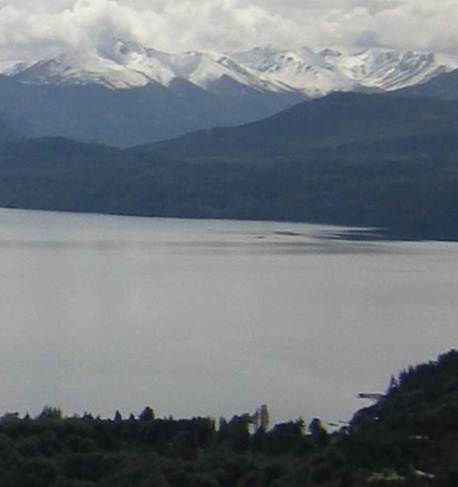
A preview:

nahuel huapi lake creature

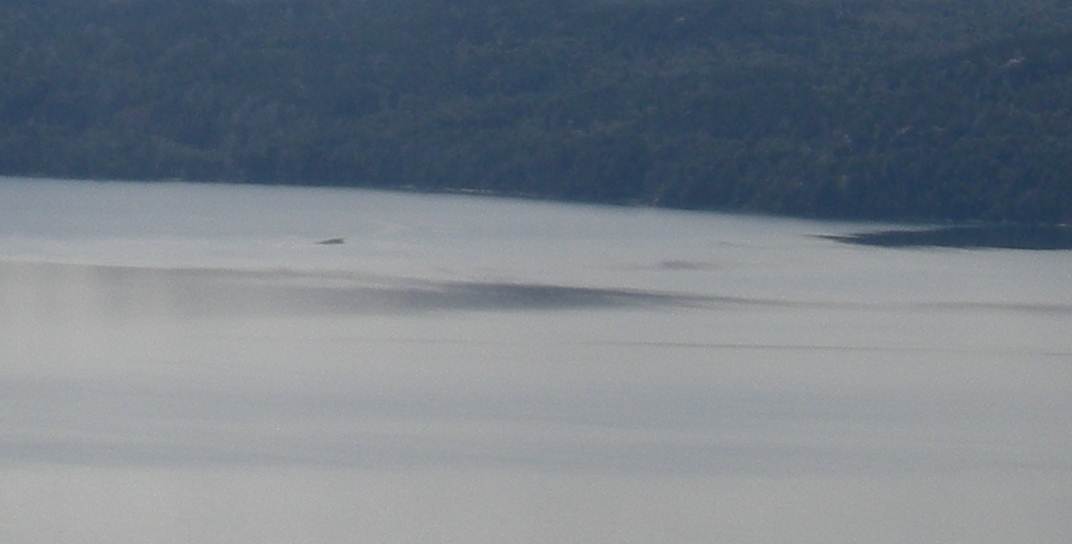
detail of Nahuelito

The first image, above, shows a view looking north, across the narrow part of the lake, the circle is enlarged in the bottom image. It shows a dark shape floating in the lake, it later disappeared.

More photos and details in my next post.


Patagonian Monsters - Cryptozoology, Myths & legends in Patagonia
2011 International Year of Forests
2011 International Year of Forests Copyright 2009-2011 by Austin Whittall © 

Thursday, September 15, 2011

Nahuelito in Google Earth?

 
nahuelito
Odd shape in Lake Nahuel Huapi. Google Earth

Above is a screenshot from Google Earth. The coordinates of the white blob inside the red circle are given in the image. It is a spot in the middle of the lake, between Huemul Peninsula and San Pedro Peninsula, just east of Victoria Island.

It is about 8 m (25 ft.) long and big enough to appear in the satellite photograph.

What is it? Jokingly I could say it is Nahuelito. But it is more likely a train of waves which, in that part of the lake can be quite big on a windy day. Frothy rolling waves may appear on a satellite image. However the shape is odd. Could it be a boat? (not too clear an image to let us decide if it is or it isn't). It could also be a burst of bubbles issuing from the fault that lies below, on the lake's bed (see my post Bubbles and Nahuelito).


Patagonian Monsters - Cryptozoology, Myths & legends in Patagonia
2011 International Year of Forests
2011 International Year of Forests Copyright 2009-2011 by Austin Whittall © 

Tuesday, February 1, 2011

Lake Nahuel Huapi back to its normal blue color

 
On January 4, I commented in a post that Lake Nahuel Huapi had changed its color, from its usual deep navy blue color to a pale turquoise hue. Everybody was wondering what was the cause. Some had suggested that it was due to an earthquake in Chile that had shaken up sediment from the lake bed.

Well, the riddle has been solved: the cause seems to have been an inflow of "sedimentsthat the lake received from the upper basins of the rivers and streams that flow into that sector due to last week's intense rainfall"[1].

Sources.

[1] Diario Digital Bariloche. (2011). Segun las investigaciones, la hipotesis del sismo es la menos probable. 05.01.2011


Patagonian Monsters - Cryptozoology, Myths & legends in Patagonia
2011 International Year of Forests
2011 International Year of Forests Copyright 2009-2011 by Austin Whittall © 

Tuesday, January 18, 2011

Pre-hispanic horses at Lake Nahuel Huapi

 
Pre-hispanic horses at Nahuel Huapi

pre-hispanic horse in rock art
Both images show a man riding a horse before the introduction of horses to America by Spaniards in the 1500s. Rock Art at Lake Nahuel Huapi, Patagonia

I have written several posts on the possibility that the supposedly extinct horses that were native to America, managed somehow to survive into modern time, and maybe even mate and cross with European horses introduced by the Spaniards after they discovered America in 1492.

Pre hispanic horses at Lake Nahuel Huapi

Well, there are several pre-Hispanic horses in rock art depictions; at Nahuel Huapi Lake there are several (see the images above), and they represent a horse riding warriors; they were discovered by Asbjorn Pedersen in 1960. He wrote that he was amazed by these horsemen but was even more surprised when he “later noticed that these paintings could be the first tangible manifestation of an extinct fauna, since they do not represent the common horse (Equus caballus), but the American horse (Equus rectidens)”.[1]

My posts on extant pre-hispanic horses

In one post on these horses, I mentioned that pre-Hispanic horses resembled donkeys.

In another I mentioned the possible survival of supposedly extinct megafaunal horses.

And in another I explored the possibility that Native American horses survived extinction.

Sources.

[1] Pedersen, A., (1979). Las pinturas rupestres del parque nacional Nahuel Huapi. Anales de Parques Nacionales XIV (1978): 7-43.


Patagonian Monsters - Cryptozoology, Myths & legends in Patagonia
2011 International Year of Forests
2011 International Year of Forests Copyright 2009-2011 by Austin Whittall © 

Tuesday, January 4, 2011

Lake Nahuel Huapi has changed color

 
color change nahuel huapi
Pale color on lake Nahuel Huapi (usual color is navy blue). From [2].

Nahuel Huapi, the lake where Nahuelito the most famous of Patagonia's cryptids lives, has changed its color.

According to an article published today, [1] the lake changed color, after an earthquake shook the Bio Bio region in Chile last Sunday afternoon (it had an intensity of 6.9).

The color has shifted the lake's deep blue waters to a paler tone, and the unusual phenomenon began in front of the city of San Carlos de Bariloche and spread out across the eastern (shallower) tip of the lake.

Scientists believe that the lake's shelf, which have sediments and even ancient volcanic ash, were shaken by the quake and they, being unstable on the shelf's slope, slid and mixed with the water, where they became suspended. It may take some time for them to decant and sediment on the lake's bed.

This is very similar to what happened at Lake Huechulafquen, a few hundred kilometers north of Nahuel Huapi, which also changed color last year.

Update 01.02.2011: The cause was excess sediments flowing into the lake due to heavy rains. (See my post on it: Nahuel Huapi back to its usual color)

Sources.

[1] Cambio el Color del lago Nahuel Huapi y lo atribuyen al terremoto en Chile. Clarin. 04.01.2011.
[2] El lago Nahuel Huapi cambió de color y dicen que podría ser por un sismo. Diario Jornada. 04.01.2011.


Patagonian Monsters - Cryptozoology, Myths & legends in Patagonia
2011 International Year of Forests
2011 International Year of Forests Copyright 2009-2011 by Austin Whittall © 
Hits since Sept. 2009:
Copyright © 2009-2025 by Austin Victor Whittall.
Todos los derechos reservados por Austin Whittall para esta edición en idioma español y / o inglés. No se permite la reproducción parcial o total, el almacenamiento, el alquiler, la transmisión o la transformación de este libro, en cualquier forma o por cualquier medio, sea electrónico o mecánico, mediante fotocopias, digitalización u otros métodos, sin el permiso previo y escrito del autor, excepto por un periodista, quien puede tomar cortos pasajes para ser usados en un comentario sobre esta obra para ser publicado en una revista o periódico. Su infracción está penada por las leyes 11.723 y 25.446.

All rights reserved. No part of this publication may be reproduced, stored in a retrieval system, or transmitted in any form or by any means - electronic, mechanical, photocopy, recording, or any other - except for brief quotations in printed reviews, without prior written permission from the author, except for the inclusion of brief quotations in a review.

Please read our Terms and Conditions and Privacy Policy before accessing this blog.

Terms & Conditions | Privacy Policy

Patagonian Monsters - https://patagoniamonsters.blogspot.com/