Translate

Guide to Patagonia's Monsters & Mysterious beings

I have written a book on this intriguing subject which has just been published.
In this blog I will post excerpts and other interesting texts on this fascinating subject.

Austin Whittall


Showing posts with label hominin origin in Europe. Show all posts

Saturday, July 13, 2019

Homo Sapiens in Greece 210,000 years ago


This paper: Apidima Cave fossils provide earliest evidence of Homo sapiens in Eurasia published in Nature (Katerina Harvati et al., Nature (2019). DOI: 10.1038/s41586-019-1376-z) provides sound evidence that Homo Sapiens were living in Greece 210,000 years ago, which is 150 ky earlier than what had been considered as their arrival date in Europe.


The cave of Apidima had two skulls, located side by side, roughly one foot apart (30 cm). One was identified as that of a Neanderthal, the other, a modern human skull.
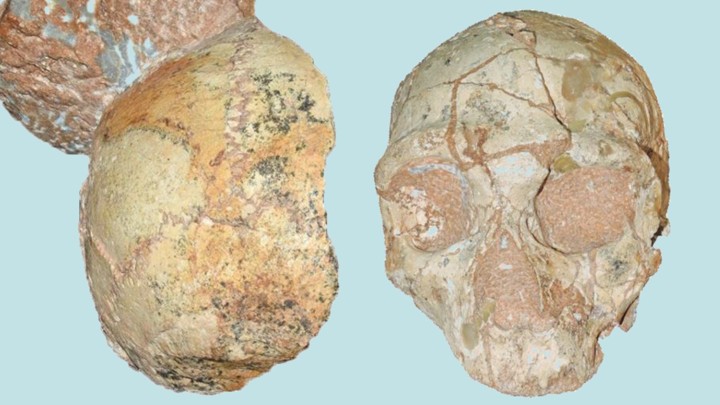

Apidima Cave skulls, Homo sapiens (left) and Neanderthal (right).

The human skull is known as Apidima-1, and is definitively a H. sapiens skull based on its shape. It lacks the characteristic occipital bun that Neanderthals have.


The other skull, Apidima-2 is clearly a Neanderthal one. Its age is also correct -it was dated as being 170,000 years old- because Neanderthals lived in Europe at that time.


The paper summarizes its importance:


"Together, the Apidima crania suggest a complex pattern of population dispersal and possible replacement for southern Greece that is not dissimilar to that proposed for the Levant —a potential source area for the population represented by Apidima-1. In such a scenario, early modern humans who were present in the region in the late Middle Pleistocene were replaced by Neanderthals, whose subsequent pres-ence in southern Greece is well-documented. The latter were them-selves replaced by Upper Palaeolithic modern humans, whose earliest appearance in the region—as documented by Upper Palaeolithic lithic industries—dates to approximately 40ka."


The Apidima-1 skull is the oldest known modern human in Europe, and very likely in all of Eurasia. It is over 160,000 years older than the next oldest known European H. sapiens fossil.


The earliest Homo sapiens African remains -Africa is supposed to be the cradle of modern H. sapiens- date back to 315,000 years and were found in Morocco at Jebel Irhoud. Then come the Florisbad remains from South Africa at 260,000 years.


The skulls were washed into the cave in separate events 40,000 years apart, and stuck in the breccia, one foot apart until discovered in the 1970s.


This age of 210 ky is very close to the date assigned to another skull found in Greece, the Petralona crania dated at 160 - 240 kya yet belonging to a hominin which has been alternatively classified as being that of a Homo erectus, a Neanderthal and also a Homo heidelbergensis (ESR-dating of the fossil hominid cranium from Petralona Cave, Greece, G. J. Hennig, W. Herr, E. Weber & N. I. Xirotiris Nature volume 292, pages 533–536 (1981).


The dates are going back in time, and Sapiens in Eurasia is older than what a few years ago was deemed possible. Perhaps Homo sapiens fossils even older than those found in Africa are out there, waiting to be discovered.


Patagonian Monsters - Cryptozoology, Myths & legends in Patagonia Copyright 2009-2019 by Austin Whittall © 

Sunday, September 3, 2017

Hominin footprints from Crete... 5.7 Million years ago


New discoveries every day. A few months ago the paper on Graecopithecus freybergi hinted at a hominin living in the Balkans 7.2 Million years ago:


Fuss J, Spassov N, Begun DR, Böhme M (2017) Potential hominin affinities of Graecopithecus from the Late Miocene of Europe. PLoS ONE 12(5): e0177127. https://doi.org/10.1371/journal.pone.0177127


Today I came across this article:


Gerard D. Gierliński et al. Possible hominin footprints from the late Miocene (c. 5.7 Ma) of Crete? Proceedings of the Geologists’ Association, published online August 31, 2017; doi: 10.1016/j.pgeola.2017.07.006


Amazingly, footprints of an ancient hominin were found in Crete and they are 5.7 Million years old, so here we have Balkans and Crete and hominins in two separate papers... were we from Africa?


The Footprints from Crete. Gerard D. Gierliński et al

Notice the compact foot with even sized toes, a human-like big toe and a heel! This is no chimp-like ape, this is a bipedal hominin walking along a beach in Crete! Maybe related to the Graecopithecus?. Was there an into-Africa event from Europe?


Patagonian Monsters - Cryptozoology, Myths & legends in Patagonia Copyright 2009-2017 by Austin Whittall © 
Hits since Sept. 2009:
Copyright © 2009-2025 by Austin Victor Whittall.
Todos los derechos reservados por Austin Whittall para esta edición en idioma español y / o inglés. No se permite la reproducción parcial o total, el almacenamiento, el alquiler, la transmisión o la transformación de este libro, en cualquier forma o por cualquier medio, sea electrónico o mecánico, mediante fotocopias, digitalización u otros métodos, sin el permiso previo y escrito del autor, excepto por un periodista, quien puede tomar cortos pasajes para ser usados en un comentario sobre esta obra para ser publicado en una revista o periódico. Su infracción está penada por las leyes 11.723 y 25.446.

All rights reserved. No part of this publication may be reproduced, stored in a retrieval system, or transmitted in any form or by any means - electronic, mechanical, photocopy, recording, or any other - except for brief quotations in printed reviews, without prior written permission from the author, except for the inclusion of brief quotations in a review.

Please read our Terms and Conditions and Privacy Policy before accessing this blog.

Terms & Conditions | Privacy Policy

Patagonian Monsters - https://patagoniamonsters.blogspot.com/