Translate

Guide to Patagonia's Monsters & Mysterious beings

I have written a book on this intriguing subject which has just been published.
In this blog I will post excerpts and other interesting texts on this fascinating subject.

Austin Whittall


Showing posts with label lake creature. Show all posts

Tuesday, September 23, 2025

Capibara in Patagonia?


Though most rodents are small (i.e.,mice) the largest extant rodent, the South American capybara (capibara) or carpincho (Hydrochoerus hydrochaeris), can weigh up to 80 kg (180 lb.)


Carpincho is the name given by the Spanish speakers of the River Plate region to the capybara, a word originated from its Guaraní language name “capiigüá.”


It is found across the South American wetlands and in the basins of the Orinoco, Amazon and Paraná-Plata rivers. It is well adapted to living in this habitat. The carpincho is an aquatic hog-like animal, stout and with thick, bushy reddish hair. They have partially webbed feet.


capybara
Capybara. Source

In Patagonia?


In the northernmost tip of Patagonia (36°50’S, 70°40’W - spot marked with a yellow star in our online map.) at the confluence of the Varvarco and Neuquén Rivers, Alegría and Belver compiled reports from the locals about the presence of a four-legged creature that had been seen there/p>

"In the pools of the Varvarco and Neuquén in front of Invernada Vieja, it is a ‘bear’… the size of a small calf, with fins on its front legs… some maintain that it could be the survivor of the extinct ‘huillines’ (of the carpincho type) that existed in large amounts in this area, large as pigs, which were hunted because with their hairy hide they made excellent saddle mat."


See : Alegría, H. and Belver, I. (2007). Tradiciones del Norte Neuquino. Neuquén, Argentina, Escritores del Caleuche. pp 187. Cited by Eduardo G. y Marina Ottone. (2021) Coipos, huillines y el oso de varvarco. Historia Natural (tercera serie), 11 (1): 149-163.


The huillines mentioned above are Patagonian Otters (Lontra provocax), but note how the authors describe it as being "of the carpincho type", what do they mean by that? A fat, big otter? Being the size of a calf is quite large. There is no such type of otters in Patagonia. The most parsimonious explanation is that they were actual capybaras (carpinchos).

Map


Our interactive map shows the main rivers in northern Patagonia and how they could be linked to the Plata-Paraná basin.


Sowé or Soven


There was another reference to capybaras in La Pampa, by a woman of native ancestry, Mrs. Ángela Mariqueo who was a Ranquel. She gave the creature a Ranquel name: “Soven” or “Sowé”. Stieben wrote about here description, and commented: "she described it as a fierce animal of the lagoons of the central part of La Pampa province." See the wetland and lagoons in my map.


Carpinchos don't seem fierce, in fact they are quite tame and non-aggressive. Which makes me wonder why would Mariqueo describe them like that.


However, this supports the idea that the capybara reached the Wetlands of Bañados del Atuel following the Salado and Vallimanca Rivers, the Encadenadas (chained) lakes and then the more or less wet temporary lagoons along the Utracán and General Acha valleys (all marked in my map). From the wetlands they could have spread across the Curacó-Salado basin, into the Colorado River and then, after bridging an arid gap, reached the Neuquén, Negro and Limay rivers.

swimming capybara
Swimming capybara family. Source

Currently (source: Bolkovic, María Luisa; Quintana, Rubén; Cirignoli, Sebastián; Perovic, Pablo G.; Eberhardt, Ayelen; Byrne, Soledad; Bareiro, Ricardo ; Porini, Gustavo (2019). Hydrochoerus hydrochaeris. En: SAyDS–SAREM (eds.) Categorización 2019 de los mamíferos de Argentina según su riesgo de extinción. Lista Roja de los mamíferos de Argentina) they can be found further north, but close to the Patagonia.


They have been seen in La Pampa, along the Quinto River between the towns of Sarah and Larroudé (red marker in my map).


They are also reported in the Southwestern region of Buenos Aires province, west of Bahía Blanca and Sierra de la Ventana. It is connected to the Vallimanca-Salado Rivers basin and to the "chained" lakes (Encadenadas).


Another route of access into Patagonia was the now submerged continental shelf, which during the peak of the Pleistocene ice ages, was exposed and covered a vast area with vegetation, rivers and forests. Research provides additional proof; a paper published in 2024 (Pinaya, J.L.D., Pitman, N.C.A., Cruz, F.W. et al. Humid and cold forest connections in South America between the eastern Andes and the southern Atlantic coast during the LGM. Sci Rep 14, 2080 (2024).) [LGM is the Last Glacial Maximum, 19,0000 to 29,000 years ago] confirms that there is:


"strong evidence for the establishment of ecological corridors linking Andean, Atlantic and Amazonian regions under the relatively cool and moist climates of the LGM, which favored the migration of various plant and animal groups […] The significant sea level fall of ca. 120 m exposed the South American Continental Shelf, which could have created an important migration corridor for different southern Andean plant species to migrate northwards and colonize areas of the Brazilian Atlantic coast. Our data suggests that this vast coastal corridor was possibly covered by temperate-like forest with prevalent Andean floristic affinities in the south and a more Atlantic floristic composition in the north."


The authors note that the Southern Atlantic Continental Shelf Connectivity (SACS) had forests that included Araucaria and Drimys, which are still found in the southern Andean woods. They add that this continental shelf exposed an area of 1.94 million km2 (750,000 sq.mi.) "equivalent in size to the combined areas of France, Spain, Germany, Italy and the United Kingdom."


Patagonian Monsters - Cryptozoology, Myths & legends in Patagonia Copyright 2009-2025 by Austin Whittall © 

Sunday, September 21, 2025

The 1922 Plesiosaur was probably a Turtle or Crocodile


Back in 1922, while the expedition was searching for the Plesiosaur that Sheffield had said he'd seen in a tiny lagoon close to his home near the Epuyen River, many looked on with a skeptic attitude.


Below is the text from an article published in the New York Times (HINT 'PLESIOSAURUS' WAS A HUGH TURTLE; Dr. Lucas and Washington Scientists Scoff at Tale of Finding Monster in Patagonia) published on March 8, 1922, mocking the expedition.


"Dr. F. A. Lucas, director of the Museum of Natural History, does not credit the report that a plesiosaurus, an amphibian of the Mesozoic period, generally believed to exist only in fossil form, has been seen alive in Patagonia.
'It is very unlikely that a plesiosaurus has been seen,' said Dr. Lucas yesterday. 'It is possible that something has been seen, but not a plėsiosaurus. It has been my experience that the nearer one goes to the source of such reports the less people seem to know about them. Nobody seems to know just how these wild reports start. Not long ago a report was circulated that a glyptodon, a genus of large extinct mammals of the order of edentata, related to the armadillos, had been seen in New Zealand.'
'As nearly as I can recall, no fossil remains of plesiosauri have been found in South America, but I know of no reason why they should not exist there. The most recent remains found in this country date from the Cretaceous period. It is barely possible that the animal seen was a large fresh-water turtle or a crocodile, though Patagonia is far south for a crocodile.'
WASHINGTON, March 7. - Professor Gilmore of the National Museum and N. Hollister of the National Zoological Park said today that they were of the opinion that such animals as plesiosauri vanished from the earth long ago.
'The last positive evidence of such creatures running at large,' said Professor Gilmore, dates back some 10,000,000 years. So far as scientists are aware, no such animal has been seen since that period. I would not hesitate in advising that the subject be dismissed.'
"


Scientists


These men were authorities, and they made a good point.


Frederic Augustus Lucas, (1852-1929) was a naturalist, director of the American Museum of Natural History from 1911 to 1924, and honorary director until his death. He was an authority on vertebrate anatomy.


Charles Whitney Gilmore (1874–1945) was an renown paleontologist who worked with dinosarus during his career at what then was the United States National Museum (now the National Museum of Natural History).


Ned Hollister (1876-1924) was a naturalist, and between 1910 and 1916 served as Assistant Curator in the Division of Mammals, United States National Museum. Then he became the Superintendent of the National Zoological Park in Washington, where he worked until his death.


Comments


The New Zealand glyptodon is an interesting story, since there were no native mammals in the islands because it split from Gondwana before the first mammals appeared. It only had birds and reptiles, but no mammals. It is the first time I have read about it, but I have not been able to find any references to this sighting.


The suggestion that if there is an animal, it may be "a large fresh-water turtle or a crocodile" is reasonable. Nevertheless, Lucas points out that there are no known crocs in Patagonia. I agree with this possibility.


plesiosaurus
Plesiosaur from an article published in Buenos Aires in 1912.

The image above was published in 1912 ( Fray Mocho: semanario festivo, literario, artístico y de actualidades. (1912). En Busca de un Nuevo Monstruo. Argentina. Año 1, N° 11.) and its caption reads: "A plesiosaur, a species who mister König believes the mysterious inhabitant of Lake Pueyrredón belongs to."

This sighting at Lake Pueyrredón took place ten years before Sheffield's sighting.


Of course, Plesiosaurs died out 65 million years ago. The creatures, if real, were not plesiosaurs.


Patagonian Monsters - Cryptozoology, Myths & legends in Patagonia Copyright 2009-2025 by Austin Whittall © 

Sunday, September 14, 2025

Pudu Pudu swimming in a lake!


The world's smallest deer lives in Patagonia, and swims across its lakes.


Like the Patagonian deer, the Huemul, and the Red deer brougt from Europe to Patagonia, the endemic Pudu Pudu also enjoys swimming in the Patagonian lakes, and it could be mistaken for some strange lake creature if spotted by someone who is not aware of this fact.


The following video (see it online here) shows a pudu pudu swimming in a large Chilean lake.


pudu pudu swimming in a lake
Pudu Pudu deer swimming in lake Cólico, Chile. Still from a video by Ricardo Hinstz

The video was shot by Ricardo Hinstz, and it shows a pudu pudu deer swimming in Lake Cólico, in Chile's Patagonian region. The lake has a surface area of 56 km2 ( sq. mi.) and you can see its location here, in Google maps.


Pudu pudu (Pudu Puda)


The Pudu pudu is the world’s smallest deer, and it lives in the Patagonian forests. It stands only 38 cm (15 in.) high at the shoulder and 85 cm (2 ft. 7 in.) long; it weighs about 10 kg (22 lb.) Males have small antlers barely 10 cm (4 in.) long.


Pudu is a vulnerable species, and only ten thousand of them survive. They are also unique because they can go a long time without drinking water, getting the needed moisture from plants. They live in the rainforests of Patagonia’s northern Andes and on Chiloé Island and are related to the tiny Northern Pudu (Pudella mephistophiles) that lives in the Andes of Colombia, Ecuador, and Peru.


In 2024, a pudu was photographed while it swam across Lake Frias (map) in the Nahuel Huapi national park. The picture can be seen below.


swimming pudu lake with green water
Pudu swimming in Lake Frias, Argentina. Source

Some pictures of pudu-pudu.

pudu pudu deer
pudu pudu deer
Pudu Pudu deer. Sources: Top, Bottom.

Cute creatures!


Patagonian Monsters - Cryptozoology, Myths & legends in Patagonia Copyright 2009-2025by Austin Whittall © 

Sunday, June 8, 2025

Solitons and Lake Monsters


Solitons sound like some particle from quantum physics, but they were discovered by a classic Victorian scientist, J. Scott Russell in 1845. He was a Scotsman, a civil engineer and a naval engineer. One day and he observed a strange wave formed by a boat in a canal that traveled several miles along it without decaying. He wrote an article about this stange phenomenon, in 1845. Waves are supposed to lose energy and fade away, this one, on the other hand, remained coherent-


The name Soliton is now used to describe these waves "solit" from "solitary" wave, and the "-on" suffix in an analogy to the one used for elementary particles (electron, photon, proton, etc.)


The "solitary wave" or "soliton" are a special type of wave, that once they form move constantly in the same direction with no changes in the height of the wave, its interval (frequency) or shape. They don't dissipate, they maintain their form and can travel long distances from the spot they were created.


They form in the sea, in rivers, lakes, and canals. Wind, tides, shallow water, water layers with different temperatures, ships, and underwater topograph can contribute to their formation.


Johen Scott Russell pointed out that "if a wave is too big for the depth of water, it splits into two, one big and one small" with the bigger one traveling faster than the smaller one. Over time they will become separate waves. But there are other mechanisms that can split solitons even in deep water forming a train of waves that travel together over an otherwise flat body of water. These trains can contain between two and six separate waves.

Professor Sergei Eremenko describes this in his book and includes photographs like the one below.


Soliton in Lakw Wakatipu, NZ.

The video is captioned: "Unstoppable like tsunami, soliton envelope wave packet, composed from two distinct sub-groups, slowly cruising Lake Wakatipu, New Zealand."


The same type of wave trains can be seen in Patagonia. Below is a soliton observed in Lake Nahuel Huapi on Feb 16, 2020. The viewers thought they were seeing the activities of the famous "Nahuelito". But a scientist consulted by the press suggested it was a soliton (source),


2020 Soliton in Lake Nahuel Huapi.

As expected, the video mentions "Nahuelito," ignoring the scientific explanation.


In recent posts I have suggested that waves are a reasonable explanation for mysterious lake creatures, especially single wave fronts that look like the wake left by a submerged animal.


Patagonian Monsters - Cryptozoology, Myths & legends in Patagonia Copyright 2009-2025 by Austin Whittall © 

Saturday, June 7, 2025

Lake Mascardi "creature" (I don't think so)


Lake Mascafrdi is U-shaped and is fed by the meltwater from the glaciers of Mount Tronador which enter its NW tip. Its NE tip on the other hand is a wide valley, with a marshy area that marks the continental divide. Just north of the divide is Lake Gutierrez that drains into the Atlantic Ocean through Lake Nahuel Huapi and the Limay and Negro Rivers. Mascardi, on the other hand, drains west through the Lower Manso River on its SW shore, which eventually reaches the Pacific Ocean throught Puelo River.


It is set at an elevation of 750 m (2,460 ft.), and has a surface area of 39,2 km2 (15 sq.mi.). It is deep (on average 218 m - 715 ft.), and in the past its waters had a greenish tint due to the glacial sediments from Mt. Tronador.


The map shows Mascardi (bottom-center), the city of Bariloche on Lake Nahuel Huapi (upper right), Mt. Tronador (upper left). The red arrow marks the spot of the sighting.


Lake Mascardi map

The "serpent"

The following video was published in the news on March 14, 2018 as "Two families assure having seen a 'long serpent' in Lake Mascadri? (source)


The video on youtube, is shown below:


Lake Creature?

This is the story published in the media:


Maricel Gómez, who lives in Bariloche, and her family stopped at a service station (ACA Mascardi - see a Google Street view at this spot, red arrow in the map below).

The lake was calm and they saw a "wake", Maricel described the incident as follows:


"The lake was completely calm and suddenly I saw like a large serpent coming in and out of the water. What protruded above the water was a black, large back, and when it went underwater it left a long wake like two meteres, although that is what it seemed like from a distance, the wake was very long, like those left by planes in ths sky... The hump of the back emerged and submerged in the water, it did so like six times. We all saw it. Even, Cinthia [her sister] thought it was the tail of a snake. We couldn't believe it, we imagined it was a fish or a diver, but no. It was crossing the whole lake, but very far from us."


In my opinion, probably a fish, a diving bird like a huala, a special type of wave known as a soliton, or even the wake of a distant boat. Not a "serpent".


I have fished on the lake in a boat, picnicked on its northern tip by Fresco Creek, trekked its shore to lake Llum, and from the Casalata Creek to the Upper Manso River. I have driven along its coast on Ruta 40 and on the Tronador highway (all these spots can be seen on the map). I never saw anything odd. Just a regular Patagonian Lake.


Lake Mascardi
Top: central part, Mt. Bonete. Middle: Heart Island. Bottom: Mt. Tronador seen from the lake.


Patagonian Monsters - Cryptozoology, Myths & legends in Patagonia Copyright 2009-2025 by Austin Whittall © 

Monday, June 2, 2025

"Cuero" in Lake Lolog or waves?


Lake Lolog is a glacial lake with a surface area of 35 km2 (13.5 sq.mi.) set at an elevation of 900 m (2,952 ft.). It is located 9 km (5.7 mi.) north of San Martín de los Andes in Neuquén, Argentina. Its western tip is part of the Lanin National Park.


Its name comes from "lolo" = mouse, and "hue" = place, a place with many mice. There are different species of rodents like the long-tailed mouse (Oligoryzomys longicaudatus) living in the forests.


Long and narrow, it flows eastwards along the Quilquihue River and its water reaches the Atlantic Ocean along the Chimehuin, Collón Curá, Limay and Negro Rivers.


Its western part is surrounded by steep mountains and the dense Andean forest, to the east it is drier, with an open wooded area, that gradually blends into the steppe.


Lake Lolog. Eastern tip and Quilquihue River (top), western tip (bottom).

Creature or waves?


The following video taken in 2018 shows a wake on the surface of a relatively calm lake. The caption video says "25-10-18 where you can see strange waves in Lake Lolog that can only be caused by the "Monster of Lake Kolog", known fondly as "Lologuito"."

Lake Lolog waves.

Trains of waves, the wake of a boat, a sudden burst of the potent Patagonian wind can cause a phenomenon like the one shown in this video. I think it is just waves. No animal involved.


Patagonian Monsters - Cryptozoology, Myths & legends in Patagonia Copyright 2009-2025by Austin Whittall © 

Thursday, May 29, 2025

Lake Vidal Gormaz creature


Lake Vidal Gormaz is located in Chile, in the area between Puerto Montt, Chiloé Island, and Bariloche and El Bolsón in Argentina (see it in Google maps).


It is a long, narrow lake, 7.8 km by 0.8 km (4.9 by 0.5 mi.) it drains into the Manso River that comes from Argentina, with the outflow of several lakes including Lake Mascardi, the waters end up in the Pacific Ocean along the Puelo River.


We had mentioned it in our post on the Reloncavi region's monsters, and found another reference, quoted below: (online here)


"While we were there, more precisely at its northern tip, we found out about disquieting news . Like Nahuel Huapi who has its "Nahuelito", and other Southern lakes the famous "cuero", Vidal Gormaz also has a tennant, a supposed "monster". At least that is what the members of the Bahamonde family -legendary settlers in the area- told us, seriously. And there is more. A few months after this expedition, and because we mentioned this rumor in a post, they have written to me to tell me that in the Las Rocas Lake (located south of the Vidal, and in the same basin) there have been reports on this matter."


Looking south along Lake Vidal Gormaz. Source

The lake is quite inaccessible, and set in the middle of the Andean forests. There is a fishing lodge on a farm on its southern tip.


Patagonian Monsters - Cryptozoology, Myths & legends in Patagonia Copyright 2009-2025 by Austin Whittall © 

Saturday, May 24, 2025

Boars swimming in Lake Nahuel Huapi


A surprising sighting took place on March 13, 2024 (source) when a fishing guide filmed a group of wild boars that were swimming in the lake and approached the boat he was in with some tourists. The video can be seen below.


The video is captioned: "Tourists surprised by four wild boars swimming in Lake Nahuel Huapi". Copyright LMNeuquen

These boars are not a local species, they were introduced from Europe into Patagonia to stock hunting grounds.


Seen from afar, would someone wonder if it was a lake monster?


I recall a personal experience that took place in February 1971, when my family camped in the forest lose to the Raquitue stream by Lake Huechulafquen in a wild setting. My parents had bought a box with 20 kg of apples in the Río Negro Valley during our 1.600 km (1,000 mi.) trip from Buenos Aires to Lake Huechulafquen. The Valley is packed with apple orchards, and they were the best apples I had tried in my life.
The day after we arrived, in the morning my Dad took the box -which was half empty- down to the lake and rinsed the apples, I asked why, if we had eaten them without washing them. And he told us that during the previous night a group of boars (which is called a "sounder") had intruded on our campsite and eaten most of the apples. Dad heard them grunting and munching apples and woke up, he frightened them away with his flashlight. My mother didn'l kie it at all, she wanted to move to a more civilized spot, so we uplifted our camp and went to an organized campsite at Bahía Cañicul. I was 11 years-old at that time and it was quite an experience!


Patagonian Monsters - Cryptozoology, Myths & legends in Patagonia Copyright 2009-2025 by Austin Whittall © 

Wednesday, May 21, 2025

Lake Huechulafquen


The journalist that covered the Plesiosaur expedition in 1922, sent by the Buenos Aires magazine Caras y Caretas interviewed a Mr. Goicochea who had lived in Minas (central Neuquén province) about other sightings. Below is what he reported in issue 1229 (April 1922).


The Plesiosaur in Lake Huechulafquen


The text in English is the following:


Mr. Goicochea said "I remember, when I was the Secretary of the Court in the Department of Minas, hearing many times, [from] respectable neighbors something similar to that... and they were not young fellows... I will cite their names: Mr. Cecilio Gerio, merchand in Junín de los Andes, Mr. Mendaña, old rancher of those regions, one of the first settlers in the Cordillera... Another: "Fair" Bagual, which is his nickame, but is really named Rodriguez... Well, this Rodriguez was a soldier in the expedition to the desert. He deserted and then obtained his retirement and now owns a small ranch over there... All of them have said many times that in the lake Huachi-Lauquén [sic] at sunset, an animal often appewars on the surface of the water, with more or less the same features of the one they say they have seen in Esguel [sic]. Very long neck, head of a lizard, the body that must be enormous, because when it submerges, it produces like a boiling in the water


Huachi-Lauquen is Lake Huechulafquen, and Esguel, is a small lake close to the town of Esquel in Chubut.

You can read the original Spanish text here

Huechulafquen is a large lake, 30 km (19 mi.) long and up to 5 km (3.1 mi.) wide, it covers an area of 78 km2 (30 sq. mi.), and is very deep.

Lake Huechulafquen and Lanin Volcano by the northeastern tip of the lake

In the 1960s, Gregorio Alvarez casually mentions among several other strange mythical animals which he calls zoomorphs, a “cow at Lake Huechulafquen.”Unfortunately, he did not describe the beast, so its appearance is a mystery.


In March 2009, a tourist named Jorge Salcedo, while on an excursion in a catamaran, photographed what looks like a set of three waves that look more like the wake of some boat than the back of an animal swimming just below the surface. The media quickly reported it as a lake creature and named it “Huechulito.”


In 2023, a tourist filmed some strange waves in the calm lake (Source). Below is a still from the video (video online).


2023 sighting Huechulafquen.

A plausible explanation could involve otters or even gas bubbles surfacing in the lake because there is plenty of geothermal activity and hot water springs in the area as it is located beside the Lanin volcano.


Lanín is a stratovolcano, that is 3,747 m (12,293 ft.) high, it has a conical shape and its summit is covered by glaciers. It last erupted around 1,500 years ago.

Patagonian Monsters - Cryptozoology, Myths & legends in Patagonia Copyright 2009-2025 by Austin Whittall © 

Thursday, November 7, 2019

Freshwater stingray sighted in Lake Nahuel Huapi - or was it a catfish?


I have posted on the "cuero" myth of the Mapuche natives, which is a creature that resembles a stingray (see my posts here). I mentioned some reports of freshwater stingrays in the region (Northern Patagonia) as an explanation for the myth.


However there are no scientific records of freshwater stingrays in Patagonia.


Today I came across a newspaper report published in January 2014 in Bariloche 2000, which mentions a sighting of a ray in lake Nahuel Huapi


"The neighbor René Zuker said he saw a ray in the waters of Lake Nahuel Huapi, in Villa La Angostura. The fisherman shared a photograph with B2000... [see photo below]... 'I think that it it a freshwater stingray and not a manta ray' René stated after verifying the information on the Internet... he reported that he was on the pier at Bahia Mansa and spotted the animal at a depth of 6 meters approximately. 'At first sight I didn't notice it, then I saw that it moved and I took the photograph quickly' he said, and he explained that as he is a photography fan, he carries his camera with him wherever he goes.
[he] told us that it is not the first time that he sees an animal of this kind: 40 years ago, on the shore of the lake, meters from the Limay River
[the outlet of Lake Nahuel Huapi] he saw a ray which he described as follows: 'it was the size of my hand, almost just born, and it was being eaten by some bugs, and it drew my attention, it was half rotten".


Ray in Lake Nahuel Huapi. By Rene Zuker

There are no rays, but the lake, and Northern Patagonia is the home to one of the oldest catfish familiess, the Diplomystidae. Not many people know that these fish live in the lakes and rivers of Patagonia. Most are aware of trout, salmon and perch, but not these catfish, pictured below:


They live in Chile and Argentina in the same region where the "Cuero" myth appeared (is that a coincidence?) - see maps below


The map above shows Patagonia in green, the oval is the area where the Cuero myth was popular among the Mapuche natives. In Yellow is the area where you can find freshwater stingrays.


Below is the current distribution of velvet catfish:


Of course a ray and a catfish are different, yet, a fish 6 meters (18 feet) underwater will appear larger than it is due to the refraction of light at the water-air interface (roughly 1.33 times larger than it really is):


The fossil record tells us that catfish have been living in Patagonia since the Eocene, tens of millions of years ago. The Diplomystidae or "velvet catfish" are quite special: they are the basal clade of all catfish, they are the only catfish to have a maxilla (bony jaw) with teeth on it. Furthermore, they are only found in Chile and Argentina.


The only problem with trying to identify the Nahuel Huapi catfish (Diplomystes viedmensis - also known as Olivaichthys viedmensis) with a gigantic freswater stingray is the size. The catfish are barely 30 cm long (one foot). However catfish (sliuridae) can grow into giants: the Siluris glanis can measure 5 meters long (15 feet), and one catfish caught in the Mekong river (source and photo) weighed 646 lbs and measured 8.9 ft long (293 kg - 2.7 m).


Maybe there are some very big catfish in Lake Nahuel Huapi... or who knows, perhaps some yet to be discovered freshwater stingray.


For now all we have is a blurred photo of a dark fish in the lake's clear blue waters.


Patagonian Monsters - Cryptozoology, Myths & legends in Patagonia Copyright 2009-2019 by Austin Whittall © 

Saturday, August 2, 2014

Llumu the Patagonian River Pig


While writing for my website on Argentina's National Highway No. 40 (Ruta 40), about the things to visit and do close to the town of Las Lajas in the northern part of Patagonia, in the province of Neuquén, I came across a very odd river name, which did not sound like a Spanish word or a local native Mapuche word either, actually it is the same word repeated: "yumu yumu". The map below shows the location (the river coming in from the left).


It is the name of a stream, which flows in a West to East direction, down from the Andes, towards the Atlantic, down the slopes of a hill named Butahuao (2,578 m - 8,452 ft.). By the way, Butahuao is the combination of two Mapuche words: "Buta" = Big and "huao" = gully.


The river crosses Neuquén provincial highway No. 21, at Campana Mahuida (place name that combines a Spanish word Campana = bell and Mahuida, Mapuche word = hill), 54 kilometers (33 miles) northwests of Las Lajas (Spanish words: The Shale in plural).


The place name repeats a Mapuche word according to Anthropologist and Historian Rodolfo Casamiquela [1]. He cites one of the few inhabitants of the region, Manuel Quinchao (note his Mapuche surname), from Chenque Cura, near Las Lajas. Mr. Quinchao said that it is the word is actually "llamü", the name of an animal, "a creature similar to a hog" [1].


There is another version which is also mentioned by Casamiquela, and he quotes Harrington-Benigar and Groeber, in which the llamü is not a pig but a crab, a freshwater crab.


I have seen these endemic crabs in the Patagonian lakes (see the photograph below where I am holding one in my hand and a close up shot on a stone):


patagonian freshwater crab
patagonian freshwater lake crab
Patagonian freshwater lake crab (Lake Nahuel Huapi). Copyright © 2014 by Austin Whittall

In case you are not too familiar with Spanish and Argentine Spanish in particular, the double "L" or "LL" is pronounced all over the Spanish speaking world -except Argentina- as the English "Y" in "Yes" (so "llumü" would sound like "You-moo" in English).


However, the Argentine Spanish pronounciation has a different sound for the double "L". It sounds like the "Sh" in "Show", and in fact it sounds identical to the Spanish pronounciation of the letter "Y".


By the way, the double "L" is not ever pronounced in the way that the double "L" in "million" is pronounced in English. So a "Llama" is not a "lama" but a "Shama" (Argentina) or a "Yama" (rest of Spanish speaking countries).


Argentines pronounce "LL" and "Y" with the same sound, the rest of Spanish speakers have two distinct sounds for those phonemes. That is why "llamü" became "yumu", (an Argentine pronounces both words in the same way: "Shoe-moo"). And this is the reason why a word written with a double "L" changed to a "Y".


In case you wonder why Argentines pronounce the language differently (Uruguayans do to), it is due to the enormous influx of Italian migrants to both countries in the late 1800s and early 1900s. Half the Argentine population has Italian blood in their veins. So the Italian accent mixed with the Spanish one, softening it. (you can hear it in this Video spoken in "Argentino" or Argentine Spanish).


But getting back to our pig or is it a crab? Which is the correct interpretation? To name a stream after the crabs that live in it sounds quite reasonble. So does naming a river after pigs. But the point is that pigs were not native animals. They were brought to America by the Spaniards. The Mapuche word for pig, hog is "Sanchu" (san-chew) which is the phonetic rendering of the Spanish word for pig: "Chancho" (chan-chou). This is logical, they adopted the Spanish word for pig.


Yes, there was a wild pig, native to America which is now extinct in Patagonia, but was known to the Mapuche: the Pecari tajacu or Collared Peccary (pictured below), which had different Mapuche names: sohue, sürse, sañhue, sanue, chanue, sane, saino. Distinct from the "Sanchu" name given to Eurasian pigs.


pecari tajacu

So what was the yumu, a pig or some other creature?


I have my doubts, I have come across the following explanations, all duly backed by bibliography:


  • "Llamü are little frogs of different sizes that lived in the rushes" [2]
  • Cuchi is another name for pig, and is used in Cuchivilu, or cuchi = pig, vilu = snake, the Snake-hog creature of Patagonian lakes.
  • Llamü according to a nineteenth century dictionary means "blind" [3]
  • Yumu derives from the Mapuche word "yumid", to shine, bright, glistening, shiny. [4] Which would be appropriate for a brook.

The question will remain open for now.


Sources


[1] Casamiquela, R., (2003). Toponimia indígena de la Provincia del Neuquén pp. 57
[2] Martin Alonqueo, (1985). Mapuche: ayer-hoy, Editorial San Francisco, pp. 135
[3] Andrés Febrés, Antonio Hernández, (1846), Diccionario hispano chileno
[4] Hasler Juan A. Topónimos Mapuches. AUCh, °5 serie N°


Patagonian Monsters - Cryptozoology, Myths & legends in Patagonia Copyright 2009-2014 by Austin Whittall © 

Monday, March 5, 2012

Stingray - El Cuero


stingray
Sting Ray at an aquarium. Copyright © 2012 by Austin Whittall

I have posted that the Cuero, a mythical lake creature that is said to inhabit Patagonian lakes is a freshwater stingray.
I got to see one recently during my vacations (not in Patagonia or Argentina by the way), swimming in a salt water aquarium.

I took some photographs, one of them is posted above. It is quite an impressive being, moving slowly, gliding through the water. Notice that it has had its barb cut off to avoid harming the keepers.

It is quite likely that a creature such as this gave rise to the Cuero myth.


Patagonian Monsters - Cryptozoology, Myths & legends in Patagonia
 Copyright 2009-2012 by Austin Whittall © 

Thursday, December 29, 2011

"Cabralito" a lake creature in Salta Argentina


Cabralito lake creature
Cabralito lake Creature. From [1]

Todays news reports that in Northern Argentina, in the province of Salta, a mysterious lake creature was filmed. The photo above is a still from the video. The press quickly named it "Cabralito" after the lake it lives in (it is a cute diminutive of the lake's name similar to Nahuelito of Nahuel Huapi fame or Nessie of Loch Ness).

The footage was taken close to a pier known as El Préstamo by Leo Bonino, on the lake of Cabra Corral. The lake is man made, as a dam was built in 1972 on the Juramento River. It has a surface of about 127 km2 (49 sq. mi.) and its water flows all the way to the Paraná River north of Buenos Aires.

The dam is 65 km from the city of Salta, captial of the province of Salta in Northwestern Argentina.

Jorge Santi, a diver of the Lake Division of the Salta Provincial Police, said that:
"There have been rumors about this for years. Some say that they have seen a reptile similar to a yacaré and others swear that they have seen a great snake moving with its head above the surface".

Nevertheless, a local named Roberto Eduardo Portal, says that "Cabralito" skeptically said that "'Cabralito' is nothing more than a family of otters who have lived in the lake for the last 30 years".

Below is the video (from Youtube) and the map showing the location of Cabra Corral dam.

The Video:


The Map:


View Larger Map

Since this may be my last post for 2011, I wish you all a very Happy New Year and an excellent 2012 (may the Mayan doomsday myth be proven wrong!).


Patagonian Monsters - Cryptozoology, Myths & legends in Patagonia
2011 International Year of Forests
2011 International Year of Forests Copyright 2009-2011 by Austin Whittall © 

Saturday, December 3, 2011

Setting the Stingray Hypothesis straight

 Rewritten on 14 Dec. 2011.

Ever since I was nine, I have been terrified of freshwater stingrays. I read a fable by Horacio Quiroga, "El paso del Yabebirí".

Horacio Quiroga (1878-1937), a Uruguaya author, wrote several books about his life in Argentina's Northeastern province of Misiones. A land covered with jungles, and where the marvelous Iguazú falls are set.

In this story a man, wounded by a "tiger" (the name given to the South American jaguar), was saved by the timely action of the stingrays who "stung" the jaguars as they tried to cross the river to kill the man. He had protected the rays in the past so they helped him. The river's name means "river of stingrays".

Stingrays have always been on my mind, when I swam in the brown silty waters of the Paraná River delta and the River Plate during my youth I always wondered if a ray would sting me when I stood in the muddy river bed.

I posted about them and included them in my book... and today, came across a strange online article:

An online article

It was published in an site (The Anomalist [*]) , and mentioned the Patagonian Cuero. I quote it below (Bold font is mine):

December 3

Capture of the Cuero Frontiers of Zoology
Dale Drinnon features an article about television fisherman Jeremy Wade of "River Monsters" capturing a 280-lb giant freshwater stingray in the waters of Argentina's Parana River near Buenos Aires. Photos of the fisherman and his catch are included, and Drinnon takes the catch further to reveal what it has to do with cryptozoology.
It turns out Drinnon had identified freshwater stingrays as the origin of tales of plesiosaurs in the freshwater lakes and rivers of Patagonia. Drinnon's original report on the Patagonian cryptid is included along with some excellent comments from other cryptozoology bloggers, including Austin Whittall of Patagonian Monsters whose comments had sparked Drinnon's stingray identification.

Some reviewers should get their facts straight

You can imagine my surprise, I believe that the story should actually record that it was a Catholic priest, Father Molina in the late 1700s wrote about manta rays as the explanation for Chilean Cuero myth. While researching my book, I came across his work, and I mention it in my book and in a post written Over two years ago, in my September 30, 2009 post on El Cuero - Nahuelito I jotted down that:

...The ray theory is the most reasonable explanation, in fact the shape and size of the cuero are similar those of fresh water stingrays.

However these apparently do not live in the Patagonian lakes or rivers, their habitat is in the Tropical to Temperate regions of eastern South America....
South America is home to the only exclusively freshwater stingrays in the world, the family Potamotrygonidae. The closest to Patagonia live in the Paraná River basin. These rays have a sharp spike on the rear of their tail which they use for self-defense and, interestingly, their disk can be covered with small denticles, small to large thorns which are thooth-like in structure, and covered with a tough enamel.


For those interested, my Jan 20, 2010 post on the Cuero goes into plenty details and even includes a map on South American freshwater stingrays and mentioned the Paraná River stingrays:

There are only on family of freshwater stingrays in the whole world, these are the Potamotrygonidae and they live in South America, but the closest that they get to Patagonia is over 1.600 km (1,000 mi.) to the north in the Paraná River basin...

What Molina wrote was that the Cuero was:
“a monstrous type of Manta ray”, or perhaps a squid with cat-like nails; the 'Seppia unguiculata'" (its Latin name means “clawed” Seppia)

As there are no known freshwater rays in Patagonia, this is a possible explanation for them being there (If and when they are found there)
But there is another intriguing option: Potamotrygonidae are related to the Dasyatid rays who often venture into fresh water in several parts of the world; one of these species can be found off the Chilean Patagonian coast. Maybe these Dasyatids swam up the rivers into the Andean lakes and their denticles were taken for claws.

However let me make it clear that my tirade is not against Dale Drinnon who is an honest researcher and writer, who gets his facts straight before publishing them. It is an outburst born from my surprise at how "reviewers" can sometimes distort facts!.

[*] Note: The Anomalist is a daily online review of world news on maverick science, unexplained mysteries among other subjects.


Patagonian Monsters - Cryptozoology, Myths & legends in Patagonia
2011 International Year of Forests
2011 International Year of Forests Copyright 2009-2011 by Austin Whittall © 

Friday, November 25, 2011

Lake Epuyen a Lake Creature sighting

 
A few days ago I came across a comment posted on a blog entry about Nahuelito. The person who wrote it, is named Rocío (evidently a woman), who interestingly was initially skeptical but, is now a "believer" in Lake creatures.

See for yourself (I am quoting her comment from the above mentioned blog):

"Rocio said:
March 7, 2011 at 2:56 pm
I was born in Bariloche and I have spent nearly all my life in this beautiful place and have been lucky enough to navigate the Nahuel Huapi quite often.
I have never seen anything resembling the Cuero or Nahuelito. Furthermore I believe that there is an explanation for everything. That we ignore it is another matter.
But, I want to tell you that last weekend (Saturday 05-March-11) I saw something super incredible at Lake Epuyen (Chubut). It was very calm, not even one single wave, a lovely day. My friend and I felt as if somebody dived into the water on the coast opposite to us, then we both looked and saw two long [animal] backs, which could be seen on the surface and then submerged, creating waves that reached us.
Looking for an explanation, I wondered if they were not two scuba divers, but I dismissed the idea due to the large size they had. Now I do believe that there may be an unknown animal living in the Lake District.
"

Lake Epuyen is quite close to the lake where the famous Plesiosaur was said to have been sighted and which led to an expedition to hunt it back in 1922.

I posted on the Plesiosaur and included a map of lake Epuyen.

Comments:

So what did Rocío see? Huemul live on the northern part of the lake. There is a Provincial Natural Reserve just there, to protect them. Huemul (an endangered native Patagonian deer) like to swim in the lakes (more on Swimming Huemul. A calm day is the best one to notice waves and the lack of wind can carry sound better so a deer jumping into the lake would have been heard across the lake. Once in the water, the animal's backs would be seen.

I can't explain the "submerged" part of her comment. The animals dived under water! and did not surface again.

Maybe the creature is not a Huemul. Perhaps it is an otter? But Rocío said they were big. Otters (huillín) are not so big. Less than 3 feet long.


Patagonian Monsters - Cryptozoology, Myths & legends in Patagonia
2011 International Year of Forests
2011 International Year of Forests Copyright 2009-2011 by Austin Whittall © 

My big "fish" at Millaqueo Bay

 
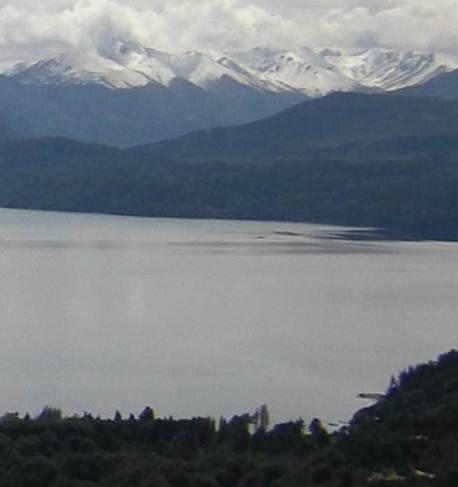
lake Nahuel Huapi, Millaqueo Bay
Western Nahuel Huapi, Millaqueo Bay from Mount Campanario . Copyright © 2011 by Austin Whittall

This morning I was looking at the photographs taken during our recent trip to Bariloche, when we went up the chairlift to the summit of Mount Campanario, a solitary cone shaped mountain that lies on the southern shore of Lake Nahuel Huapi which is 1,030 m (3,377 ft.) high.

From the mountain top (which has a nice cozy restaurant where you can enjoy a hot chocolate laced with cognac!), the view is impressive. To the East, the city of Bariloche, 20 km away and beyond it, the Patagonian steppe and the eastern tip of Lake Nahuel Huapi.

To the North, the lake itself, majestic, with the forest covered hills that enclose it. Snow on the mountain tops as it is mid Spring. Far to the North, the peaks of the Andes that mark the border between Argentina and Chile. To the West, more mountains and a view of the Tristeza and Blest Arms of the lake. And, Behind us, to the South, Lake Moreno and the tall mountains (López, Capilla, Goye, Catedral -with its ski resort), and to the South East, the Otto and Ventana Mountains.

The forest, the deep blue lakes, the snow and clouds. A great scenery!
Anyway, one of the photos that we took, showed Millaqueo Bay. Behind it is Mount Millaqueo (1,800 m - 5,900 ft.) on the left, and Mount Vinagre (1,870 m - 6,131 ft.) and Colorado (1,900 m - 6,229 ft.) (center and right).

A large stream flows into the Bay's northern shore, Millaqueo Creek, this part of the bay is relatively flat and has a nice sandy beach. Its western shore is steep and forested.

map Millaqueo Bay
Map of Millaqueo Bay. Based on Google EArth maps

The "big fish" incident

I was fishing here with my father in the early 1970s, I think it was 1975. We used to bring our boat all the way from Buenos Aires to fish for trout, trolling the lake if the weather allowed us to.

It was a 4.5 m (14.75 ft.) fiberglass speedboat equipped with a 90 HP Chrysler outboard motor. We used to troll for hours, leaving home early in the morning, at sunrise and getting back by midday.

On this particular day we decided to fish along the lake's western coast in the area by Millaqueo. We had equipped our lines (we used two canes, on on each side of the boat) with a flatfish lure. We added a small lead-sheet weight wrapped round the tip of the line to sink the lure even deeper (without the weight the lures sank to a depth of about 1 m - 3 ft., with the lures weighed down, they sank to about 3 m - 9 ft.).

With this method we had caught some big (5 kg - 11 lbs.) brown trout! Which we smoked and ate the following winter.

This morning, we began trolling at the mouth of the lake's Blest Arm, parallel to the coast, about 50 yards from it, going north. When we reached the mouth of Millaqueo Stream, I got a tug on my line. (the map shows our course, in red).

The usual sign of a bite was that the line began to run out from the spool. We had adjusted the fishing-reel's brake to allow the line to be drawn out if a fish took the lure. My Dad stopped the engine and I started to reel the line in. The brake was skidding even though the boat had stopped dead. This "fish" was pulling the line out faster than I could reel it in!

I tightened the brake a little (a delicate balance the tightness issue, I had lost some fish because the line cut due to an over-tight brake) to slow the "fish" down and kept on reeling in as fast as I could. But the line kept on running from the spool until it came to an end, tensed, became more and more taught, and cut!
We used a 0.4 mm mono-filament nylon line, which could withstand fish weighing up to 11 kg (24 lb.) so we were quite surprised at what had happened.

We had fished in the Patagonian lakes for many years, caught dozens of trout of all kinds and sizes (many were returned unharmed to the water). But not once did we lose a fish because it took the whole line and then cut it! We had big reels with over 150 m (491 ft.) of nylon line in them.

What bit my lure and drew all the line is a mystery. It must have been a very big fish. Which, by the way did not jump out of the water, not even once. Rainbow trout, once they bit the lure, jumped out of the water. But this trout stayed submerged.

We often wondered what "fish" it could have been. I don't know. It was not an underwater snag as the lake is deep there, and a rock or tree would not have taken the line from my reel.

Who knows! I only hope that it wasn't a Patagonian otter (huillín), though we never saw one of them in the lake.

2011 and the "big fish"

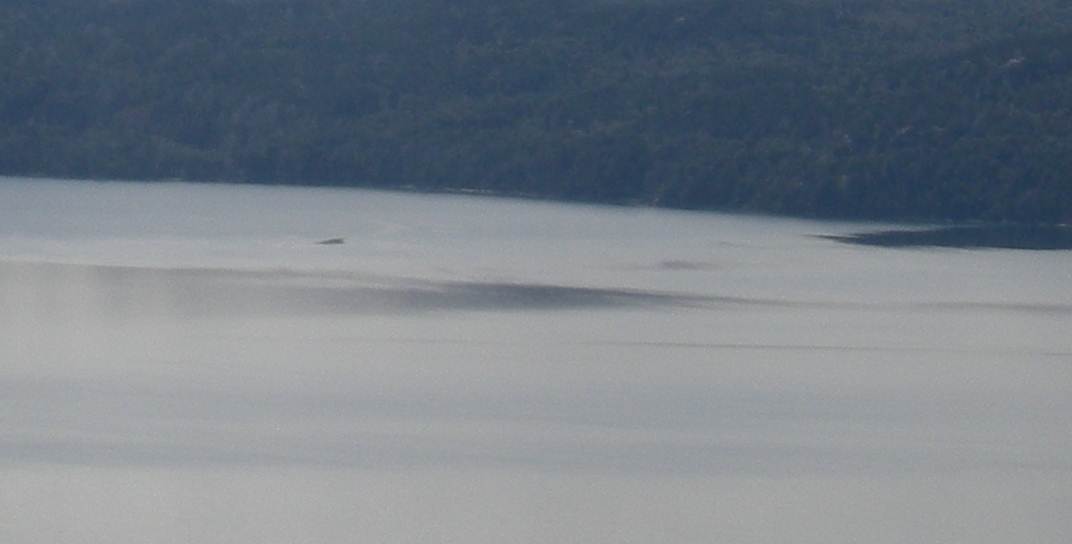
The reason I wrote about the big fish 36 years later, is because, if you take a good look at the photo above, in the central part of the image, close to the northwestern shore, by the mouth of Millaqueo Stream, you will see an odd thing on the lake's surface. Below is the zoomed image:

ripple on lake
Detail showing "circular ripple" at Millaqueo Bay. Copyright © Austin Whittall 2011

The lake is perfectly calm except for this circular shaped ripple, which is quite big considering how far away it is from my observation point!.

Perhaps the "big fish" is still alive and kicking!


Patagonian Monsters - Cryptozoology, Myths & legends in Patagonia
2011 International Year of Forests
2011 International Year of Forests Copyright 2009-2011 by Austin Whittall © 

Saturday, November 5, 2011

Culebrón in Neuquén, Lake Polcahue

 
During our recent four day vacation in San Carlos de Bariloche, we stopped by our favorite bookstore to take a peek at what was for sale (they sell second hand books as well as new ones, and they have a wide range of books on my beloved topic: Patagonia).

I managed to buy three jewels. Two old ones:
  • Gregorio Alvarez's El Tronco de Oro, Ediciones Corregidor, 1994.
  • Rodolfo Casamiquela's En pos del Gualicho, Fondo Editorial Rionegrino - EUDEBA, 1988.
And a new one on Rio Negro province's place names: R. Casamiquela (1998), Estudios de la Toponimia Indígena de la Provincia de Río Negro. Ed. del Autor.

The first two are especially interesting since they mention some cryptids. The second one focuses on the Ellengassen monster, also known as Gualicho.

But today I will mention something I found in Alvarez´s book, the Culebrón a snake-like aquatic creature.

On page 247 Alvarez wrote:

At lake Polcahue there is a culebón whose body must be about one meter [3.3 ft.] thick. It appeared after a herd that had rushed to the frozen lake to drink, sank in it. This lake is located close to China Muerta, in a place known as Pulmary. The locals say that Mr. César Fosbery saw it. [1]

Mr. C. Fosbery was a local pioneer (1898-1976)[2]. The name of the lake has two possible meanings:

Polcahue: Deformation of pulcu, a native alcoholic beverage and hue = place. So, it means "Place where there is pulcu". Alternatively, it may derive from "Polca = slippery. Hence: "Slippery place".[3]

You can see the lake at this link leading to Google maps or, at another scale below:


View Larger Map

The lake drains towards the east through the Arroyo China Muerta (China Muerta Creek) by the way this name (China Muerta) means "Dead" [Muerta] and "Native woman" [China]. Yes, China means Chinese in Spanish, but in the local Pampean and Patagonian dialect it means a native American woman (due to the oriental appearance of the American indians).

This stream drains into the Aluminé River, which flows from Lake Aluminé (to the north of Polcahue). Aluminé River flows throguh the Collón Curá River into the Limay River, and then into the Negro River and into the Atlantic Ocean.

Close by (south) is Lake Quillén with its Cuero lake creature.


Important. The bookstore is: La Barca Libros Usados, on Mitre street, 534. San Carlos de Bariloche.

Sources
[1] Gregorio Alvarez's El Tronco de Oro, Ediciones Corregidor, 1994.
[2] Fosbery Cesar Family tree.
[3] Juan Perón Toponimia Patagónica de Etimología Araucana, pp. 42.
Yes, the (in)famous former President 1946-1951(and then dictator 1951-1955, exile 1955-1972 and again President 1973-1974) of Argentina, whose wife was Eva Perón, (better known as Evita of musical fame). He left us his last wife as Vice President, who upon his death in office on 01.Jul.1974, swore in as President. Her job qualifications were poor (former cabaret dancer) so she lost the grip on things, and one tragedy followed another until on 24.March.1976 the military took over and ran the country until 1983. In the meantime they did horrendous things (disappearing people, torturing women, giving away the babies of people held in custody. Genocides and murderers). So yes, I do blame Perón for his ill choice of his running mate! He could have chosen someone with experience, but no, he left us his cabaret dancer wife "Isabelita" (yes, she even had a "nom de guerre") María Estela Martínez de Perón.
Enough history for today. It makes you wonder who are the real Monsters.


Patagonian Monsters - Cryptozoology, Myths & legends in Patagonia
2011 International Year of Forests
2011 International Year of Forests Copyright 2009-2011 by Austin Whittall © 

Sunday, October 23, 2011

My photos of "Nahuelito"

 
In a recent post I wrote that during my trip to Bariloche I had taken some photographs of a strange thing in Lake Nahuel Huapi.

The sequence is shown below, the first photo shows the view, looking North,from the summit of Cerro (Mount) Campanario, a solitary mountain 1.050 m high (3,442 ft.), which gives a great 360° view of the Lake and its southeastern coast. It is located 17 km (10.6 mi.) from Bariloche and 3 km (2 mi) from my family's cabin. We took a walk on Oct. 8, and rode up the mountain on a chairlift. The day was lovely, slightly cloudy, not windy and sunny. The lake was calm and the view great.

We looked at the lake and the scenery and took some pictures. Then I saw what I thought was a boat on the lake, close to Huemul Peninsula, between it and Victoria Island. It stood out as a dark dot on the calm lake which moved slowly, too slowly for a boat. I took several photographs (numbered 1 to 4). Now, looking at them, they seem to show a rippled lake surface which reflects the mountains in the back, hence the dark reflection on the lake surface. It was not a boat, it was the reflected forest.

However, photo 5 shows something else (clearly seen in photo 5 and its zoom):

It is a minute dot, a triangular shaped dark object towards the right of the central part of the photo. It is seen in photo 6 and then it is gone, it does not appear in the remaining photos.

Options: Possible explanations and my estimated probability.

1. Another reflection of the mountains... 95%
2. Some sort of wave... 5%
3. Nahuelito surfacing... 0%

Sorry, but I am a skeptic, even if I see it myself. Perhaps, if I had taken my binoculars I could have seen it better and been able to give a better explanation.

nahuelito sequence

The detailed photos are these:
Photo 1: General view of the area, the remaining photos concentrate on the region within the red circle.

nahuelito sequence
Photo 2:
nahuelito sequence
Photo 3:
nahuelito sequence
Photo 4:
nahuelito sequence

Photo5: "Nahuelito" is the tiny dot, a small dark "wedge" on the central right part of the image.
nahuelito sequence
Zoom on Photo 5:
nahuelito sequence
Photo 6:
nahuelito sequence
Photo 7:
nahuelito sequence
Photo 8:
nahuelito sequence

If you want a copy of any of these photos, I can send you the originals.
The original high definition photo 5 is below:
nahuelito sequence


Patagonian Monsters - Cryptozoology, Myths & legends in Patagonia
2011 International Year of Forests
2011 International Year of Forests Copyright 2009-2011 by Austin Whittall © 
Hits since Sept. 2009:
Copyright © 2009-2025 by Austin Victor Whittall.
Todos los derechos reservados por Austin Whittall para esta edición en idioma español y / o inglés. No se permite la reproducción parcial o total, el almacenamiento, el alquiler, la transmisión o la transformación de este libro, en cualquier forma o por cualquier medio, sea electrónico o mecánico, mediante fotocopias, digitalización u otros métodos, sin el permiso previo y escrito del autor, excepto por un periodista, quien puede tomar cortos pasajes para ser usados en un comentario sobre esta obra para ser publicado en una revista o periódico. Su infracción está penada por las leyes 11.723 y 25.446.

All rights reserved. No part of this publication may be reproduced, stored in a retrieval system, or transmitted in any form or by any means - electronic, mechanical, photocopy, recording, or any other - except for brief quotations in printed reviews, without prior written permission from the author, except for the inclusion of brief quotations in a review.

Please read our Terms and Conditions and Privacy Policy before accessing this blog.

Terms & Conditions | Privacy Policy

Patagonian Monsters - https://patagoniamonsters.blogspot.com/