The CueroSome time ago In my post on
Nahuelito I mentioned the Mapuche native's “
Cuero” myth, but it was merely a short comment and I did not go into the matter in depth.
I am aware that the “
Cuero” is often mentioned as an explanation for the
Nahuelito phenomenon and also as proof of the great antiquity of its existence (back to pre-Hispanic times). Most web articles are quite superficial and merely copy and paste from similar websites. Furthermore, some cryptozoology sites and books have a fuzzy and unclear notion regarding this interesting cryptid.
Additionally all of the sources that mention the
Cuero are written in Spanish and are unavailable in English.
For these reasons, and being perfectly fluent in Spanish, I have decided to go to the sources, translate them myself and post them here so that all can read them and each one form his or her own opinion on the matter.
Some
images showing what the Cuero looks like.
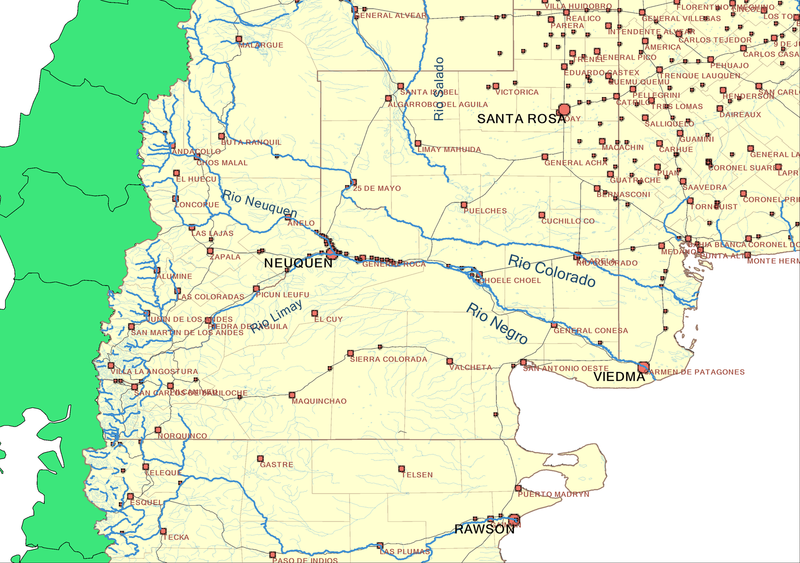
Map.The following map shows the places that I will mention in today's post. In green is Patagonia, the blue line at its northern border is the Colorado River, which runs from the Andes to the Atlantic Ocean. In Yellow is the habitat of the South American freshwater stingray. Atacama and Coquimbo in Northern Chile are the home of a similar named but totally unrelated cryptid (the
Huecú). To the south inside the dull green ellipse is the
Cuero's habitat.
Notice how it is restricted to what was once the land of the Mapuche people. Further south, in the land of the different Tehuelche pepople, the myth did not exist (see the following map that shows the original distribution of the Patagonian natives).

Geographic location of the Cuero and other places mentioned in this post. Copyright © 2010 by Austin Whittall.
"Cuero". SourcesOldest references.Cuero, in Spanish means “hide” a “skin” of an animal. The Mapuche had another name for it,
Trelque huecuve or
Trelque lafquen or
Trelque leufu the first part of the word
Trelque is Mapuche for
hide and “
huecuve”, “
laufquen” and “
leufu” are “evil spirit”, “lake” and “river” respectively. So they knew it as “evil spirit hide”, “lake hide” or “river hide”.
I have not been able to find any printed report on the “
Cuero” prior to 1810. The chronicles of the Jesuit and Franciscan missions (Nahuel Huapi and Rucachoroi) in the Araucanian region of Chile and in what are now the provinces of Neuquén and Rio Negro in Argentina do not mention it.
See my post on
these books that don't mention the "Cuero".
Note that many missionaries lived in this area between 1670 and 1718, others explored the area in the 1750’s and 1790’s: Nicolas Mascardi, José de Zuñiga, Juan de Olivares, Felipe de la Laguna (Philliphi van den Meeren), Juan José Guillelmo, Manuel de Hoyo, Arnold Jaspers, Francisco Menéndez and Bernardo Havestadt. But not one of them mentioned the “
Cuero”.
It was first mentioned by Father Juan Ignacio Molina, the first European naturalist to describe Chilean animals in his scientific book “
Essay On The Natural History Of Chile” (1810). He noted that (Bold font mine):
Reproduction of page 233 of Molina’s book. From [1].
The locals assure that in certain Chilean lakes there is an enormous fish or dragon, that they name Ghyryvilu, that is, Vulpangue or fox-snake, which, they say, is man-eating and for this reason they abstain from swimming in the water of those lakes.
But they are not in agreement the appearance that they give it: now they make it long, like a serpent with a fox head and now almost circular, like an extended bovine hide. If it was so, it would come to be species of Manta of a monstrous race. [1]
From this text we can ascertain the following:
1. There is a lake creature that resembles “
an extended bovine hide”, and Molina believes that if may be some kind of gigantic stingray (or
Manta).
2. The other creature the
Ghyryvilu or
fox-snake which is “
like a serpent with a fox head” is indeed another animal, a different being. The natives had different names for it.
I have posted on this creature
Here, but bear in mind that the mythical
Nguruvilú (also known as Nirribilo, Ghyryvilu, etc.) derives its name from the Mapudungun words “
nguru”= fox and “
filu”= snake, hence “fox - snake”, which is a very close description of this beast.
We will focus on the “cow hide” creature (which in Spanish is a “
Cuero”) and leave
Nirribilo for a later post.
A void of nearly one centuryAfter the missions closed due to Mapuche hostility, the area remained unexplored for another 60 years. Only one expedition reached Neuquén from the east, it was led by Spanish pilot Basilio Villarino (1782-83). He did not mention the native myths.
From the west, Chilean explorers Francisco Fonck and Fernando Hess (1856) and Guillermo Cox (1859) also explored the region but did not mention the
Cuero. English traveler George Musters (1869) followed by Francisco Moreno (1870s) came again from the Atlantic coast. None saw anything. Then the Argentine forces occupied Patagonia in a series of military campaigns between 1879 and 1884. None of the official reports mention the
Cuero.
I also posted on the
books written by these explorers, none of which mention the "Cuero".
Nearly one hundred years after Molina published his essay, Chilean folklorists and linguists began scouring the Mapuche land gathering their myths and folk stories. Among them were professor Tomá Guevara (1863-1938), linguist and philologist Rodolfo Lenz (also born in 1863 and deceased in 1938), Francisco J. Cavada (1864-1950) and author and folklorist Julio Vicuña Cifuentes. (1865-1936). Later, ethnologist and archaeologist Ricardo E. Latcham (1903-1965) followed up on their work.
They interviewed the natives and recorded their oral traditions before they were diluted by foreign Western elements after the conquest and destruction of the Mapuche way of life when Chile occupied the region of Araucania in the late 1800’s.
An exclusively Mapuche mythI must point out that the myth is exclsively found in the territories that formerly belonged to the Mapuche people or the "
Araucanized" Tehuelche groups that absorbed their language and some of their myths. It is not found further south among the Southern Tehuelche groups (i.e. south of the Senguer, Chico, Mayo rivers in Chubut province). I base my assertion on my posts (and still unpublished entries) on "lake monsters" in Southern Patagonia: there are creatures in these lakes, but none are "
Cuero".
Tomás Guevara and the Cuero.Guevara wrote in 1908 [2] about the creature and even included an image of it (see below), that looks like a cow hide with “thorns” around its edge:
Reproduction of pages 322 and 323 of Guevara’s book. From [2].
The text says (Bold font mine):
Trelquehuecufe (hide huecuve [*]) is what the Indians call an octopus the size of a calf’s hide, armed with claws all around it. It inhabits the depths of lakes and rivers, where it takes men and animals bathe or cross those parts and it kills them by means of an irresistible contraction. Mapuche that falls into the deep sinking and does not appear on the surface because he has become tangled in submerged trees or muddy [river] beds, has been taken by the trelquehuecufe.[2]
From the text we can conclude that Guevara believed that:
1. Cuero and what he calls “
Nguruvilu” are different beings as can be seen in the image above: after the
Cuero he writes about the “fox-snake” myth and also depicts it differently (the cat headed long tailed being drawn to the left of the cow hide is a fox-snake) .
2. Iit is an “octopus” which is “
the size of a calf’s hide, armed with claws all around it”.
Cavada and the Cuero.Francisco J. Cavada in his book “
Chiloé y los Chilotes” published in 1914, [3] calls the animal
La Manta or
Cuero. Below is his text and its translation:
Reproduction of page 104 of Cavada’s book. From [3].
La Manta [*]
Is the octopus named Cuero in other parts of the country. The islanders depict it as an extended hide that folds upon itself to grab and wrap up its prey.
When a person or an animal go into the water, the Manta rises and, draping it with strength, it drags it to the bottom and devours it.
It is the terror of bathing children.
This belief is widespread in the country [Chile] because it extends up to Chiloé.
You can look up about the Manta with Mr. Tomás Guevara and Doctor Rodolfo Lenz.[3]
[*]
Manta in Spanish means blanket, mantle, cover. Which gives a clear idea of its body shape (flat, wide and thin).
Comments:
1. Cuero and
Manta are the same (the latter is the local name it gets in Chiloé).
2. Like Guevara, he believes it is an octopus. Was he basing his comment on first hand experience or merely transcribing Guevaraás prior work? I do not know.
Vicuña Cifuentes and the Cuero. Reproduction of pages 335 to 337 of Vicuña Cifuentes' book. From [18].
He calls it
Huecú and describes it as follows:
aquatic, it lives in deep and lonely lakes which now do not exist […] it is an animal “shaped like a goat skin, overo [with white spots] brown or overo-black color”. It frequents the water surface, basking in the sun or awaiting its prey, that it traps with “its breath”, wraps with its “garreos” [claws] and submerges to devour it. The cattle that drinks at lakes where there are Huecú […] are seduced by the aquatic animal and give birth to offspring so ugly that they instill fear. [18]
He mentions that it can be killed with the thorny
quisco branches. That it is dangerous to kill if on the shore because it
"has a lot of strenght and drags one with horse and all [into the water]”.
In northern Chile, Atacama and Coquimbo, the name
Huecú is applied by the miners to another kind of spirit. This is not the Mapuche lake creature, but another kind of being which Cifuentes mentions only because it has the same name. Not because it is the same creature. [18]
Latcham and the Cuero.In 1924, Ricardo Latcham wrote about the Relgious beliefs of the “Araucano” people (now the term Mapuche is favored), and he also mentioned the “Cuero”: [4]
Reproduction of pages 575 and 576 of Latcham’s book. From [4].
He wrote not only what he had investigated but also cited Lenz and Guevara, below is my translation of his text:
The trelque or trelquehuecuvu [*] is a myth known among the Chilean people by the name of manta or cuero. It is an amphibian animal that has the shape of a cow or sheep hide, whose border is surrounded by hooks or long nails. It lives in the water and rarely comes out to the shore. It grabs hold of men and animals that cross or bathe in the neighborhood of its lair, it wraps them up, holding them with its claws and by constriction, kills them.
Lenz gives them the name “chueiquehuecuvu – fabulous animal of the Chilean mythology, that lives in the water and harms those who pass by or bathe. It can only be hunted with a noose of lleivún (fibrous plant). These monsters are also named cueros and mantas, due to the vague shape they have.
According to Guevara, when it comes out on the shore to bask in the sun’s heat and wants to return to its usual habitat, a whirlwind is produced, that pushes it back towards the water.
In the north of the country [Chile] where they call it huecú, they say that it can be hunted, throwing into the water where it is found, auiscos (chunks of thorny cacti) , with which, when it rolls up, it pierces itself, gets tangled and dies.[4]
Explaining the Beast.Latcham goes on and gives his point of view on what this creature actually is: [5]
Reproduction of page 610 of Latcham’s book. From [4].
Latcham above, states that:
the myth […] must have originated from squid (Sepia tunicata, Mol. O Omastrephes gigas) of the Chilean seas. This mollusk can measure up to 1,2 meters (3.9 ft.) long without taking into account the length of its tentacles or arms, of which it hast ten, eight short and two longer ones, whose lower surface is provided with suction [pads]. Its body is wrapped in a skin seath called manto, joined on its dorsal side and free on the ventral [part]. Molina speaks about another larger species that he calls Seppia unguiculata[*], and that ‘instead of a suction pad it has its legs (tentacles) armed with two rows of claws or sharp nails similar to those of cats that it withdraws just like that animal in a kind of sheath … but is not very common in those seas’.
It is likely that he learnt about that species only by references and mistaking it for the myth of the trelque or manta, he gave it nails instead of suction cups...
[*] Latin name that means “clawed” Seppia or “giant squid” which can measure up to 2 meters (6.5 feet) in length is also known as Taningia danae.
Before we look into the squid or the stingray option, I want to transcribe another sighting:
A sighting ca. 1967 at Media Luna.César Fernández recorded this story in 1989, it was told to him by Luciano Huenufil at Aucapán in 1987:[16]
Reproduction of page 44 of Fernandez’s book. From [16].
The Cuero appears in the pools, in the lake or in a lagoon. There still are. IT wraps one up and takes you under the water. He who knows how to defend himself takes out his knife and stabs it.
Lafquén Trilque is [its name] in the language.
It makes like a noise, like a wind storm when it passes by.
At Media Luna [*] there was a case. It happened a long time ago, more than twenty years. The woman was washing by the shore of a stream and had mad a fire where she had a pot. She felt around her a very strong wind, that began suddenly. It took everything, it went over the fire and left nothing, no sticks, no embers, nothing. It also took the clothes.
The woman managed to run away. So she said.
It was a cow hide that made wind and destroyed everything.
[*] Map
online here The “
still are” part is interesting, it seems to imply that the animal is not very common maybe on the verge of extinction.
The second part of the story gives the creature supernatural powers (tornado-like); this is surely some embellishment on the original myth because the tornado is actually another Mapuche myth, the
meulén or dusty whirlwind, which is caused by wizards or witches who stalk people. [17]
RaysThe shape of the
Cuero wide, slender, thin and its aquatic habitat are very like those of a stingray. Molina and Latcham must be right.
Giant dead stingrays washed upon a beach would surely impress any Mapuche who stumbled upon it. That is the kind of stuff that myths are made from.
There are several varieties of sea rays in Chile:
Dipturus chilensis,
D. trachyderma, as well as the enormous manta rays
Myliobatis chilensis and
Mobula tarapacana.
Yet these are all marine animals not freshwater creatures (which is what they would have to be in order to live in Patagonian lakes and rivers).
Freshwater rays.South America is home to the the
Potamotrygonidae freshwater rays. These are not found in Patagonia, but they are closely related to the
Dasyatid rays that
often venture into freshwater in several parts of the world; one of these species can be found off the Chilean Patagonian coast.
Could some of these Dasyatids swim up the Chilean Patagonian rivers into the Andean lakes and thus have originated the
Cuero myth?. Maybe. But if they did, they would not survive in such an environment because they are adapted to highly saline sea water furthermore, they live in "
all temperate and tropical seas, and some species enter tropical and warm-temperature rivers and lakes" but, not cold water lakes or rivers (like those found in Patagonia).
Freshwater rays in Patagonia?I have read an entry in Eberhart’s excellent book [6] on “
Mysterious Creatures” which mentions that “
giant freshwater rays were seen in 1976” at Lago Gutiérrez, Rio Negro Province.
Reproduction of pages 689 of Eberhart’s book. From [6].
This same 1976” incident is reported in detail by Sebastián Jarré[7][8] yet at a different location: Lake Moreno.
Lakes Moreno and Gutierrez are quite close to each other (8 km – 5 mi.) and both flow into Lake Nahuel Huapi, the map below shows the site of the 1976 accident (red circle) a very narrow stretch of road carved into a steep cliff that skirts the lake.
Lakes Moreno and Nahuel Huapi, Gutiérrez. From Google Maps, Online. Adapted by the author.
According to Jarré:
1976, a tourist bus falls of a cliff at Lake Moreno. A team of divers is sent to the rescue. And according to their testimony, while they were probing for the vehicle ACCIDENTADO, they had seen the presence of large sized rays on the lake’s bottom […] at that time, the then chief of the Prefectura Naval [Argentine Coast Guard], Principal Prefect Walter Hormastorfer, confirmed this account, though with some tenuous geographic variations. [7] [8]
The above sighting of freshwater rays in a Patagonian lake is an amazing piece of news. Why? Because they are no known rays in Patagonia.
However no reference or source is given, I was not able to follow up on the report.
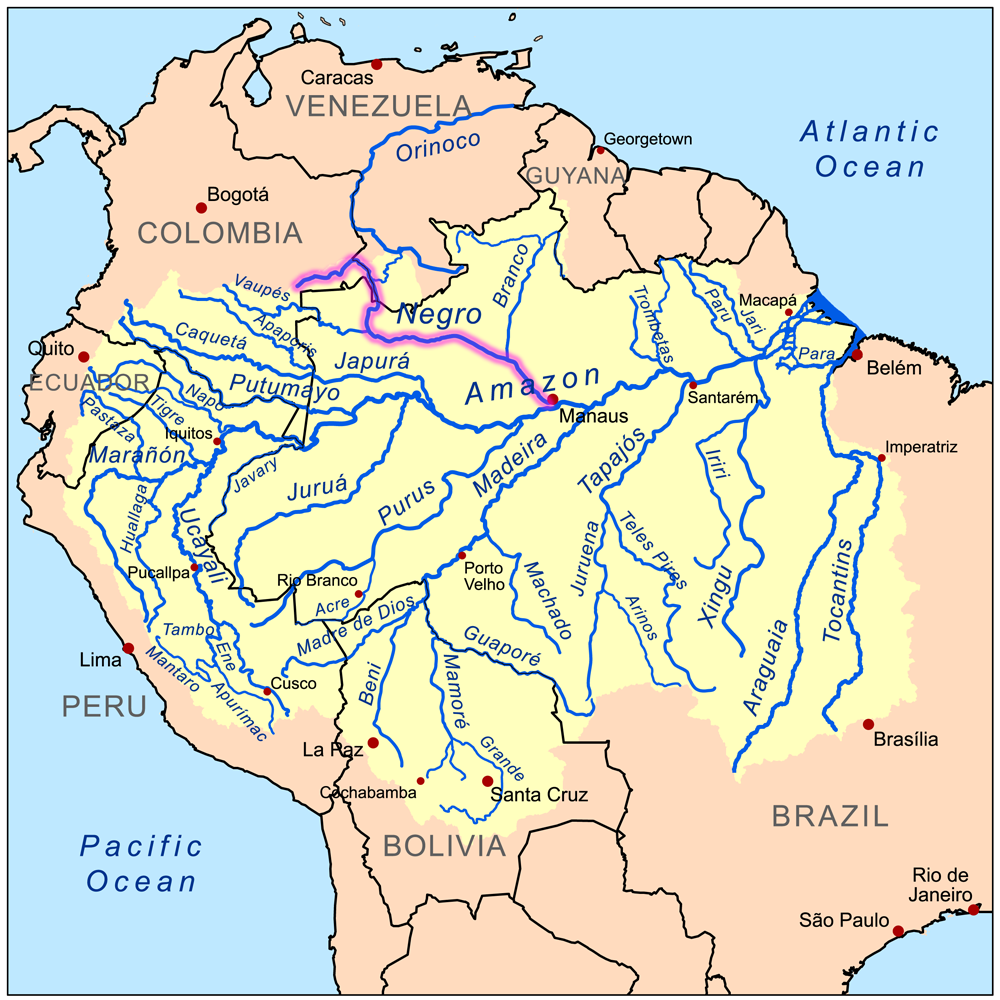
It is absolutely correct to assert that there are freshwater stingrays in the Rio Negro. But I must add that not in the Patagonian Rio Negro (
map here) but in the Amazonian Rio Negro[15], which flows into the Amazon close to the Brazilian city of Manaus (
map here).
Why?
There are only on family of freshwater stingrays in the whole world, these are the
Potamotrygonidae and they live in South America, but the closest that they get to Patagonia is over 1.600 km (1,000 mi.) to the north in the Paraná River basin. See the following map in which Patagonia is shaded yellow and the rays’ habitat is shaded black:
Distribution of Freshwater Stingrays and location of Patagonia. Adapted From [9].
The map clearly shows that Patagonia is not close to the freshwater stingray's habitat.
These rays live in temperate to tropical rivers and have a sharp spike on the rear of their tail which they use for self-defense. If stood on by an unaware person wading in the water, they bend their tail and strike with their sting inoculating poison; this causes a very painful wound that is slow curing and can ulcerate. They can grow quite large, up to 1 m (3.3 ft.) diameter and have an elliptical shape; however none have “claws” along their edges. Yet, interestingly, their disk-shaped body can be covered with small denticles (small to large thorns) which are tooth-like in structure and covered with a tough enamel.[9]
Could they live in the cold Patagonian lakes? Temperature gradient at Lake Nahuel Huapi. From [10].
Lake Nahuel Huapi’s surface temperature oscillates between 7 and 10.5°C (44.5 and 51°F) and it is really cold, as anyone who has taken a dip in the lake can attest.
The deeper you go (i.e. where the rays allegedly live) the colder it gets.[10]
Finally, take a look at the 2009-2010 Continental Patagonian Fishing Regulations [11], which describe
all the fish you can find in the area. No rays are mentioned.
Nevertheless, I have posted on sightings of this cryptid in the following lakes:
Lacar Rosario Carrilaufquen Yelcho Quillen Lolog Paimun, though this lake's cuero is amphibian.
FutalaufquenAnd it has been reported in other lakes (I haven't posted on them yet) such as Lake Ranco: this lake (40°11’ S, 72°22’ W) is set very low (65 m – 213 ft. above sea level) and has a surface area of 442 km2 (171 sq. mi.). It is notorious for
Cuero sightings. A compilation of contemporary Mapuche women anecdotes mentions Lake Ranco’s Cuero as follows: “
cat-like nails all around it. In the past, more were seen, in the inlets […] of all colors, and also of all sizes, and there are big Cueros too and these Cueros in the water are super strong”.[12]
Closing comments.I said that I would provide the information (yet I ended up saying that Patagonia is too cold for rays!). To summarize the post:
- No written reports on the "
Cuero" before 1810.
- Mapuche myth only. I have not found any other information beyond what was gathered in Chile in the early 1900s.
- Other Patagonian natives did not report the "
Cuero" or have similar mythical beings.
- If the Mapuche migrated long ago to Chile from the Amazon basin (see my post on the
possible ties between the Mapuche and Guaraní people) they may have brought traditions referring to stingrays found in their original homeland.
- Some liken it to a squid or octopus, others to a stingray.
- Squids and octupus are salt water creatures. They could not live in the Andean lakes.
- South Pacific stingrays may wash up on the shore and may swim up a river (but not live there). This may have originated the myth.
- Salt water and freshwater stingrays prefer warm habitats. Patagonian rivers and lakes in the Andean region are cold.
- Freshwater stingrays native to South America are about 1600 km (1,000 mi.)away from Patagonia. This would bar them from entering Patagonia.
- Only one unverified report on stingrays in Patagonia, no source given.
- Not one scientific paper on the subject. No rays mentioned in Patagonia in any of them.
A less skeptical point of view.I have been over skeptical until now and you may think that I am biased against stingrays so I will look at the options:
a. Slim, flat, flexible and wide aquatic being:
- not a fish (spindle shaped, scaly, shiny, with fins and tail does not fit the description of the "
Cuero").
- mammal? unlikely as no one reports legs (only claws), though described as a hide it is not described as hairy (the hide resemblance is used to indicate the shape, not the texture).
- reptilian? same objections, no known reptile is wide, slender and flexible (not a turtle or a tortoise).
- Rays do resemble this being but lack claws (only denticles as mentioned above).
- Squid too. Could the tentacles be mistaken for claws?
b. Assuming it is a freshwater ray, how did it reach Patagonia?
- As posted previously, there was a
connection between the Colorado river and the River Plate / Paraná River basin. Freshwater stingrays could have swam up stream along the Colorado to the Andean region.
The Colorado basin is not linked to the basin of the Negro, Neuquén, Limay rivers (into which most of the Northern Patagonian lakes drain), so rays could not have swam between them. But at least it places them in the region.
- Could ray eggs have been transported on the feet of water fowl (i.e ducks, huala, swan?). I don't know if this is applicable to rays, but I have found an article online [13] that indicates that fish eggs can be transported in the crop of birds.
Now the bad news, stingrays don't lay eggs, their eggs develop and hatch inside the female’s body. The pups come out alive. [14]
- Maybe a bird capturing one let it drop accidentally in some stream or pond. If this happens repeatedly, then a new population could be established in another river stystem not connected to the original habitat.
- Other fish live in cold water, stingrays could have adapted to live in Patagonian lakes and rivers.
- Not seen now but seen in the past. Why? Salmonids (see my post on
how they displace local fish) are aggressive predators and have endangered most local fish species. Could they have led stingrays to extinction in Patagonia?
- Only a Mapuche myth, it is not found further south. Why? Because the colder weather was an effective barrier to their dispersal into that area. The Tehuelche lived in a region where there were no stingrays so they did not have any myths regarding these animals.
Let each reach his or her own conclusions. (My apologies for the length of this article). A I gather more evidence, I will keep updating this post.
Thanks!.
Bibliography.[1] Molina, J., (1986).
Ensayo sobre la historia Natural de Chile. Santiago: Ediciones Maule. pp. 233
[2] Guevara, T., (1908).
Psicolojia del pueblo araucano. Santiago: Imprenta Cervantes. pp. 322-323. Read it online:
[3] Cavada, F., (1914).
Chiloé y los Chilotes. Santiago: Imprenta Universitaria. pp.104.
[4] Latcham, R., (1924).
La organización social y las creencias religiosas de los antiguos araucanos. Santiago: Cervantes. pp. 575-576.
[5] Ibid. pp. 610.
[6] Eberhart, G., (2002).
Misterious Creatures: A guide to Cryptozoology. S. Barbara: ABC Clio. pp. 689.
[7] Jarré S., (2008).
Online.
[8] Jarré, S., (2004).
Guarida de Monstruos. La Rosa de los Vientos. A° 1. N° 3.IV: 2+
[9] Berra, T. M., (2007). Freshwater Fish Distribution. University of Chicago Press. pp. 20+ Online.
[10] International Lake Environment Committee.
Lake Nahuel Huapi [11]
2009-2010 Continental Patagonian Fishing Regulations.
[12] Guerra, M., et al., [Comp.], (1999).
Las ñañas. Santiago: LOM Ed. pp. 49.
[13] Malone, C., (1966).
The Wilson Bulletin. June 1966. Vol. 78, No. 2. pp. 227
[14] Oldfield, R,G.,
Biology, husbandry, and reproduction of freshwater stingray [15]
Online.
[16] Fernández, C., (1995).
Cuentan Los Mapuches. B. Aires: Ediciones Nuevo Siglo. pp. 44
[17] Barreto, O., (1996).
Fenomenologia de la religiosidad mapuche Editorial Abya Yala. pp. 25.
[18] Vicuña Cifuentes, J., (1915).
Estudios de Folklore chileno. Mitos y supersticiones recogidos de la tradicion oral chilena, con referencias comparativas a los de otros paises latinos. Santiago: Imp. Universitaria.
Further reading:Evolution of Freshwater stingrays Excellent
maps showing ray distribution in the River Plate basin. Fundación Proteger .
On
dasyatidae.
Copyright 2009-2010 by Austin Whittall ©Patagonian Monsters Cryptozoology, Myths & legends in Patagonia