Translate

Guide to Patagonia's Monsters & Mysterious beings

I have written a book on this intriguing subject which has just been published.
In this blog I will post excerpts and other interesting texts on this fascinating subject.

Austin Whittall


Showing posts with label denisovian. Show all posts

Tuesday, July 23, 2013

Denisovans, Neandertals and the peopling of America


Skoglunda and Jakobssona postulated in a paper [1] published in 2011 that the apparent inflow of archaic genes into modern humans in two separate episodes (one involving Neandertals and the other Denisovans) is not totally correct, at least regarding Neanderthals.


Their computer simulations suggest that an archaic admixture event (not out of Africa, but in Africa) would result in the current pattern of higher similarity with Neanderthals the further you go from Africa.


This would be caused by genetic drift and ascertainment bias, and the outcome is "artificial differences between populations that have exactly the same admixture history." [1]


However the Denisovan genes in Austronesians and South East Asians could not be explained away by the same cause and the "results suggest admixture between Denisovans or a Denisova-related population and the ancestors of East Asians..." [1]


Comment


Ascertainment bias is a systematic distortion in measuring the true frequency of a phenomenon due to the way in which the data are collected: the sampling may cause some members of the population to be less likely to be included in the sample than others. This distorts the randomness of the population, which is not equally balanced or objectively represented.


The study


Their study defines two principal components (PCs) using Denisova, Neandertal, chimpanzee and modern human data.


They obtained a PC1 component which describes general genetic similarity to archaic humans (genomes of both Neandertals and Denisovans - it separates the archaic humans from chimps) and a PC2 which contrasts genetic similarity between Denisovans and Neandertals (it separates Denisovans from Neandertals).


Findings


They detected:


  • That moden humans can be grouped into three clusters: Africans, Oceanians and the other non-Africans. See Figure 1B below
  • That PC1 and PC2 were correlated with geography in America and Eurasia, they find this incompatible with existing admixture theories since they expect homogeneous admixture of archaic ancestry in all non-Africans.
  • The "East Asian [...] and Native American [...] populations were found to be more similar to archaic hominins compared with European and Central/South Asian populations"
  • Also the further the populations were from our African homeland, the greater the "archaic ancestry signal". Seen in Fig. 1C

Figures taken from [1].


human groups

Notice in 1B how Native Americans are closer to Neanderthals and further from Denisovans (to which the Oceanians are closer).


Fig. 1C, also shows that both these groups have a greater "signal" of archaic ancestry. (Click on image above to enlarge)


archaic ancestry

Fig. 1D, shows a high Denisovan frequency in Oceania and South East Asia as well as the expected high Neandertal frequency in their former homeland (Europe and Middle East, North Africa), but unexpectedly high in Central America, Mexico and northern South America.


They suggest that these Neandertal genes came to America after its discovery by Europeans with the influx of settlers from that region ("individuals that were skewed to having European ancestry" [1]), and they add that the "remaining pattern of increased signs of archaic ancestry in American populations more distant from Africa is in line with the joint effect of ascertainment bias and genetic drift" [1].


It could also be possible that Neandertals migrated to America and settled there in Mesoamerica, admixing later with modern humans who migrated to America later through Beringia.


Surprisingly the authors state that there is an "apparent absence of Denisova ancestry in Native Americans" is probably due to the bias that makes Neanderthal genome higher in America due to genetic drift and the ascertainment bias.


denisova neandertal content

As far as I can see, there is a high Neandertal frequency but also a high Denisovan one too.


Taking a look at Fig 1E, which replicates the same data as Fig 1D in Europe, SE Asia and Oceania, it clearly shows a high Denisovan frequency in Northwestern South America (Colombia, Ecuador)


Why?


Could it be due to an influx of SE Asian navigators' genes in the region (a junk sailing across the Pacific from China to Peru? or does it reflect an ancient migration of Denisovans into America long before modern humans ventured into the region to admix there, in America, with this relict Denisovan population?


If the latter was the case, then it is not a statistical artifact (bias in sampling), but a "real" admixture of genes. The Lack of Denisovan genes in Northern Asia is due to the fact that these genes did not arrive in America via Beringia carried by modern humans, they came long before, inside the bodies of the migrating Denisovans.


The authors however elaborate further by saying that if Americans lack Denisovan genes then their ancestors left Asia before admixture and, tainted with what I call the "recent-peopling-of-America-bias" they place this event some 14- 30 kya.


The maps clearly show an "island" between Mexico and Ecuador where there is a higher proportion of both Neanderthal and Denisovan genes in America. Is it due to a statistical bias? or is it faint proof of the ancient peopling of America by those archaic humans?


Our next post will deal with some odd skulls that were discovered in that region of South America, in Ecuador, and a possible link to H. erectus.


Sources


[1] Pontus Skoglunda, and Mattias Jakobssona, (2011) Archaic human ancestry in East Asia. www.pnas.org/cgi/doi/10.1073/pnas.1108181108
Patagonian Monsters - Cryptozoology, Myths & legends in Patagonia Copyright 2009-2013 by Austin Whittall © 

Tuesday, November 22, 2011

Yeti nests


View Larger Map
Map showing Kemerovo. Altai is between it and Urumqi.


Recently, I have been following some articles online regarding the Siberian Yeti. I am skeptical about this particular Yeti, but I want to share it with my readers.

Siberia is quite far from Patagonia yet both places share some common features which may link any hominids in one place with those in the other:

  • Empty spaces - not crowded with human beings
  • A relatively unpolluted and natural environment
  • A similar environment: mountains, forests, lakes and steppes
  • Myths regarding ape-men
  • Similar people (Central Siberia is the alleged home of the native American people) - perhaps similar myths?

As Siberia is the home of Denisovans and Neanderthals also lived in Western-Central Asia, it is the likely source of American hominid cryptids.

Well, an online article published in the Daily Mail's November 15, 2011 edition, mentions "Yeti 'nests'".

The intertwined saplings shown in the photographs seem to be flimsy evidence and the footprint in the ice may be "man made". Personally I tend to believe that the authorities at Kemerovo Region are fishing for tourists interested in sighting the Yeti and promoting their region as a Yeti haven. (see my Oct. 2010 post about Cryptids and Tourism which mentions Russian Yetis.


On the other hand, as you can see in the map above or int the map of Kemerovo published in the article, that it is very close to Altai (where Russia, Mongolia, China and Kazakhstan meet), home of Denisovans.

They have also found some tufts of hair. Lets wait for the DNA tests to reveal who they belong to.

Well, that is all for now!


Patagonian Monsters - Cryptozoology, Myths & legends in Patagonia
2011 International Year of Forests
2011 International Year of Forests Copyright 2009-2011 by Austin Whittall © 

Tuesday, September 27, 2011

Denisovans and America

 
My previous post (first Asians were not erectus) concluded with a reference to a paper on Denisovans which stated that: “ modern humans acquired the HLA-B*73 allele in west Asia through admixture with archaic humans called Denisovan” [1].
Lets dig a little deeper into this HLA allele.

A very uncommon HLA allele

Among all the HLA-B groups (which add up to thirty six ( 36 varieties): B*07, B*08, B*13.... B*83) it is the one with the least quantity of specific HLA halotypes. In other words each of these thirty six groups have their own variations. For instance HLA-B*07 has 124 different allotypes, HLA-B*15 has 221 allotypes.

The one that we are interested in, HLA-B*73 has only two: B*73:01 and B*73:02 (which was detected in only one person in Abi-Rached’s study, so we can set it aside).

Globally its frequency within the human population is quite low, less than 1%, and in most of the world it is closer to zero. But, some places show a very high frequency in comparison to others.

The “raw” data is shown in the following table which combines data from [1] and [3]:

Frequency / Place – ethnic group
(Data from [1] unless indicated otherwise. )
4.90% Parsi
2.30% Israel Jews
2.00% United Arab Emirates
1.10% Cameroon Beti
0.90% Georgia Tiblisi,
0.90% Bulgaria
0.90% Morocco Casablanca
0.90% Burkina Faso Mossi
0.80% Russia Tuva,
0.80% Oman
0.70% Average for SW Asia [3]
0.60% Albania
0.60% Cameroon Bamileke
0.50% Mongolia Khalkha
0.50% Pakistan Pathan
0.50% Iran Baloch
0.50% Tanzanaia Dodoma Kongwa
0.50% Israel Druze
0.50% Algeria
0.40% Average for NE Asia [3]
0.40% Saudi Arabia
0.40% Turkey
0.30% Bangladesh Dhaka Bangalee
0.30% Jordan Amman
0.30% Uganda Kampala
0.20% Kenya Nandi
0.20% Kenya Luo
0.20% Zimbabwe Harare Shona
0.20% Rwanda
0.20% Greece
0.20% Macedonia
0.20% North America, Hispanic [3]
0.10% Europe [3]
0.15% Mexico Sonora, Seri [3]

Comments.

  • We see that it is strongly concentrated in the Middle East and SW Asia, across central and northern Africa and in the Balkans and Caucasus (home of the Dmansi people).
  • There are some local “islands” or “singularities”:

    • in Mexico (the Seri natives). We will look into them later.
    • in Mongolia (close to the Denisovans?)
    • in the Russian republic of Tuva (right next to Altai, homeland of the Denisovans)
  • The highest frequency is in Pakistan (more later)
  • The Israeli Jews and Druze together are second highest.

Some maps

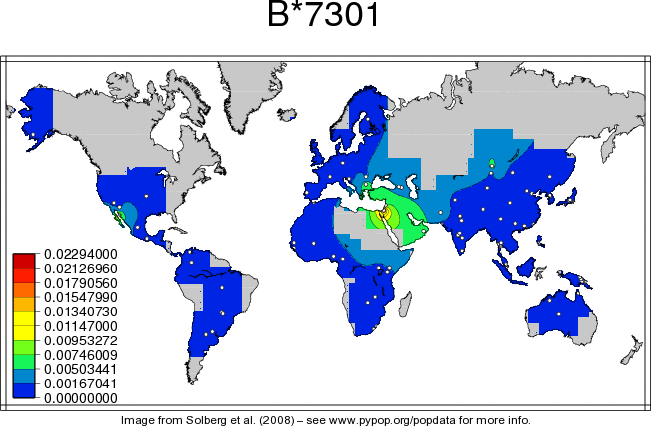
I love maps! As they show things more clearly than a table. Fortunately, all this data was placed in a map by Abi-Rached [1]. In which he shows the Current distribution “A”. Then, trying to explain the anomalously high Pakistan figure, he defines two models which take into account that the Parsi population now living in Pakistan came from Persia, escaping religious persecution. Figure “B” shows one of these models (they are both very similar) which considers the city of Nishapur as the refugee of the persecuted Zoroastrians. There is yet a third map, “C” which shows the global distribution of the HLA-B*73:01 allele, now including Australia and America, as it comes from another source [2] it differs slightly from the data given by [1]. Nevertheless, Maps “A” and “C” are very similar and show the same trend.

HLA-B*73 frequencies
Map showing the global distribution and
frequencies of HLA-B*73:01 (adapted from [1] and [2]
.

Remarks

The maps clearly show some “hot spots” in Mongolia and the Altai Region and an anomaly in Western Mexico (the Seri natives land).

Could the swath across Africa be related to Arab slave trade and possible mixing with locals? Or is it more ancient and shows a returning flow of humans into Africa after acquiring the HLA-B*73 from the Denisovans.

The Balkans, may be due to the Turkish occupation of that area between the 14th and the 19th century.

We see tha China, SE Asia, Australia, Southern Africa and Mots of America and Europe have less than 0.5% frequencies.

So, what does all this mean?

If, as Abi-Rached contends, modern humans picked up the HLA-B*73 allele from Denisovans, they must have “trekked” through Denisovan terrritory. Perhaps the areas where the HLA-B*73 frequency is highest corresponds with the Denisovan homeland: because the humans who settled in the Denisovan territory would have had more time /chances to “mix” with them and breed future generations carrying Denisovan HLA alleles. And from there they would have dispersed to other locations taking the HLA alleles with them.

So, if the maps are correct, Iran is the homeland of the Denisovans. Pakistan’s high figures are just a coincidence, because it is there where the Persian Parsis moved to save their lives.

The Druze and Israeli Jews are also another hot-spot which we will look into later (they are linked to other genetic evidence) , but the high frequency in this region may have two possible explanations:

  • It probably indicates that Denisovans were living in that area along the Jordan River valley
  • Perhaps it reflects the comings and goings of the Jewish people (remember that they were held captive in Babylon (Babylonian exile) after Nebuchadnezzar forced them in o exile after conquering the kingdom of Judah ca. 590 BC. They probably picked up the “Persian” HLA-B*73 during their captivity there, Persia is right next to Israel. Furthermore, after the creation of the state of Israel, many Jews living in Iraq and Iran were forced to move out and migrate to Israel.

Map “C” clearly shows the hot spot centered in the Middle East and fanning out north west into the area where “late” Denisovan remains were later found (Altai). Suggesting perhaps that the Denisovans occupied this area and later were forced to less favorable lands such as Altai and Southern Central Siberia / Mongolia.

Coincidentally this region (Levant, Caucasus and Altai / South Central Siberia) is where Neanderthal remains have also been found. This may just indicate that it was an area where the last remnants of dwindling homind populations found refuge (i.e. Neanderthals and Denisovans).

Denisovans

Since those (H. heidelbergensi?) who would later become Neanderthals and modern humans split from the Denisovans about 1 million years ago, and Denisovans survived until about 30-50 kya, we can imagine that they lived for 1 million years in this same territory. Let’s put this in context and link it to our previous post.

We had said that about 2 million years ago, H. habilis left Africa, settled in the Caucasus and there evolved (1.75 M years ago) into the Dmanisi people Homo georgicus. These in turn led to H. erectus (which peopled Southeastern Asia and China, moved back to Africa and into Europe). The Dmanisi may have also moved on into America and into Flores Island, where they became the local Hobbits.

All of this happened before 1.5 million years ago. Then there is a blank space of half a million years. The next solid evidence is that 1 million years ago, the Denisovans split from the branch that led to modern humans and Neanderthals: the H. heidelbergensis.

What happened in the Dmanisi homeland during the period 1.5 to 1.0 million years ago? Had all the Dmanisi disappeared, becoming H. erectus and migrating to East Asia, Africa (or America)? Did any remain behind, to become the ancestors of both H. heidelbergensis and the Denisovans? Did they die out?

I have not read about any H. erectus fossils being found in South Western Asia, so if the Dmanisi stayed there, and did not become extinct, they had to become something else.

Getting back to Africa, H. ergaster is said to be the ancestor of H. heidelbergensis and of modern humans, so it is them, the H. ergaster who is the most likely common ancestor of Denisovans and the rest of mankind. And, on the “human - Neanderthal” branch, immediately after the Denisovan split, we can fit H. heidelbergensis, see below (it is a revised version of the tree published in yesterday's post):

phylogenetic tree
Revised phylogenetic tree.

This does not tell us anything about the fate of the Dmanisi though. It says that Denisovans split before the appearance of H.heidelbergensis, and marched out of Africa towards the Middle East, settling in South Western Asia where, they would later mix with modern humans and maybe, Neanderthals.

The Seri natives in Mexico

The the Seri language is a linguistic isolate which has no apparent connection with any language in the United States or Mexico. They are only about six hundred Seri left, and a Genetic study [4] seem to link them to the Warao Indians of Venezuela and suggest that the Seri’s ancestors were part of a first wave of migrants into America.[5]

The paper [4] however does not mention HLA-B*73.

There is however more data in Abi-Rached’s paper:

Worldwide, ~98% of people carrying B*73 also carry C*15:05[1]

This C*15:05 (also known as Cw*15:05) as seen in the following maps, is also present in Mexico – see red arrow, as well as all the other Asian regions that have a high frequency of B*73. The maps are from [1] above and [2] bottom and show the same distribution (with the exception of SE Asia, where there is a spot with very high frequency of C*15:05 in Indochina which is not shown in the bottom map.

We have to understand why the Seri have such a high frequency of B*73 and Mexicans of C*15:05 in comparison to the rest of the American Indians.

That will be the subject of a future post.

Map showing the global distribution and
frequencies of HLA-C*15:05 (adapted from [1] and [2]
.

Sources

[1] Abi-Rached, et al. (2011). The Shaping of Modern Human Immune Systems by Multiregional Admixture with Archaic Humans Science 25 August 2011: 1209202DOI:10.1126/science.1209202
[2] Map showing B*7301 dispersion is from This page: Allele frequency net: a database and online repository for immune gene frequencies in worldwide populations. From: Gonzalez-Galarza FF, Christmas S, Middleton D and Jones AR Nucleic Acid Research 2011, 39, D913-D919 and based on Solberg et al (2008) the original is at: http://www.pypop.org/popdata/2008/maps/B-7301.gif
[3] dbMHC Home, NCBI
[4] Infante, E., A. Olivo, C. Alaez, F. Williams, D. Middleton, G. de la Rosa, M. J. Pujol, C. Duran, J. L. Navarro, and C. Gorodezky. ( 1999). Molecular analysis of HLA Class I alleles in the Mexican Seri Indians: Implications for their origin. Tissue Antigens 54:35-42.
[5] Jim Hill, David Yetman, A world revealed by language: a new Seri dictionary and unapologetic speculations on Seri Indian deep history


Patagonian Monsters - Cryptozoology, Myths & legends in Patagonia
2011 International Year of Forests
2011 International Year of Forests Copyright 2009-2011 by Austin Whittall © 

Monday, September 26, 2011

The first Asians were not Homo erectus

 
Although I have been following paleoanthropology through scientific magazines for decades, recent discoveries have overturned what I have previously learned about human dispersion out of Africa. So, before embarking on our “Neanderthal in America” thesis lets brush up on what is currently going on in the hominid field so that we can put things in perspective.

The late Twentieth Century Hominid scenario

What I knew was this: after a long chain of Australopithecines, the first member of genus Homo appeared.
It was the primitive forbearer of mankind,Homo habilis (Latin for skilful man) who lived in Eastern Africa about 2.3 M years ago. They had a small brain (600 cm3) and were quite small (1.3 m - roughly 4.25 ft.) yet they developed a simple stone tool technology known as “Oldowan”. They disappeared about 1.4 M years ago.

Oldowan stone tools were of the “core and flake” variety, in which a stone core was hit with a hammer stone chipping it to produced flakes and leaving a “chopper core” both flakes and core were used to cut, bash and scrape.
It is the earliest (oldest) stone tool industry dating back to about 2.6 M years ago. It was replaced 1.7 M years ago by the more advanced Achulean technology.

If Oldowan tools are found, you can be certain that they predate the discovery of Acheulean tools and therefore belong to a group that predates the inventors of these tools.

About 1.8 M years ago, Homo erectus (upright man) appeared, bigger and brainier (850 to 1,100 cm3) . They were the first humans to leave Africa, as their remains have been found mostly in Indonesia and China. They, in turn were replaced by an out of Africa wave of modern humans some 70- 30 kya. H. erectus produced a more “advanced” stone technology, the “Acheulean” and also learned to use fire.

Acheulean stone tools were also flakes knocked off a core, but these flakes were reworked several times, chipping their edges, to produce a sharp blade. The worked core resulted in a pear-shaped “axe”. The working of the core produced tools which were more symmetric than the Oldowan ones.

The H. erectus stock that remained in Africa is known as Homo ergaster (working man)kept on evolving, producing a group that left Africa and peopled Europe via the Middle East, the H. heidelbergensis (Heidelberg man – where its remains were first found, in Germany), who then evolved ino H. neanderthalensis (After the site of Neanderthal in Germany).

Those that remained in Africa continued evolving, becoming Homo Sapiens, (wise man), modern humans.

The changing picture

That was the neat former picture, but science evolves with new findings at new sites and novel techniques (genetic ones) which have somewhat altered it. Fossils found in Spain, Georgia and Russia plus genetic analysis of hominid remains have redrawn this nice picture.

To make it worse, you should bear in mind that there is little consensus among scholars regarding the relationship between all these hominids as dates are sometimes uncertain or, the fossil evidence is lacking.
Anyway, as I am not a scholar I can allow myself to speculate freely!

Dmanisi hominid

A variety of human dating to 1.75 M years ago, it is also known as Homo georgicus, (Man from Georgia – where it was found). Their small brain size and rounded shape of their skulls places them closer to H. habilis than to H. erectus, and their discoverers wrote:

We suggest that the ancestors of the Dmanisi population dispersed from Africa before the emergence of humans identified broadly with the H. erectus grade.[3]

Furthermore, their tools were “Oldowan” [4] (“primitive”).

Did H. habilis leave Africa first?

The discoverers of Dmanisis suggest that these hominids are a variety of Homo habilis that left Africa, crossed the Middle East and moved on into the Caucasus (Europe and Asia) about 2 M years ago. If so, they were the first “humans” to do so.[2]

H. erectus originated in Asia

They also suggest that the Homo habilis “Dmanisi” evolved in Asia, becoming an “early” variety of H. erectus.[2]

And now things get interesting: they split into different branches of H. erectus, some stayed in Asia and walked east, the ancestors of later Java and Peking men (the H. erectus remains found in Indonesia and China). Others went back, south and returned home to East Africa, originating a more slender African erectus, H. ergaster, who would eventually give rise to us, modern humans.[2]

The map below shows the path out of Africa (from Olduvai gorge) towards Georgia (Dmanisi) of our tiny African H. habilis with his Oldowan tool industry (Red arrow).

At Dmanisi they evolved into H. erectus, who acquired the Acheulean stone tool technology and took it with them back to Africa, but, surprisingly they did not take it along with them in most of their journeys:

  • Eastwards into China and Indonesia (no tools found in Java though, perhaps they used bamboo cane for their tools). Their bones have been recovered from the sites at Sanigran (1.66 M years ago) and Yuanmou Man (1.7 M years ago) , and their tools at Nihewan (1.65 M years ago) however they were “more comparable to Oldowan localities in Africa”. Close to Beijing, later H. erectus remains have been found but the only Acheulean tools found in China are much more recent (ca. 800 kya). Pale blue arrows across southern Asia.
  • West, into Europe, where H. antecessor was found in Spain (Sierra de Atapuerca) where they lived between 1.2 M years ago and 780 Kya. They also used “Oldowan” tools (perhaps they moved west before acquiring the Achulean know-how?). Pale blue arrow through Europe.
  • A third group walked back, through Israel (Ubeidiya site’s Acheulean tools 1.5 M years old) into Africa, across the north (Algiers site at Ain Hanech 1.8 M years ago with “Advanced Oldowan tools”.) the rest moved south back towards East Africa. Pale blue arrows into Africa.

homo habilis dispersion across the globe
Map showing the possible dispersion of H. habilis across the globe.
Copyright © 2011 by Austin Whittall


Hobbits and American ape men

The minute Flores Island “hobbit”, Homo floresiensis is also more primitive than h. erectus, which leads us to ask: Was he the outcome of an H. habilis group that split from those moving north, and migrated east, into South East Asia and Indonesia?

And, for us, keen on finding out more about the possible origin of our Patagonian ape-like creatures, could tiny H. habilis have kept on walking across Asia and reached America via Bering? (both the Hobbit route and the American path are shown with green arrows in the map above).

There is some evidence of human presence in the Indian Subcontinent: “hominid-struck stone artefacts [...] ca. 2 million years old”[1] In artifacts near Riwat, northern Pakistan, on the Indo –Gangetic floodplains. No bones have been found, so it is not possible to identify their makers, but we know that they are “Oldowan” so they are pre-H. erectus.

Similar tools have been found in China, and date back to 2 M years at Renzidong in Anhui, Eastern China. But, again, human bones are lacking.

So we have ancient human presence in India and China, 2 million years old, contemporary to the H. habilis out of Africa event. These probably kept on moving into America (the north group) and to the southernmost island, at Flores.

Archaic modern men

There is a clear differentiation between those “primitive” H. erectus, H. ergaster and H. antecessor and the more “modern” variety that later spread out across Africa, Europe and the Middle East. The latter had a larger brain, and have been found at different sites.
The transition between both “varieties” is unclear because the period covering it (1,000 to 600 kya) is not very abundant in hominid fossils all across the Old World.

We know that something happened at that time, we are not quite sure where it happened, but the outcome was a brainier mankind.

  • Europe . H. heidelbergensis. Their remains at Atapuerca, Spain date back to about 600 kya. Their tools are Acheulian. Where they replaced the H. antecessor people. They had Acheulean assemblages. They are also found at Heidelberg and Steinheim (Germany), Arago (France), Petralona (Greece), Sima de los Huesos (Spain), Boxgrove (UK) and Ciampate del Diavolo (Italy).
  • Africa. Bodo and Kabwei sites (which some group within Homo rhodesiensis).
  • Asia. Dali and Jinnishuan in China

Some 300 kya, they gave rise to Neanderthals in Europe and the Levant, and Modern Humans in Africa some 150 – 200 kya. But there is another mysterious group, the Denisovans:

Denisovans

The site located in Altai, Russia, produced a fossils of a new species of hominids. The Denisovans.

These Denisovans differ from both H. neanderthalensis and H. sapiens but share a common ancestor with them about 1 M years ago. The Denisovans may represent an unknown homind that left Africa and originated the human and Neanderthal ancestors. They managed to survive until 40 kya.

Using DNA extracted from a finger bone found in Denisova Cave in southern Siberia, we have sequenced the genome of an archaic hominin to about 1.9-fold coverage. This individual is from a group that shares a common origin with Neanderthals. This population was not involved in the putative gene flow from Neanderthals into Eurasians; however, the data suggest that it contributed 4–6% of its genetic material to the genomes of present-day Melanesians. We designate this hominin population ‘Denisovans’ and suggest that it may have been widespread in Asia during the Late Pleistocene epoch. A tooth found in Denisova Cave carries a mitochondrial genome highly similar to that of the finger bone. This tooth shares no derived morphological features with Neanderthals or modern humans, further indicating that Denisovans have an evolutionary history distinct from Neanderthals and modern humans [5]

The paper also showed that Neanderthal and modern humans share a common ancestor 800 kya and that they split apart between 270 and 449 kya. The Neanderthals and Denisovans diverged 604 kya and 804 kya from modern humans.[5]

A possible cause for these exceptional genetic traits in Denisovan remains of people who lived 30 to 50 kya, may be the following:
  • Denisovans retained features that Neanderthals and humans lost
  • The Denisovans acquired them from "some even more diverged hominin[5] that is, extant out of Africa H. habilis or their later descendants.
  • Reversal to ancestral traits.

The molar that was recovered from a Denisovan shows that it was much larger than those of early modern humans and Neanderthals but similar to those of H. erectus and H. habilis. Could they be some relict descendants of H. habilis?

denisovan phylogenetic tree
Denisovan, Neanderthal and humans.From [7]


The Image above is “Phylogenetic tree” adapted from Paabo.[7] The actual dates are 1.3 Mya – 779 kya for the divergence between Denisovans and Neanderthal / Humans, and 321 – 618 kya (mean 466 kya) for the Neanderthal – Sapiens cleavage.

Though some disagree [6] and interpret the data differently.

The HLA-B*73 allele and Denisovans

Human leukocyte antigens (HLAs), are a family which has roughly 200 genes which are crucial for our survival as they allow our bodies to fight off diseases. They make up our immune system. They are also among the most variable of human genes: there are hundreds of variations (known as alleles) of each of these genes in the human population. And thanks to them, we are tweaked to react to different diseases and adapt to new ones.

Modern humans walking out of Africa in small groups had, most likely a very limited quantity of HLA alleles, and these were specially adapted to those diseases found in Africa.

When these modern humans reached Asia, with two million years of parasite-human host adaptation, between the first waves of hominids leaving Africa and the native Asian disease agents, they were in deep trouble. But, if they “mingled” (i.e. mated) with a native Asian hominid population, their offspring would have inherited Asian HLAs, well adapted to indigenous diseases.

A study has proven just that, and guess who passed on the HLAs to modern humans? Yes, the Denisovans (below is an abstract from a paper –bold face mine):

Whole-genome comparisons identified introgression [genetic input] from archaic to modern humans. Our analysis of highly polymorphic HLA class I, vital immune system components subject to strong balancing selection, shows how modern humans acquired the HLA-B*73 allele in west Asia through admixture with archaic humans called Denisovans, a likely sister group to the Neandertals. Virtual genotyping of Denisovan and Neandertal genomes identified archaic HLA haplotypes carrying functionally distinctive alleles that have introgressed into modern Eurasian and Oceanian populations. These alleles, of which several encode unique or strong ligands for natural killer cell receptors, now represent more than half the HLA alleles of modern Eurasians and also appear to have been later introduced into Africans. Thus, adaptive introgression of archaic alleles has significantly shaped modern human immune systems.[8]

Now this is really interesting, moreso because this HLA-B*73 allele is not very common and appears at very low frequencies among the modern human population.
But this post has got too long! Next post will look into the B*73 and its current global distribution (yes, it is found in America, but in very strange locations, and with very odd natives! Also it is found in ... Altai, the Denisovan enclave and the Middle East, home to the Druze, which also are linked to America... but more in my next post).

Sources
[1] R. W. Dennell, H. M. Rendell and E. Hailwood, (1988). Late Pliocene Artifacts from Northern Pakistan. Current Anthropology. Vol 29, No. 3. Jun. 1988. pp. 495-498.
[2] John g. Fleagle. Out of Africa. pp 249 – 277
[3] Abesalom Vekua, David Lordkipanidze et al. (2002). A New Skull of Early Homo from Dmanisi, Georgia. Science 5 July 2002: Vol. 297. no. 5578, pp. 85 - 89 DOI: 10.
[4] Deborah Barsky, (2009), An Overview of Some African and Eurasian Oldowan Sites: Evaluation of Hominin Cognition Levels, Technological Advancement and Adaptive Skills. In Interdisciplinary Approaches to the Oldowan . Vertebrate Paleobiology and Paleoanthropology, 2009, 39-47, DOI: 10.1007/978-1-4020-9060-8_4
[5] Reich, David, et al. (2010). Genetic history of an archaic hominin group from Denisova Cave in Siberia
Nature 468, 1053–1060 (23 December 2010) doi:10.1038/nature09710
[6] Caldararo, Niccolo and Guthrie, Michael. A Note On The Denisova Cave mtDNA Sequence. Available from Nature Precedings (2011).
[7] Krause, Johannes; Fu, Qiaomei; Good, Jeffrey; Viola, Bence; Shunkov, Michael; Derevianko, Anatoli and SvantePääbo. (2010) The complete mithocondrial DNA genome of an unknown hominin from southern Siberia doi:10.1038/nature08976. Letters. Nature 464, 894-897 (8 April 2010)
[8] Abi-Rached, et al. (2011). The Shaping of Modern Human Immune Systems by Multiregional Admixture with Archaic Humans Science 25 August 2011: 1209202DOI:10.1126/science.1209202


Patagonian Monsters - Cryptozoology, Myths & legends in Patagonia
2011 International Year of Forests
2011 International Year of Forests Copyright 2009-2011 by Austin Whittall © 

Thursday, December 23, 2010

Homo Erectus in America - More

 
Melanesia map
Map of Melanesia. From [2]

Came across a very interesting article online today, it relates to some remains found in a Siberian cave, at Denisova, (I posted about this in my entry on Homo erectus in America - Part 2), which shared a common ancestor with modern humans about one million years ago.

"Densiovians" and Melanesians

Well, this article "DNA says new human relative roamed widely in Asia" mentions that these Denisovians were not restricted to their cave habitat in central Asia, but, seem to have spread out across Asia:

Scientists found evidence that in the genomes of people now living in Melanesia, about 5 percent of their DNA can be traced to Denisovans, a sign of ancient interbreeding that took researchers by surprise.[1]

Melanesia, as the map above shows, is just above Australia and comprises not only Papua New Guinea, Fiji and New Caledonia, but also Vanuatu and the Solomon Islands.

Somehow these distant relatives got their DNA into modern Melanesians in Southeast Asia, but there are two possibilities:

1. Mating with modern humans after we came out of Africa and reached that area some 55,000 years ago.
2. No intermixing. Both Denisovians and modern Melanesians have retained ancestral strands of DNA in our genes, sequences that other modern humans have lost.

"Denisovians" in America?

It would be interesting to see if modern Amerindian populations have the same ancestral DNA as Denisovians, which would indicate that either the Denisovians came to America first, and mixed with the later humans when we arrived in America later.
Or, that a group of humans with Denisovian DNA moved into America and settled there.

Perhaps Denisovians could explain the "hominid" ape men or "Bigfoot" sightings in America just as easily as Homo erectus could. What is needed is to prove that one or the other came to America: we must find remains or artifacts made by them.

Melanesians in America?

Regarding people in South East Asia and their possible migration to America, I wrote about it in my book [3]:

mtDNA taken from skeletons of the now extinct Yagan, Selk’nam and Alakaluf populations as well as Aonikenk Tehuelche show that they, from a genetic viewpoint, were different from all other American natives (including the Mapuche in northern Patagonia).
[...]
Human remains discovered in Brazil show a very strong resemblance to modern South Pacific people, suggesting that America was first colonized by the generalized human (Homo sapiens) population that inhabited East Asia in the Late Pleistocene. These people arrived in America in very ancient times long before the Mongolid morphology of the forebearers of the Clovis had evolved
[3]

Portuguese anthropologist Mendes Correia (1888-1960) proposed a migration route for these "Austronesians" from their homeland in Australia via Tasmania, the Antarctic and Drake Passage, instead of a trans-Pacific oceanic route, entering South America at Tierra del Fuego some 8,000 years BP. It his a highly disputed concept and lacks archaeological proof. Alternatively they could have sailed across the Pacific Ocean.

This same notion, but regarding the Melanesians reaching America through Polinesia was put forward by Erland Nordenskiold in 1931, [4] an event which would have happened long before the arrival of modern Polynesians in the region. This could account for many similar myths shared by peoples on both sides of the Pacific, and particularly, some that are common to Australians and Patagonians regarding mythical (or maybe real) monsters and entities such as: Yowie, Gubba, Mimi, Bunyip, the "Dreamtime". Or maybe these coincidences can be due to the "genetic memory" mentioned in yesterday's post, a shared "archetype" common to all humans.

Interesting reading on Homo erectus in America and very interesting topics regarding our ancient ancestor: The Pleistocene Coalition, they challenge conventional (or should I say "orthodox" views in a scientific way).

Sources.

[1] Malcom Ritter, (2010). DNA says new human relative roamed widely in Asia, AP Science writer. 22.12.10.
[2] ANU College of Asia & the Pacific. The Australian National University
Melanesia
[3] Whittall Austin. (2010). Unpublished. Patagonian Monsters. Zagier & Urruty. Soon to be released.
[4] Kenneth Emory, (1942). Oceanian Influence on American Indian Culture. Nordenskiold's veiw. Volume 51 1942 > The Journal of Polynesian Society. Vol 51 No. 2 pb 126-135


Patagonian Monsters - Cryptozoology, Myths & legends in Patagonia
2010 International Year of Biodiversity Copyright 2009-2010 by Austin Whittall © 
Hits since Sept. 2009:
Copyright © 2009-2025 by Austin Victor Whittall.
Todos los derechos reservados por Austin Whittall para esta edición en idioma español y / o inglés. No se permite la reproducción parcial o total, el almacenamiento, el alquiler, la transmisión o la transformación de este libro, en cualquier forma o por cualquier medio, sea electrónico o mecánico, mediante fotocopias, digitalización u otros métodos, sin el permiso previo y escrito del autor, excepto por un periodista, quien puede tomar cortos pasajes para ser usados en un comentario sobre esta obra para ser publicado en una revista o periódico. Su infracción está penada por las leyes 11.723 y 25.446.

All rights reserved. No part of this publication may be reproduced, stored in a retrieval system, or transmitted in any form or by any means - electronic, mechanical, photocopy, recording, or any other - except for brief quotations in printed reviews, without prior written permission from the author, except for the inclusion of brief quotations in a review.

Please read our Terms and Conditions and Privacy Policy before accessing this blog.

Terms & Conditions | Privacy Policy

Patagonian Monsters - https://patagoniamonsters.blogspot.com/