Translate

Guide to Patagonia's Monsters & Mysterious beings

I have written a book on this intriguing subject which has just been published.
In this blog I will post excerpts and other interesting texts on this fascinating subject.

Austin Whittall


Showing posts with label mtDNA X2. Show all posts

Wednesday, September 10, 2025

The Transatlantic X2 haplogroup - Revisited


The mtDNA haplogroup X2 has been found among Amerindians at extremely low rates (3%) and together with haplogroups A2, B2, C1 and D1 makes up the founding lineages of American Natives. The other haplogroups are found at higher levels A2 is roughly 51%, B2 at 18%, C1 is 19% and D1 roughly 6%. Clearly X2 is quite rare.


It is unsual for several reasons the main one is that unlike the others, there seems to be no basal population in Siberia or East Asia with X2 mtDNA. It is far more common in western Eurasia. Raising the question of how did it reach America and leave no treaces in Siberia or Beringia.


Back in 2014 I posted about it, at that time I wrote that "I was reluctant to engage in further investigations because I found the Solutrean hypothesis as a source for the X2 mtDNA population was rather weak, and some theories regarding ancient Greek admixture into the Cherokees and other North American natives as too flimsy (I omit the Mormon theories and quack Atlanteans as totally non-scientific). There were no serious papers on these subjects and mostly posts in questionable - racist - supremacist forums made me drop further research, until now.".


map X mtdna
X2 mtDNA dispersal map. Copyright © 2025 by Austin Whittall

I suggested an early peopling of America by Neanderthals, overlaid by later Homo sapiens as an Eurasian source, via Beringia, for this X2 haplogroup, and discarded the Solutrean route across the Atlantic.


One year later, a paper published in 2015 by Raff and Bolnick (Does Mitochondrial Haplogroup X Indicate Ancient Trans-Atlantic Migration to the Americas? A Critical Re-Evaluation) looked into the matter and concluded that:


" We remain unconvinced by the arguments advanced thus far in favor of a trans-Atlantic migration prior to 1500 cal yr BP or so. As we have discussed, X2a has not been found anywhere in Eurasia, and phylogeography gives us no compelling reason to think it is more likely to come from Europe than from Siberia.
Furthermore, analysis of the complete genome of Kennewick Man, who belongs to the most basal lineage of X2a yet identified, gives no indication of recent European ancestry and moves the location of the deepest branch of X2a to the West Coast, consistent with X2a belonging to the same ancestral population as the other founder mitochondrial haplogroups. Nor have any high-resolution studies of genome-wide data from Native American populations yielded any evidence of Pleistocene European ancestry or trans-Atlantic gene flow.
"


The authors analyze the Solutrean (Europe to America via the Atlantic Ocean), and consider it improbable: "It is of course possible that genetic evidence of an ancient trans-Atlantic migration event simply has not been found yet. Should credible evidence of direct gene flow from an ancient Solutrean (or Middle Eastern) population be found within ancient Native American genomes, it would require the field to reassess the “Beringian only” model of prehistoric Native American migration. However, no such evidence has been found, and the Beringian migration model remains the best interpretation of the genetic, archaeological, and paleoclimate data to date."


Raff published another paper in 2017 and suggested a late arrival of X2a into eastern America and the Great Lakes region, where it now prevails, and defends the theory that it reached America through Beringia, once again mentioning Kennewick Man.


"The one exception to the absence of shared maternal lineages between the Maritime Archaic and Beothuk, X2a1/X2a1b, is interesting. Haplogroup X2a is found only in North America, primarily in populations around the Great Lakes, and the specific lineages present in the Maritime Archaic and Beothuk populations appear to be derived from the basal X2a lineage found in the 8,800 YBP individual from Washington State, known as Kennewick Man (or the Ancient One). This pattern may reflect the expansion of a population bearing X2a from the Pacific coast to the Northern Atlantic coast by about 4,000 YBP. Additional genomic analyses comparing Kennewick Man to the Maritime Archaic and Beothuk populations would provide a test of this model; if true, it would be a good step forward in understanding the crucial population movements following the Last Glacial Maximum that established regional patterns of genetic variation ."


I haven't found more recent papers, meaning that over the past 8 years, few scholars have looked into this matter. Only some DNA testing sites and Mormon groups have posted on X2 as you can see in the following examples:


From the Mormon page #2 is the following image, supporting a Trans-Atlantic route.


While preparing this post, I came across a post in Facebook which criticizes Raff and the Beringian entry route, instead it proposes a later Aleutian route: "The history of haplogroups X2a in North America is very clear. It came late, almost certainly in a single migration along the Aleutians, carried by a small group of founding women. Its initial spread was limited to the area of Washington and Oregon, after which is spread with the Algonquian expansion across the continent, beginning about 7,000 years ago. It was amplified in certain Algonquian groups, most clearly the Ojibwe, because of the early Algonquian practice of matrilocal cross-cousin marriage, which promoted the growth of communities that carried only a single mtDNA haplogroup."


Quite neat in my opinion. Asia is clearly the source of this haplogroup, I may disagree with the dates, but there is no way any "ancient" Europeans could have reached America by crossing the Atlantic Ocean. Beringia is an option too, along with an ancient entry. Was X2a overlaid by the A, B and C halpogrups the same way that D was?


Let's see what is uncovered by further research.


Patagonian Monsters - Cryptozoology, Myths & legends in Patagonia Copyright 2009-2025 by Austin Whittall © 

Monday, June 16, 2014

MAPT Gene, H. habilis or H. erectus and Amerindians


AAlways on the lookout for "anomalies" in global distributions of genetic markers I came across another one which has a very high frequency in two areas and a void in between: The high frequency area is Europe, Southwestern Asia and North Africa, in other words, the homeland of Neanderthals and the areas where they or humans with Neanderthal admixture later migrated to. The other "high" (though it is quite low indeed) frequency region is South America. The void is in East Asia and Siberia.


The authors of the paper describing this gene (Donnelly et al., 2010) [1] mention the possibility of a Neanderthal admixture in modern humans.


The gene in question is the MAPT (for: microtubular associated protein tau) gene; it is classed into two families of chromosomes, the H1 and the H2 haplotypes:


  • H1 has been widely studied because of its close relationship with several neural disorders such as Alzheimer and Parkinson diseases as well as a variety of palsy and sporadic fronto temporal dementia. [3] [4] H1 is the most frequent variant among modern humans and is found in all human populations at frequencies ranging from 100% to 70%. It has evolved into several sub-haplotypes (H1a to x).
  • H2, is the ancestral variant (and is found in gorillas and chimps); it is also known as "inversion haplotype". It is found at variable but low frequencies across the globe (0 to 30%), with a marked cline as you move away from Western Eurasia and North Africa. H2 is associated with a higher fecundity rate and is believed to be positively selected for. [4]

A discontinuous distribution


The highest global frequencies for H2 are found around the Mediterranean Sea (ranging from 13% in North African Mozabites to 37.5% in Sardinians), decreasing to between 15% and 24% in more distant European areas. Elsewhere it is a lower frequency haplotype: 4% in Mandenkas, 0.7% among Biaka Pygmies and between 2& and 12.2% in most of South West Asia.


It is found at "extremely low frequencies in three populations (Mongols, Taiwan Chinese, and Japanese) and could be the result of admixture or just a very low frequency in the region". Siberians do not carry the H2 haplotype nor do the North American Cheyenne or Pima (both from Arizona and Mexico).


In North America, where Y chromosome R is found among natives and this is explained as caused by admixture with English, Spanish and French colonization, this H2 haplogrop is absent. This clearly shows that it was not introduced by the Europeans otherwise it would have admixed just the same way as R haplogroup did (unless R hg is not European, and entered America as one of the founding Haplogroups during the peopling of the New World, via Asia).


Amerindians' frequencies are around 6.4 % (Mayan and Quechua) dropping to 1.1% (Rondonian Surui) and zero among Ticuna, Guihiba and Karitiana. The presence among South American Natives is, according to the paper, due to historical European admixture.


I differ: if Europeans (i.e. Portuguese or Spanish Conquistadors mixing with the natives) were the source, we would find it uniformly spread out across the former Spanish and Portuguese colonies in America. Instead it is absent in Mexico, SW USA, Mesoamerica (excluding the Maya), Colombia and Venezuela, Argentina and Chile, Brazil...


Furthermore, only certain native groups carry it, others do not. This is a clear indication of its ancient origin and survival among Native Americans prior to the arrival of Europeans.


The map shown below depicts the global range and frequencies. Notice the absence of H2 hg in Siberia, the purported ancestral home of Amerindians.


H2 haplogroup map MAPT Gene
MAPT gene H2 Haplogroup global distribution
Adapted from Fig. 3 in [1]

The Neanderthal connection


Donnelly's paper tries to identify the place where this H2 haplogroup inversion took place. The authors propose three scenarios:


  1. African scenario, with an Eastern or Central African origin and its dispersion in an OOA event.
  2. Southwest Asian origin, in this case it flowed back into Africa explaining its current presence there.
  3. Neanderthal origin. They point out that this hypothesis was first suggested by Hardy et al., [2] and it explains a SW Eurasian origin since that was the homeland of Neanderthals and also the highest global frequencies which are found in the Middle East.

Hardy et al. had written: "We suggest that a plausible explanation for the ingress of the H2 haplotype is that an ancestral H. neanderthalensis allele, [...] entered the European H. sapiens genome during the period of co-existence, and has spread through selection pressure to its current allele frequency of approx. 25% in this population " [2].


However Donnelly et al. are cautious and do not favor this scenario:"Though we think that this scenario is unlikely, more evidence is needed with respect to Neanderthal’s genetic contribution to modern humans before any strong conclusion can be made. Once again, this scenario can best be addressed once the Neanderthal genome is completed." [1].


The recent sequencing of the Neanderthal genes has now allowed us to settle this issue definitively:


No Neanderthal or Denisovan H2


The remark about high Middle Eastern frequencies is interesting, especially its peak of 31% among the Druze who, incidentally are believed to be the source of the mtDNA X2 haplogroup mentioned in my previous post as a potentially Neanderthal mtNA, or, (As I will explain in another future post, probably the mtDNA of some even older hominin, below I also hint at this possibility).


The time frame proposed by Donelly et al., favors a possible Neanderthal admixture because it spans a wide period: 16,400 to 108,400 years BP, plenty of time for Neanderthal - human admixture. [1]


Fortunately for us all, two years later (2012), Setó-Salvia et al., [4] used the Neanderthal and Denisovan gene sequences to study the matter and discovered that:


"both hominins harbored the H1j variant [which] represents ~ 1.7% of all possible subhaplotypes in present-day humans of European ancestry" [4]


This finding disqualifies both a Neanderthal or a Denisovan origin for the human H2 haplogroup and the authors conclude that the inversion to H2 arose within the modern human lineage.


Interestingly, the H1j that those hominins carry, has not been correlated to neurodegenerative diseases in modern humans and the paper suggests that H1j introgressed into us due to admixture with Neanderthals or Denisovans.[4]


The paper points leaves the door open to finding H2 in our ancestors because the "data from both Neandertals and Denisova are scarce, we cannot discard the existence of H2 chromosome carriers" among both hominins. [4] I was disappointed, I really believed that our H2 came from Neanderthals.


How about an even more archaic Homo as the source of H2?


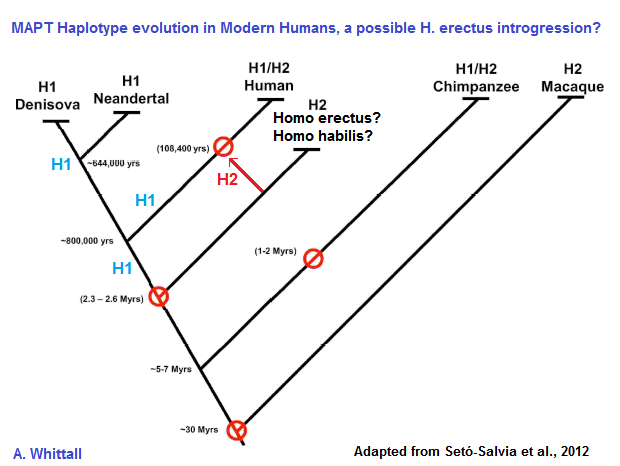
But I have not lost hope: Setó-Salvia et al., found "68 intronic variants within the MAPT gene, 23 exclusive to Denisova hominin, 6 limited to Neandertals, and 24 exclusive to present-day humans." [4]. This is a lot of variation and that requires time to develop, H1 must have diverged from the ancestral H2 longer ago than the 16.4 - 108.4 kya suggested by Donnelly. [1] And this may mean that H2 is indeed an ancestral form, found in an even older ancestor that made it out of Africa into SW Asia and Europe: Homo erectus.


Both Donnelly and Setó-Salvia cite previous work (Stefansson et al., 2005) [5] which gave an even older date for the inversion of the ancestral H2 form to the H1 found currently in modern humans (and also in the othere extinct branch of Neanderthals and Denisovans).


Steffansson set the inversion H1 into H2 at ~2.3 million years ago. And this was long before there were any modern humans, Neanderthals or Denisovans around.


However Donnelly et al., dismissed the date because the H2 lineage found nowadays in humans is very homogeneous while H1 is very diverse, so they suggest that H2 is younger since and had less time to evolve and diversify. But this may not be the case since H2 offers some reproductive advantages (enhanced fertility) as well as none of the negative neurological aspects provoked by the H1 haplogroup. The fact that it is uniform may indicate positive natural selection at work, or a strong genetic drift among modern humans after they admixed with an H2 carrying ancestor.


The image below shows this new scenario of admixture with an even older ancestor:


phylogenetic tree for MAPT H1 and H2
Proposed evolutionary tree for H1 and H2 haplogroups of MAPT gene
Adapted from [4] by Austin Whittall

Based on the date 2.3 Mya, there are not many options to choose our ancestor from: either H. habilis or H. erectus. Both left Africa, the former went on to the Caucasus and were probably ancestral to H. erectus in Asia and later Denisovans. The latter spread out across South East Asia and reached China where it has survived until quite recent times.


The lack of H2 among humans in the H. erectus territories in Indonesia, China and S.E. Asia may mean that our vector is H. habilis, from Dmanisi in Georgia. Or it may mean that the humans that introgressed with them did not later move on into Southeastern and Eastern Asia. But did march on into America or did the H. sapiens that reached America pick up the H2 haplotype there, from a first peopling wave of H. habilis?


This could be settled with a gene sequence from H. erectus or H. habilis. Perhaps one day it will be done.


Source


[1] Michael P. Donnelly, et al., (2010). The Distribution and Most Recent Common Ancestor of the 17q21 Inversion in Humans. The American Journal of Human Genetics 86, 161–171, February 12, 2010. doi: 10.1016/j.ajhg.2010.01.007
[2] Hardy, J., et al., (2005). Evidence suggesting that Homo neanderthalensis contributed the H2 MAPT haplotype to Homo sapiens. Biochem. Soc. Trans. 33, 582–585.
[3] MAPT microtubule-associated protein tau [ Homo sapiens (human) ] Gene ID: 4137, updated on 8-Jun-2014
[4] Setó-Salvia, Núria et al., (2012). Using the Neandertal and Denisova Genetic Data to Understand the Common MAPT 17q21 Inversion in Modern Humans. Human Biology: Vol. 84: Iss. 6, Article 1
[5] Stefansson, H., et al., (2005). A common inversion under selection in Europeans. Nat. Genet. 37, 129–137


Patagonian Monsters - Cryptozoology, Myths & legends in Patagonia Copyright 2009-2014 by Austin Whittall © 

Friday, June 13, 2014

mtDNA C1 haplogroup in Europe a Post Script (The X2a hg)


A note to add to my previous post on the mtDNA C1 haplogroup in Europe, and new data regarding X2 haplogroup.


Before her 2014 paper (cited in my post on C1 hg), Der Sarkissian had studied the mtDNA sequenced from Northwestern Russian remains in her 2011 doctorate thesis [1]. Her comments were prescient because in 2014 they were classified as a new hg: C1f; she wrote: "the Uznyi Oleni Ostrov C1 haplotype may in fact represent a distinct European-specific lineage" not linked to the C1 found among Western Siberians.


This Russian C1 was described as "a genetic outlier at the periphery of its proposed origin" (in South Western Central Asia) and its "absence... in other ancient and modern-day European populations suggests that the spread of haplogroup C did not reach further west into central Europe". [1]


She underlines its antiquity when she gives the reason that this haplotype survived for so long: the isolation of this group and maybe, the "closed mating system in isolation with other Mesolithic populations of Scandinavia" [1]


But orthodoxy imposes its imprint on the thesis, and the Amerindian C1b, C1c and C1d lineages are shown as "newer" (the image below shows this clearly) than the "older" Eurasian C1e and C1f lineages from Iceland and the Uznyi Oleni Ostrov site:


The mtDNA C1 haplogroup tree
Phylogenetic tree for C1 mtDNA haplogroup. From [1]

But the really interesting part is that Der Sarkissian points out that another mtDNA haplogroup X2 is very similar to the mtDNA C1 hg in that:


  • It is found at relatively low frequencies in contemporary populations
  • It has a very wide geographic range (from North America to Europe and also Siberia, the Middle East, North Africa and Central Asia)

These similarities suggest a similar evolutionary history for both X2 and C1.


Furthermore X2a (the Amerian clade) split early from the other ones; the split took place in the Middle East and from there the X2a carriers swiftly moved on into Siberia and accessed America in a second migratory wave, not long after the first wave. [2]


The X2 haplogroup


I recall reading about X2 when I was researching for my book (Monsters of Patagonia) back in 2009, and at that time thought that it was most likely due to admixture from contact with Europeans post-1492 discovery of America. This was founded on the idea that it was an Old World haplogroup and that it was only found among certain North American tribes that had been in direct contact with the French and English colonies in Canada and what would later become the US.


Furthermore I was reluctant to engage in further investigations because I found the Solutrean hypothesis as a source for the X2 mtDNA population was rather weak, and some theories regarding ancient Greek admixture into the Cherokees and other North American natives as too flimsy (I omit the Mormon theories and quack Atlanteans as totally non-scientific). There were no serious papers on these subjects and mostly posts in questionable - racist - supremacist forums made me drop further research, until now.


Encouraged by Der Srakissian's thesis I decided to look into the X2 hg once again, and came up with the following details, summarized below: [2][3][4]


X1 haplogroup mtDNA map
mtDNA X haplogroup, range and entry to America. Copyright © 2014 by Austin Whittall

  • Haplogroup X has a wide geographic range covering Europe, North Africa, Asia and North America
  • It descends from the ancient N haplogroup, dating back to at least 30 kya. It evolved from N in the Near East and surrounding areas of Western Eurasia
  • It is currently found at very low frequencies in Europe (less than 5% of all MtDNA)
  • Three populations carry it at high frequencies: Orkney Islanders (7%), Georgians 8%, Druze (11%) -The Druze have the greatest diversity of X lineages of any population X1a, X1c, X2b, X2e, X2f, X2h and X3 and their territory is very likely a refugia of the original X population [4].
  • It is found among Neolithic Europeans at surprisingly high rates: Elau, Germany (4,6 kya), at 22.2%, [5] and 12.5% at Calden, Germany (3000 cal BC), [6]. In these sites all carriers were X2 hg.

  • It is split into two clades, X1 and X2: [2]
    • X1 is found in North and East Africa, with entry routes along the coasts of the Red and Mediterranean seas
    • X2 spans Eurasia and is also found in North American natives (X2a haplotype)
  • X1 is higherst in Africa (36.8% of the X carriers there are X1)
  • X2 prevails in the Middle East, Europe and South Caucasus (97.2% of X hg carriers are X2) and in Central Asia and Siberia (100%)
  • X2a (the Amerindian clade) does not have any close relative in the Old World, including Siberia (Altaian X2e2a is another haplotype which is more recent). Was it lost due to genetic drift?
  • X2a split very early from all other X2 haplotypes in the Middle East, right after X began to expand at the time of the Last Glacial Maximum (LGM)
  • Coalescence time for X2a is 18,000 +⁄- 6,800 ya.
  • X2a occurs only at a 3% frequency among North American Natives, so it is quite uncommon
  • Its range in US and Canada is centered in the Great Lakes and the Western Plains, and has some outliers in Washington State and Arizona. Perego explains this range as caused by a central dispersion corridor from Beringia to the Great Lakes after the ice sheets receded [7]
  • X2a prevails among the Algonquian natives such as the Ojibwe and Chipewa (25% frequency), and is strong among other natives to the West of them: Sioux (15%), Nuu-Chah-Nulth (13%), Navajo (7%), and Yakima(5%). The presence in the Navajo (Southern Na-Dene) is most probably due to recent admixture with other northern Native Americans
  • It has not yet been detected in Central or South America

  • The American haplotypes are: [*]
    ♦X2a1
       - X2a1a: Sioux and Tanoan speakers
         - X2a1a1
       - X2a1b: Ojibwe people
         - X2a1b1
          - X2a1b1a
       - X2a1c: Ojibwe people
    ♦X2a2: Nova Scotia and Newfoundland

Comments


[*] Perhaps there is even more diversity among Amerindians: Perego [7] classified an outlier X2g, that lacked the markers of X2a1 and was different from the other Old World X2 branches, suggesting another extremely rare founder line in America.


An interesting point regarding X's antiquity is "that the basic phylogenetic structures of the [X and U] mtDNA haplogroups in West Eurasia and North Africa are as ancient as the beginning of the spread of anatomically modern humans in this region." [2], which in this paper is dated as 23 - 36 kya, close to the LGM. X is believed to have undergone "a long incubation period coinciding with and following the most recent out of Africa expansion" [4] placing it even further back in time.


Time for my wild hypothesis...


It is old, Neanderthal old. It appeared in the heart of their Eurasian realm. Its current low frequency is due to sucessive overlays of modern human mtDNAs. It was more frequent in the past as shown by the German Neolithic remains. Some refugial areas on the fringes of Europe (Orkney Islands, the Caucasus and the Druze highlands) retained a higher frequency.


The eastern Neanderthals moved on, across Asia following the animals they hunted perhaps long before the H. sapiens OOA move. These Neanderthal peopled the New World. None remained in Siberia that is why it is not found there now. They entered America along the only available corridor open to them reaching the Great Lakes area.


I checked when this corridor was open earlier than 20 kya to provide an entry date into America and came up with the Sangamonian period 125 to 75 kya [8], so it is not so far fetched.


The Neanderthals settled there (perhaps their migration followed specific prey whose range ended there). They never moved on, further South. These were cold-climate people. Later waves of migrants occupied the rest of the New World, sealing these X2a carriers off in their current range.


But... X2 is a Homo sapiens mtDNA haplogroup, not a Neanderthal one. So the theory outlined above is wrong.


Yes, if we accept current timelines for mtDNA evolution. But if we consider that the times are underestimated, that the coalescense time for X2 is not 40 kya but 150 kya and that the African Eve is not so recent, and maybe even found in Eurasia... that perhaps the coalescense leadst to a non sapiens hominin, then it could be possible to accept the scenario outlined above.


I already mentioned something similar regarding the Y chromosome evolution, and am still trying to figure out how to write a post on this subject. The main objection I find is that the real Neanderhtal mtDNA that has been sequenced until now is very different to ours and lies on a distinct phylogenetic branch. Definitively more analysis is needed before I can post on this subject!


Sources


[1] Der Sarkissian, Clio, (2011). Mitochondrial DNA in Ancient Human Populations of Europe Doctorate Thesis Univ. of Adelaide, South Australia.
[2] Maere Reidla et al., (2003). Origin and Diffusion of mtDNA Haplogroup X Am J Hum Genet. Nov 2003; 73(5): 1178–1190. Oct 20, 2003. doi: 10.1086/379380
[3] Europedia, Haplogorup X (mtDNA) www.europedia.com
[4] Shlush LI, Behar DM, Yudkovsky G, Templeton A, Hadid Y, et al., (2008). The Druze: A Population Genetic Refugium of the Near East. PLoS ONE 3(5): e2105. doi:10.1371/journal.pone.0002105
[5] Haak et al., (2008). Ancient DNA, Strontium isotopes, and osteological analyses shed light on social and kinship organization of the Later Stone Age. PNAS November 25, 2008 vol. 105 no. 47 18226-18231 10.1073/pnas.0807592105
[6] Lee, E.J., et al., (2012). Collective burials among agro-pastoral societies in later Neolithic Germany: perspectives from ancient DNA. Journal of Archaeological Science.
[7] Ugo A. Perego et al., (2009). Distinctive Paleo-Indian Migration Routes from Beringia Marked by Two Rare mtDNA Haplogroups. Current Biology Volume 19, Issue 1, 13 January 2009, Pages 1–8. doi: 10.1016/j.cub.2008.11.058
[8] Peter C. Lent, Muskoxen and Their Hunters: A History. pp 18


Patagonian Monsters - Cryptozoology, Myths & legends in Patagonia Copyright 2009-2014 by Austin Whittall © 
Hits since Sept. 2009:
Copyright © 2009-2025 by Austin Victor Whittall.
Todos los derechos reservados por Austin Whittall para esta edición en idioma español y / o inglés. No se permite la reproducción parcial o total, el almacenamiento, el alquiler, la transmisión o la transformación de este libro, en cualquier forma o por cualquier medio, sea electrónico o mecánico, mediante fotocopias, digitalización u otros métodos, sin el permiso previo y escrito del autor, excepto por un periodista, quien puede tomar cortos pasajes para ser usados en un comentario sobre esta obra para ser publicado en una revista o periódico. Su infracción está penada por las leyes 11.723 y 25.446.

All rights reserved. No part of this publication may be reproduced, stored in a retrieval system, or transmitted in any form or by any means - electronic, mechanical, photocopy, recording, or any other - except for brief quotations in printed reviews, without prior written permission from the author, except for the inclusion of brief quotations in a review.

Please read our Terms and Conditions and Privacy Policy before accessing this blog.

Terms & Conditions | Privacy Policy

Patagonian Monsters - https://patagoniamonsters.blogspot.com/